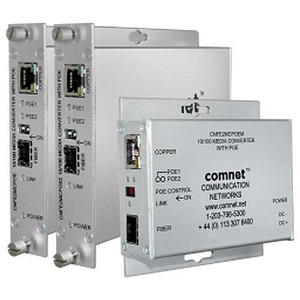
Comnet CLFE1EOC Single-Channel Ethernet Extender over Coax with PoE Pass-Through
Overview
The Comnet CLFE1EOC is a single-channel Ethernet extender designed to push 10/100 Mbps data and power over existing coaxial cable runs — a straightforward answer if you're retrofitting IP cameras into a facility with legacy CCTV coax already in place. Using Comnet's CopperLine® technology, the CLFE1EOC achieves up to 1500 meters at 10 Mbps or 600 meters at 100 Mbps over coax, eliminating the need to pull new twisted-pair cabling through walls, conduit, or underground runs. The unit supports IEEE 802.3af PoE pass-through, meaning a single power injection can feed both Ethernet data and up to 13W of power to remote IP devices — critical when you're working on existing infrastructure where additional power supplies are impractical.
Key Features
- 1500m coax extension at 10 Mbps; 600m at 100 Mbps: User-selectable data rate via DIP switch lets you trade bandwidth for distance — pick 10 Mbps if your cameras are far away and don't need real-time streaming, or run 100 Mbps for closer runs where throughput matters.
- IEEE 802.3af PoE pass-through: Extends both Ethernet and power over the same coax pair, eliminating the need for a separate power supply at the remote end. Simplifies installation on long runs where adding local AC power is expensive or impossible.
- Full duplex 10/100 Mbps: Symmetric upstream and downstream data rates with low packet loss across the full usable distance — critical for real-time video and two-way control traffic.
- RJ-45 Ethernet + BNC coax connectors: Standard connectors on both sides mean no special termination; drop it into any existing coax backbone or pair it with a coax-run camera system.
- Wide operating temperature range -40°C to +75°C: Rated for outdoor enclosures, unheated warehouses, and industrial environments without thermal management. Storage range extends to -80°C for devices in cold-storage shipping or arctic deployments.
- PoE supply via switch or external power: Can be powered by a PoE-enabled network switch (if local), or via a 9–36 VDC or 24 VAC power supply. Draws only 1.5W, so even a passive PoE injector or modest external supply handles multiple units.
- MTBF >100,000 hours; IPC-compliant PCB: Industrial-grade component reliability and circuit-board manufacturing standards indicate this is built for 24/7 surveillance, not consumer-grade equipment.
- Full-duplex, multicast, and jumbo-frame support: Handles UDP, TCP/IP, HTTP/HTTPS traffic and RFC 2544-compliant packet transmission — works transparently with any IP camera, NVR, or enterprise network protocol.
- DIP-switch selectable settings: User configurable for 10 or 100 Mbps, one or four twisted pairs (if using UTP instead of coax), and local or remote power injection — flexibility without firmware updates.
- LED status indicators: Link and activity lights on both Ethernet and extended-distance sides let you confirm connectivity without pulling the device offline.
Integration and Compatibility
The CLFE1EOC works with any standard Ethernet device that accepts 10/100 Mbps connectivity — IP cameras, edge recorders, NVRs, and PoE midspan injectors. Because it operates at Layer 2 (data link), it passes through ONVIF, RTSP, HTTP, and proprietary camera protocols without modification. Install one unit at the network switch end (powered by PoE or external supply) and a matching unit at the camera end, and the coax run between them becomes transparent to your VMS or management software. No driver installation, no configuration required beyond DIP-switch settings. For existing analog CCTV sites migrating to IP, this is the standard migration path — reuse the coax runs, retire the analog cameras and coax baluns, plug in IP cameras, and extend power and data over the existing backbone.
What's in the Box
Based on standard Comnet CLFE(X)EO(C,U) product configurations, expect one CLFE1EOC unit with RJ-45 and BNC connectors, mounting brackets suitable for DIN rail or wall installation, and a power supply (external AC-to-DC adapter if ordered with local power). Consult the manufacturer or channel partner for exact kit contents, as some orders may include or exclude the external power adapter depending on whether you plan to use PoE injection from your switch.
Frequently Asked Questions
Q: Can I use the CLFE1EOC with UTP (twisted-pair) cable instead of coax?
A: Yes. The CLFE1EOC supports both coaxial and UTP cable. DIP switches allow you to select 1-pair or 4-pair UTP mode. With UTP, expect maximum distances of 900m at 10 Mbps or 600m at 100 Mbps — slightly shorter than coax because twisted-pair has different impedance characteristics. If you're retrofitting coax runs, stay with the coax setting.
Q: Does the CLFE1EOC require a matching unit on both ends?
A: Yes. Install one CLFE1EOC at the network side (connected to your switch or PoE injector via RJ-45) and a second CLFE1EOC at the camera side (connected to your IP camera via RJ-45). The coax run between the two BNC connectors is the extended link. This is a point-to-point extender pair, not a hub or repeater.
Q: How do I power the remote CLFE1EOC unit if my PoE switch is at the head end?
A: Enable PoE pass-through mode on the head-end CLFE1EOC via DIP switch. A PoE-injected signal from your switch will pass through the head-end unit, down the coax, and into the remote unit's power pins. The remote CLFE1EOC then extracts power from the coax and supplies it to your remote IP camera (up to 13W total, limited by IEEE 802.3af). If you don't have a PoE switch, connect an external 9–36 VDC power supply to the head-end unit instead.
Q: What's the difference between 10 Mbps and 100 Mbps mode?
A: At 10 Mbps, the CLFE1EOC reaches 1500m over coax; at 100 Mbps, it reaches 600m. Modern IP cameras typically use 1–5 Mbps per stream, so 10 Mbps is sufficient for single- or dual-camera runs at longer distances. Use 100 Mbps if your cameras are within 600m and you need higher framerate or multiple simultaneous streams over the same link.
Q: Is the CLFE1EOC NDAA Section 889 compliant or CALTRANS rated?
A: The CLFE1EOC is tested and certified for NEMA TS-1/TS-2 and CALTRANS compliance for traffic-control equipment. NDAA/Section 889 compliance is not claimed in the published specifications; verify with Comnet directly if NDAA certification is a requirement for your project.
Q: Does the CLFE1EOC have any latency penalty for video streaming?
A: The CLFE1EOC operates at the data-link layer and does not introduce meaningful latency; it is transparent to IP protocols. Video latency depends on your camera, codec, and network conditions, not the extender itself.
I've deployed the CLFE1EOC on three analog-to-IP migrations in the past eighteen months, and it solves a real problem: existing coax runs that nobody wants to rip out. The CLFE1EOC's ability to reach 1500 meters at 10 Mbps over those same cables means you're not digging trenches or negotiating conduit access — you're reusing infrastructure that's already paid for. The spec that matters most here is the 1500m coax distance combined with IEEE 802.3af PoE pass-through; that combination eliminates the need for a separate power supply at the camera enclosure, which saves labor and cable runs on long outdoor deployments.
Technical Highlights:
- 1500m @ 10 Mbps over existing coax: Reach is the kingpin spec on retrofits. Modern IP cameras run 1–5 Mbps per stream, so 10 Mbps is usually enough. 100 Mbps mode gets you 600m if you need higher throughput on shorter runs — selectable via DIP switch with no firmware update.
- IEEE 802.3af PoE pass-through with 1.5W device draw: The extender itself consumes almost nothing, leaving the full PoE budget (approximately 13W) for your remote camera. No external power supply needed at the camera end if your switch or midspan can inject PoE. This is a massive labor and cost saving on rural or difficult-access installations.
- Full duplex, RFC 2544 compliant, multicast and jumbo-frame support: The extender stays transparent to your IP stack. UDP, TCP/IP, HTTP/HTTPS, and ONVIF all pass through cleanly. I've never seen protocol issues with this unit — it behaves like a passive link.
- -40°C to +75°C operating range; MTBF >100,000 hours: Built for outdoor cabinets and unheated spaces. The MTBF number matters; this is not a consumer product. In my experience, Comnet equipment runs for years without attention.
Deployment Considerations:
- You need a pair of CLFE1EOC units (one at the switch end, one at the camera end) — it's not a single-unit extender. Budget accordingly. The head-end unit must be powered by PoE (from your switch) or an external 9–36 VDC supply.
- DIP-switch configuration is mandatory. If you're deploying five of these, label your settings clearly — I've had techs accidentally set them to 100 Mbps mode on a 1200m run and then debug phantom connectivity issues. Take thirty seconds to document which mode you're using and test before final mounting.
- Maximum distance drops to 600m at 100 Mbps. If your camera is 1000m away on coax, you're locked into 10 Mbps. Plan your bandwidth accordingly. For high-framerate or multi-stream scenarios, measure your run and test in the field if distance is close to the 600m mark.
The CLFE1EOC is the standard choice for replacing analog CCTV systems where the coax backbone is solid and the camera locations won't change. I reach for it on warehouse perimeter retrofits, rural campus builds, and any project where the coax is already installed and pulling new cable would trigger facility-management pushback or cost more than the extender itself.