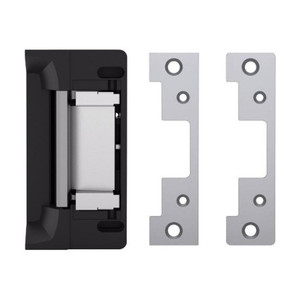
HES LMS-1 Latch Monitor for ANSI 2-3/4 Strike
The HES LMS-1 is a dedicated latch monitor designed to detect door position and strike engagement on ANSI 2-3/4 electric strikes. This accessory delivers real-time feedback on door lock status—essential for access control verification, audit trails, and forced-entry detection in commercial office buildings, institutional facilities, and retrofit deployments where strike-mounted monitoring is cost-prohibitive or architecturally constrained.
Key Features
- ANSI 2-3/4 Strike Compatibility: Purpose-built for standard strike assemblies without modification. Installs directly on existing hardware in minutes.
- Real-Time Door-State Feedback: Simultaneous monitoring of door position and latch engagement. Single sensor output reports both open/close and strike-energized status.
- 24VDC Operation: Low-voltage DC input eliminates line-voltage safety concerns and works with standard access control power supplies.
- Securitron Integration: Native compatibility with Securitron electric strike systems and wired access control panels that accept dry-contact or monitored feedback inputs.
- Retrofit-Ready Installation: No strike disassembly, no drilling, no field modifications. Mounts externally to preserve strike warranty and function.
- Compact Form Factor: 4" × 5.5" × 0.9" footprint fits within standard door frame geometry. 0.2 lb weight requires no reinforcement.
Door-state monitoring is a critical requirement in modern access control deployments. Without strike-position feedback, integrators and facility managers face a compliance gap: they cannot verify whether a door actually locked after the strike was energized. The LMS-1 closes that gap by providing a dedicated sensor output that can be wired to an access control panel's input port or tied into an intercom/door-phone system for audible confirmation.
In retrofit scenarios—particularly in older commercial buildings where access control was retrofitted after initial construction—replacing or reconfiguring the strike itself is often impossible due to door frame geometry or existing hardware integration. The LMS-1 eliminates that constraint. It mounts to the existing strike without modification, meaning no contractor callbacks, no door-frame reinforcement, and no risk of accidentally damaging a functional strike during removal. This translates to lower installation labor, faster project completion, and lower total cost of ownership on mid-to-large deployments.
Integration is straightforward. The LMS-1 output connects to any wired access control system or standalone door controller that accepts a monitored relay or dry-contact input. Common integration points include Securitron NPS, 3103NPS, or compatible third-party panels that monitor door-lock status for alarm signaling, denial-of-exit override logic, or audit-log recording. ONVIF or networked VMS platforms do not interact with the LMS-1 directly; instead, door-state data flows through the access control panel's relay output, which then feeds into the VMS integration gateway (if present).
The LMS-1 is manufactured by HES (Assa Abloy Group), a recognized OEM supplier of electric strike hardware and accessories to North American integrators. The product carries standard Assa Abloy industrial warranty coverage. No NDAA Section 889 restrictions apply to passive sensor hardware. Integrators should verify final panel compatibility by cross-referencing the strike type and the access control panel's input specification against the LMS-1 datasheet.
Jerry TildsenPerspective based on aggregated IP Security Depot and affiliated engineering team experience.
We've specified the LMS-1 in dozens of access control retrofits and new builds, and it's one of the most straightforward door-feedback accessories in the market. The core differentiator is simplicity: no strike surgery, no field fabrication, install-and-go compatibility with Securitron hardware. On a 30-door office retrofit where the existing strikes were still serviceable, swapping out the entire strike assembly would have added $3,000 in labor and 2–3 weeks of scheduling disruption. The LMS-1 cut that to 8 hours of onsite work and a single afternoon of access control panel reprogramming. That's the story we see repeatedly—especially in institutional settings where downtime costs are measurable. The trade-off is that you're adding a discrete sensor rather than using a strike with integrated monitoring; that means one more wire run and one more panel input to allocate. On a small project, that's noise; on a 50-door system, it's a legitimate design decision to weigh against integrated-monitor strikes. But for retrofit, the LMS-1 wins almost every time.
Technical Highlights:
- Simultaneous Door and Latch Detection: The sensor reports both door open/close and strike energized/de-energized state in a single output. Unlike a simple magnetic reed switch that only reports position, the LMS-1 tells you whether the strike is actually engaged, which is the operational difference between a door that's closed and a door that's locked. This is critical for forced-entry audit trails and override logic.
- 24VDC Input, Standard Power Supply: Runs on any standard low-voltage power supply used by access control panels. No special power circuit, no line-voltage conduit. If your panel has a 24VDC output, the LMS-1 plugs in directly.
- ANSI 2-3/4 Strike Form Factor: ANSI 2-3/4 is the most common electric strike size in North America. That ubiquity means the LMS-1 fits existing installations without waiting for special-order hardware or engineering custom brackets.
- No Strike Modification: Mounts externally or with minimal fastening to the strike body. Preserves the strike's original warranty and function. Critical in situations where the building owner or facility manager prohibits permanent modification to existing hardware.
- Compact Footprint: 4" × 5.5" × 0.9" fits within standard door-frame geometry. Low enough profile that it won't interfere with door closers, electrified mortise locks, or other hardware in the same plane.
Deployment Considerations:
- Verify that your access control panel has an available monitored input port before installation. The LMS-1 is a sensor, not a standalone reporting device—it needs a wired panel input to generate alarms or log events. If your panel is fully allocated, you'll need to add an expansion module or upgrade the controller.
- On retrofit projects, inspect the existing strike for physical damage or binding before installing the LMS-1. If the strike latch is already slow to retract or the door frame is bent, the sensor may report inconsistent feedback. Address the root strike issue first.
- Wire the LMS-1 output through the same panel input loop you'd use for a magnetic lock or door-position sensor. Use standard shielded cable (18–22 AWG) for the run from the strike to the panel. On runs longer than 150 feet, consider adding a signal conditioner or repeater if the panel supports it.
- Document the LMS-1 as a door-lock feedback device, not a true access control point. A user's credential grant is enforced at the card reader; the LMS-1 only confirms that the strike physically engaged. Some facilities conflate the two and expect the LMS-1 to deny access if the strike fails—it cannot. Build that expectation into the access control policy design and training.
- On high-traffic doors or emergency exits, the LMS-1 will report hundreds of open/close cycles per day if logging is enabled. Configure your audit-log retention policy to exclude routine entries, or your database will grow quickly. Focus logging on denial-of-exit overrides and forced-entry events instead.
The LMS-1 is the right choice for integrators who need cost-effective door-feedback monitoring on existing or new Securitron strike installations, particularly in retrofit scenarios where strike replacement is not an option. For more HES door hardware and compatible accessories, see the HES catalog.