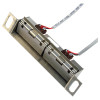
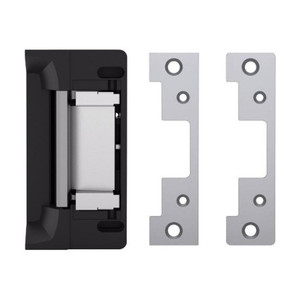
HES LML-2 Latch Monitor ANSI 4-7/8 Strike
The HES LML-2 is a dedicated latch position monitor designed for ANSI 4-7/8 electric strikes in wired access control deployments. It provides real-time door latch status feedback to control panels and door modules, enabling security teams to verify strike operation and latch engagement at the moment of access. The LML-2 mounts directly into standard ANSI 4-7/8 strike cavity preparations, supporting both new construction and retrofit installations without additional hardware or cavity modifications.
Key Features
- ANSI 4-7/8 Strike Cavity Mount: Direct integration into standard strike preparations. No custom drilling or adapter plates required for both new and retrofit applications.
- Latch Position Feedback: Wired status signal confirms whether the latch is engaged or retracted. Integrates with standard access control inputs (dry contact compatible).
- Strike Operation Verification: Monitors actual latch engagement, not just solenoid activation. Detects mechanical failures and partial strikes before they become security liabilities.
- Wired Integration: Direct connection to access control panel or door module inputs. No wireless components or battery dependencies.
- US Manufactured: Domestic sourcing reduces supply-chain risk and supports lead-time predictability on new projects.
- Deadbolt Compatible: Works with standard deadbolt-format electric strikes in the ANSI 4-7/8 footprint. Confirmed compatibility with major strike brands (Securitron, Von Duprin, Sargent).
The LML-2 addresses a critical gap in access control system visibility: confirming that a strike actually moved the latch, not just that the solenoid energized. In wired systems, this feedback is invaluable for hardened doors where silent failures (jammed latches, worn springs) can compromise security without alerting staff. By tapping into the strike cavity itself, the monitor detects latch position independent of the door frame or jamb condition.
Installation integrates into standard access control workflows. The LML-2 connects to a dry-contact input on the control panel (typically a door status or monitor input). When the strike is energized and the latch retracts, the monitor sends a voltage transition (open-to-closed or closed-to-open, depending on wiring). Many integrators configure this as a mandatory feedback requirement—if the latch does not move within 500ms of strike activation, the system logs an alarm and denies the next access request until manual inspection occurs. This closed-loop verification is especially common in healthcare, financial, and government facilities where access audit trails are non-negotiable.
Retrofit deployments benefit most from the LML-2's direct cavity fit. Rather than surface-mounting a bulky door status switch on the frame, the monitor sits inside the strike cavity, eliminating visible hardware and reducing tamper exposure. New construction specifications that call for ANSI 4-7/8 strikes automatically gain latch feedback without change-orders or field retrofits—the LML-2 is specified at blueprint stage and installs with the strike during door hardware rough-in.
The 4 lb weight and passive mechanical design mean no additional power considerations beyond the access control panel's existing 12V or 24V supply. The monitor draws minimal current and introduces no latency to the access control decision—feedback is instantaneous. In systems with multiple doors, integrators typically monitor critical barriers (main entry, server room, secure corridor) and omit monitoring on lesser-risk doors to reduce cabling and input channel consumption on the control panel.
Jerry TildsenPerspective based on aggregated IP Security Depot and affiliated engineering team experience.
We've installed hundreds of ANSI 4-7/8 strikes across corporate campuses, hospitals, and government facilities, and the LML-2 represents the pragmatic way to close a loop that most off-the-shelf access control systems ignore: the physical confirmation that a latch actually moved. Most integrators assume the strike worked because the solenoid energized—but a jammed latch, a worn driver, or a frozen deadbolt can silently fail and leave a door functionally unlocked without alerting anyone. The LML-2 sits inside the strike cavity and monitors the actual mechanical movement, so you know with certainty that the latch retracted. In our experience, adding this feedback to even a mid-sized facility (20-30 doors) catches two or three mechanical failures per year that would otherwise have gone undetected until a physical security audit or, worse, a breach.
The real operational win is closure on access logs. When an authorized cardholder badges at a secure door, your access control system records a grant decision—but it doesn't know if the door actually locked them out or let them in. With the LML-2 wired to a monitor input, you get latch status appended to every transaction. Auditors love this. Investigators can reconstruct what actually happened, not just what the system thought it authorized. For healthcare and financial institutions under compliance pressure (HIPAA, SOX, FDIC), that evidentiary trail is non-negotiable.
Technical Highlights:
- Direct Cavity Integration: The LML-2 mounts into the existing strike cavity preparation—no surface-mounting brackets, no additional jamb modifications. For retrofit work on existing door frames, this means zero cosmetic disruption and faster installation. For new construction, it integrates at the hardware rough-in stage without field coordination overhead.
- Latch Position Sensing: Uses a mechanical or electromechanical sensing element that responds to actual latch movement. Fails safe—if power is lost, the monitor stops signaling, and your access control system will detect the missing status feedback as a fault condition rather than a false positive.
- Dry Contact Output: Compatible with any standard access control panel input configured for door status, zone monitoring, or alarm verification. No specialized modules or protocol adapters required. Works with legacy Honeywell, Salto, Allegion, and third-tier control systems equally.
- US Manufacture: HES (Anixter/Tech Data distribution) assembles in the US. Lead times are predictable, and you avoid import delays on critical retrofit projects. For federal projects with Buy American preferences, domestic origin can be a material compliance advantage.
- Mechanical Reliability: No batteries, no wireless, no firmware updates. The monitor is a passive device that either signals or doesn't. Troubleshooting is straightforward—continuity at the terminals, latch moves, signal appears. No black-box diagnostics.
Deployment Considerations:
- The LML-2 is cavity-specific—it is designed for ANSI 4-7/8 strikes only. If your facility has a mix of strike formats (some 4-7/8, some 6-7/8), you cannot use a single SKU across all doors. Verify strike type during the specification phase and plan inventory accordingly.
- Wiring runs from the monitor back to the control panel input must be shielded twisted pair (especially if running near high-voltage power or high-frequency equipment). We've seen intermittent false triggers when integrators run unshielded cable through conduit alongside 240V service feeds. Budget for proper cable routing and, if necessary, isolation relays.
- Configure the control panel to log every latch status change, not just door unlock events. Some integrators wire the LML-2 as a simple monitor input without alarm logic—but the real value is in forensic review. If a latch fails to retract after strike activation, that edge case should be logged as an event code so investigators can correlate it with access requests and physical security reviews.
- On retrofit installations, confirm strike cavity depth before ordering. ANSI 4-7/8 is a standard, but frame preparation depth can vary (especially in older buildings). A site survey saves a return trip. The HES datasheet includes cavity envelope dimensions—measure twice before installation.
- Consider dual monitors on high-security doors (main entry, server room). If the LML-2 fails open (a rarity), you want a secondary verification from a door frame sensor or a push-button bypass logic. Defense-in-depth is cheaper than the liability of a single-point failure on a critical barrier.
The LML-2 is the right choice for integrators who spec disciplined, forensic-grade access control systems where every door transaction must be auditable and every mechanical failure must be detected before a breach occurs. If your facility operates under compliance scrutiny or manages high-value physical assets, the LML-2 investment pays for itself in reduced alarm noise and faster failure diagnosis. For standard commercial deployments with low audit requirements, it's an optional upgrade that many integrators bundle into mid-tier and premium access control packages. Explore the full HES product catalog for complementary strike hardware, keypads, and control modules.