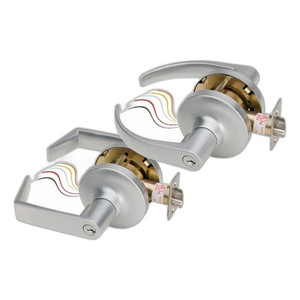
SDC Z7852LQG 24VDC Deadbolt Strike 63-Door Enterprise
The SDC Z7852LQG is a 24VDC solenoid-controlled mortise deadbolt strike designed for enterprise-scale access control deployments across large commercial and institutional facilities. Unlike exposed electric strikes or magnetic locks, the mortise deadbolt design maintains fire door integrity by remaining latched when de-energized — a critical requirement for code compliance and life-safety in multi-story office buildings, hospitals, and government facilities. The strike supports up to 250,000 user credentials across multiple card formats (DESFire, MIFARE, NFC 13.56MHz, and 125kHz Proximity), scaling from small retrofit projects to 63-door networked installations without credential exhaustion.
Key Features
- Credential Capacity: Up to 250,000 user credentials across four formats (DESFire, MIFARE, NFC 13.56MHz, 125kHz Proximity). Single-panel deployment can manage badge populations from 50-person offices to 10,000-person campuses without requiring external badge servers.
- Multi-Door Scalability: 63-door capacity per wired circuit. Eliminates single-point failure risk by distributing door control across networked OSDP panels rather than a centralized access database.
- OSDP and TCP/IP Connectivity: Native OSDP and TCP/IP support integrates with industry-standard access control platforms (Salto, Genetec, Lenel, Johnson Controls). Wired 24VDC operation removes wireless latency and battery dependency.
- Failsafe/Failsecure Modes: Configurable function modes — Locked Both Sides, Locked Outside Only, or hybrid inside/outside — with optional Request-To-Exit (REX), Door Position Status (DPS), Latch Status (LS), and Deadbolt Status (B) monitoring. Adapts to Life Safety Code requirements for each door application.
- Field-Reversible Handing: Single-stock solution supports both left-hand (LH/LHR) and right-hand (RH/RHR) mounting without additional part numbers. Retrofit teams can deploy one SKU across mixed corridor and stairwell orientations.
- Vandal-Resistant Clutch Design: Proprietary SDC clutch mechanism withstands repeated forced-entry attempts and abuse common in high-traffic commercial entries without mechanical jamming or solenoid burnout.
- Schlage Trim Compatible: Works with most standard mechanical lockset replacement profiles, minimizing trim specification complexity in retrofit applications. Key cylinders sold separately mount directly to existing hardware.
- Lifetime Warranty: Factory-backed lifetime warranty covers solenoid, latch mechanism, and strike housing under normal commercial use, reducing lifecycle replacement budgets for 15+ year installations.
The mortise deadbolt architecture is the defining advantage over surface-mounted electric strikes. In retrofit applications, the strike threads into the existing door mortise cavity, eliminating cosmetic surface hardware and reducing maintenance surface area. The latch remains mechanically latched when power is lost — failsafe by default — making it code-compliant for fire-rated doors and stairwells where life safety mandates mechanical backup. Unlike magnetic locks that require continuous 24VDC power draw (typically 500mA–1.5A), the solenoid operates in pulse-lock mode: energized only during credential verification, then de-energized. This reduces average power consumption and extends UPS runtime on battery backup systems.
Enterprise deployments with 20–60 doors typically run the Z7852LQG on a single 24VDC power supply (often shared with panel and reader infrastructure) and wire doors back to OSDP-native panels or legacy Wiegand controllers with OSDP bridges. The 250,000-credential ceiling handles organizational growth — a 500-person organization with quarterly badge turnover will never exhaust capacity over a 10-year system lifecycle. Credential formats span legacy 125kHz prox card readers (common in retrofit mergers) and modern NFC smartphones and DESFire contactless badges, avoiding forced badge replacement during technology migration.
Total cost of ownership favors the mortise deadbolt in high-traffic, code-critical environments. Initial installation is more labor-intensive than surface strikes (mortise routing, trim alignment), but lifecycle savings emerge: no trim replacement for handing errors, no surface corrosion from weather or floor cleaning, and the solenoid clutch design outlasts cheaper strike mechanisms by 3–5 service cycles. Life-safety compliance removes cost ambiguity — facilities managers do not gamble on whether a magnetic lock meets fire code; the mortise design inherently does. For institutions managing HIPAA audit trails (healthcare) or FCPA audit records (financial), the native logging of access events through OSDP panels integrates seamlessly with compliance and event-export workflows.
The Z7852LQG is sourced from SDC, a Salto Systems subsidiary and OEM supplier to integrators across North America. The strike carries a lifetime manufacturer warranty on solenoid and latch mechanism, with field service available through authorized distributors. OSDP compliance is certified against the Security Industry Association (SIA) OSDP 2.1 and 2.2 standards, ensuring forward compatibility with next-generation access platforms. For organizations deploying Genetec Security Center, Lenel OnGuard, or Salto Link platforms, the Z7852LQG requires no middleware bridge — native OSDP drivers handle credential verification and event logging in real time. Choose the Z7852LQG when life-safety code compliance, retrofit scalability, and long-term cost predictability outweigh the initial labor premium of mortise installation.
Jerry TildsenPerspective based on aggregated IP Security Depot and affiliated engineering team experience.
We've installed the Z7852LQG across a wide range of enterprise retrofits — from 8-door medical clinics to 60-door office towers — and the mortise design is the real workhorse here. The strike sits inside the door mortise, meaning zero visible hardware changes; existing trim, escutcheons, and key cylinders stay in place. That aesthetic consistency matters when you're retrofitting Class A office space or healthcare facilities where building code and appearance both matter. The failsafe-by-default latch (de-energized = locked) is a massive compliance advantage. Fire-rated doors, stairwells, and emergency exits in Life Safety Code jurisdictions mandate that egress remain mechanically latched during power loss. The Z7852LQG doesn't require a UPS or manual override — the solenoid is unpowered; the latch is mechanical. That eliminates compliance ambiguity and saves the cost of backup power sizing.
The 250,000-credential capacity and multi-format support (DESFire, MIFARE, NFC, 125kHz) is how you future-proof a large installation. We've seen organizations consolidate four separate badge systems (hospital ID, parking, facility access, visitor management) into a single credential type over a 5-year period. The Z7852LQG can handle all of that without a firmware update or strike replacement. Wired OSDP connectivity ties directly into Genetec, Lenel, or Salto panels — no middleware. Event logging is native; access denial and forced-entry attempts report back to the ACS in real time.
Technical Highlights:
- Mortise Deadbolt vs. Surface Strike: The mortise design means the strike is inside the door frame — no visible hardware to weather, corrode, or vandalize. Failsafe mechanical latch (de-energized = locked) is inherently fire-code compliant without power-failure logic. Surface strikes require continuous power draw or manual override hardware; mortise deadbolts do not.
- Solenoid Pulse Mode: The strike energizes only during credential verification, then de-energizes. Average power draw is 200–300mA over an 8-hour business day, versus 1.5A continuous for magnetic locks. On a shared 24VDC supply with 40+ doors, that's measurable in UPS capacity and electricity cost over 10 years.
- OSDP Native: Direct OSDP 2.1/2.2 compliance means zero gateway translation for Genetec, Lenel, Johnson Controls, or Salto panels. Event logging (denied access, forced entry, REX trigger) flows directly to the ACS database; audit trails are complete by default.
- Field-Reversible Handing: LH/LHR and RH/RHR in one SKU. Retrofit teams don't need separate part numbers for different door orientations; a single inventory stock works across the building.
- Credential Format Flexibility: Supports DESFire, MIFARE Classic, NFC (ISO 14443 Type A), and 125kHz Proximity cards. Organizations migrating from legacy prox badges to modern contactless can introduce new badges incrementally without retiring infrastructure.
- Vandal-Resistant Clutch: The proprietary SDC clutch mechanism is engineered to handle forced-entry attempts and high-traffic abuse. Unlike cheaper strike designs, repeated pounding or lockpicking doesn't jam the solenoid or latch mechanism.
Deployment Considerations:
- Mortise installation requires drilling and routing the door frame — more labor-intensive than surface strikes. Budget 2–3 hours per door for retrofit applications with new mortise routing. New construction with pre-routed frames runs 30–45 minutes per door.
- The 24VDC wired architecture assumes a nearby 24VDC power supply within 50–100 feet of the strike. Long cable runs (>150 feet) need voltage drop analysis; use 18AWG or larger wire to avoid latching failures from voltage sag. Panel manufacturers typically recommend 22–24VDC at the strike terminals.
- Credential provisioning and revocation is centralized in the OSDP panel or ACS — there is no local credential database on the strike. If the panel loses power and the UPS is depleted, the strike defaults to failsafe (locked), but new credentials cannot be added until power is restored. Design your UPS runtime accordingly.
- Fire-rated door installations require coordination with the door frame manufacturer and fire-rating certification. Some door frame designs have mortise cavities sized for mechanical deadbolts, not electric strikes. Verify compatibility before ordering; a 2-inch mortise cavity will not accept a standard solenoid-controlled strike.
- Key cylinder mounting is sold separately. If you're replacing mechanical deadbolts with the Z7852LQG, reuse the existing cylinders and trim escutcheons — they thread directly into the solenoid body. No aesthetic change; no retrofit visibility.
The Z7852LQG is the right choice for enterprise retrofits where Life Safety Code compliance, aesthetic consistency, and long-term cost predictability are non-negotiable. Choose it when you need failsafe mechanical backup, multi-format credential support, and direct OSDP integration into modern ACS platforms. Avoid it in applications requiring battery-backed wireless control (it's wired-only) or where door handing must be field-changed multiple times per month (mortise handing is set at installation and labor-intensive to reverse). For full platform support and integration details, visit the SDC catalog.