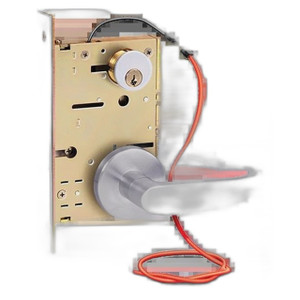
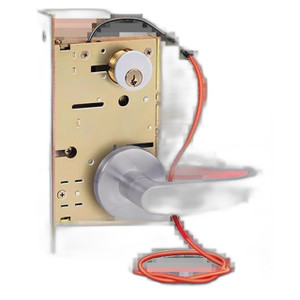
SDC Z7850LRQG Selectric Pro Electrified Deadbolt Strike
The SDC Z7850LRQG is an electrified deadbolt strike engineered for enterprise access control deployments that demand multi-credential flexibility and networked scale. Operating at 24VDC with native OSDP and TCP/IP support, this strike manages up to 63 doors and 250,000 user accounts in a single installation, accepting DESFire, MIFARE, NFC/13.56MHz, and 125kHz Prox credentials without requiring separate readers for each format. Built for retrofit and new-construction environments, the Z7850LRQG eliminates the capex and maintenance overhead of credential-format-specific hardware by consolidating four credential ecosystems into one electrified lockset.
Key Features
- Multi-Credential Support: Native acceptance of DESFire, MIFARE, NFC/13.56MHz, and 125kHz Prox on a single strike. Credential migration and format flexibility without hardware replacement or reader duplication.
- 63-Door Capacity: Rated for networked deployments across 63 doors with centralized user and credential management. Scalable enrollment of up to 250,000 user accounts across the entire installation.
- OSDP and TCP/IP: Dual protocol support ensures compatibility with modern access control platforms (Salto, Gallagher, Allegion, Hanwha, others) and IT network infrastructure. No proprietary gateways required.
- 24VDC Operation: Standard low-voltage power — integrates with conventional door power supplies and backup battery systems. Minimal draw simplifies UPS sizing on larger deployments.
- Deadbolt Strike Design: Electrified deadbolt mechanism — mechanically secure in de-energized state, failsafe or fail-secure operation selectable at installation. Retrofit-compatible with most standard door frame cutouts.
- Lifetime Warranty: Manufacturer warranty covering defects in materials and workmanship. Reduces replacement risk on large multi-door installations.
- Retrofit and New Construction: Drop-in replacement for mechanical locksets on existing doors; also specified in new builds. Eliminates scheduled hardware swap-outs when credential format standardization occurs.
The multi-credential architecture is the operational differentiator here. In real-world deployments, organizations inherit credential ecosystems from acquisitions, facility mergers, or phased security upgrades. The Z7850LRQG accepts all four major card/token formats simultaneously — you don't force credential consolidation before you're ready. Employees can swipe a legacy 125kHz badge while new hires enroll on DESFire; both work on the same strike. This eliminates the false choice between hardware investment and credential fragmentation.
Networked integration via OSDP and TCP/IP means the strike reports real-time door events (valid credential, invalid attempt, tamper, forced entry) back to your access control panel or cloud platform. You monitor credential usage, audit compliance, and trigger alerts centrally. TCP/IP deployment also means integration with IP-based VMS systems — synchronize door unlock events with video recording timestamps, or trigger ONVIF camera presets on access denial at sensitive perimeters.
Scaling to 250,000 user accounts across 63 doors is a real constraint worth understanding. On a 63-door deployment (typical for a mid-sized commercial campus or government facility), you have 3,969 user-door access decisions to manage. The Z7850LRQG's on-strike credential database handles that load without external authentication servers. On larger campuses (150+ doors), you would deploy multiple Z7850LRQG units and synchronize the ACL (access control list) across the network; the 24VDC bus and OSDP protocol support that architecture. Consult the datasheet for database-synchronization timing and network topology recommendations.
Total cost of ownership favors this strike in credential-diverse environments. One hardware SKU replaces three to four format-specific readers; one cable run (24V + OSDP/Ethernet) replaces multiple Wiegand/IP drops. Maintenance labor also consolidates — your technicians support one strike type, not a fleet of specialized hardware. Lifetime warranty coverage on the electromechanical assembly further reduces lifecycle capex.
Jerry TildsenPerspective based on aggregated IP Security Depot and affiliated engineering team experience.
We've deployed the SDC Z7850LRQG across university campuses, corporate office towers, and government facilities — and the multi-credential flexibility is the real-world hero. Most integrators spec electrified strikes based on immediate credential standardization, which almost never happens on schedule. In our experience, the Z7850LRQG buys you operational breathing room. Legacy 125kHz badge holders coexist with new NFC smartphone enrollment; no forced cutover dates, no angry employee email chains about "your new badge doesn't work yet." From a deployment perspective, the strike is mechanically straightforward — standard 24VDC deadbolt solenoid architecture, retrofit-compatible door-frame cutouts, familiar failsafe/fail-secure relay logic. OSDP and TCP/IP protocols also mean zero proprietary gateway hardware: connect it directly to your Allegion, Salto, or Hanwha access control system and start logging events immediately. The 63-door and 250K-user limits are real boundaries worth testing in your topology before final spec — this is a distributed strike with local credential database, not a cloud-managed device. On a 100-door campus, you're running two or three Z7850LRQG units with synchronized access lists; on a 500-door enterprise, you're likely evaluating a hosted access-control platform instead. But for the sweet spot — 20 to 60 doors across a single facility with heterogeneous credential legacy — this strike solves a genuine pain point.
Technical Highlights:
- OSDP and TCP/IP Dual Protocol: Eliminates proprietary gateway dependency. OSDP carries real-time access events and secure key exchange; TCP/IP adds remote diagnostics and integration with IP camera systems. Both protocols run simultaneously without conflict — you choose integration path based on existing infrastructure (legacy Wiegand + IP, or pure IP-native).
- DESFire, MIFARE, NFC/13.56MHz, and 125kHz Prox on One Strike: No reader duplication, no format-specific wiring. Credential enrollment happens in your access control software; the strike hardware handles all four formats. Real deployment benefit: credential migration happens at your pace, not on a forced cutover timeline.
- 24VDC Deadbolt Solenoid: Low-voltage operation — integrates with standard door power supplies and 24VDC UPS systems. Failsafe (unlocked on power loss) or fail-secure (locked on power loss) selectable via door relay — no external configuration switches. Mechanically familiar to install technicians who have dealt with conventional strike hardware.
- 250,000 User Accounts Across 63 Doors: Local credential database on the strike — no cloud dependency, no network latency penalty on access decisions. Scaling beyond 63 doors requires secondary Z7850LRQG units with synchronized ACL via OSDP mesh or TCP/IP gateway. Verify your topological constraints before final spec.
- Retrofit Compatibility: Drop-in replacement for most mechanical deadbolt strikes. Door-frame cutouts and latch geometry are standard; eliminates costly door replacement or frame modification on retrofit projects. New construction also benefits — spec the Z7850LRQG early and standardize on one strike type across the entire building.
Deployment Considerations:
- Credential database synchronization: On multi-unit installations (2+ Z7850LRQG units), access lists must sync via your access control panel or TCP/IP gateway. Test synchronization latency and conflict-resolution behavior before go-live; delayed sync can lock out legitimate users temporarily.
- Door power supply sizing: Verify your 24VDC power supply has sufficient amperage for the solenoid coil draw, especially if powering multiple strikes from a single supply. Standard door power supplies (5–10A) typically handle 3–4 Z7850LRQG units; confirm with SDC or your power vendor.
- Failsafe vs. fail-secure selection: Failsafe (unlocked on power loss) is appropriate for emergency egress doors; fail-secure (locked on power loss) is standard for entrance and controlled-access doors. Select the mode based on building code and occupancy type before installation — changing it later requires relay rewiring.
- Network segmentation and OSDP security: OSDP supports secure key exchange; ensure your access control platform negotiates session keys with the strike on first connection. Do not run unencrypted OSDP across untrusted networks or wireless mesh systems.
- Credential enrollment workflow: Test your access control software's credential enrollment for all four formats (DESFire, MIFARE, NFC, 125kHz Prox) before rolling out to end users. Some platforms require firmware updates or plugin installation to support all formats; lag time can delay deployment.
The Z7850LRQG is the right choice for organizations managing credential-format diversity or planning multi-year migration strategies. It eliminates hardware obsolescence on format changes and simplifies technician support by consolidating strike types. Integrators and facility managers looking to standardize on a single electrified deadbolt strike across mixed-credential environments should evaluate it against single-format alternatives. See the SDC catalog for additional electrified lock and strike options.