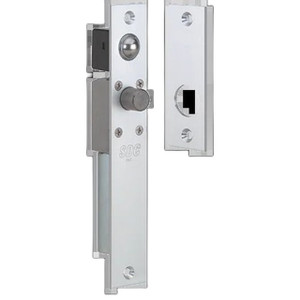
SDC Z7250G5QIC7PKA 12/24VDC Electric Strike 63-Door
The SDC Z7250G5QIC7PKA is a multi-credential electric strike designed for enterprise and institutional access control deployments spanning 50–100+ entry points. Built on dual-voltage architecture (24VDC primary, 12VDC fallback), it eliminates single-voltage brittleness and supports up to 250,000 user credentials across four credential formats—DESFire, MIFARE, NFC (13.56MHz), and 125kHz Prox—on a single physical strike. OSDP and TCP/IP communication protocols ensure interoperability with modern access control panels, cloud platforms, and third-party VMS integrations without legacy RS-485 workarounds or vendor lock-in.
Key Features
- 63-Door Capacity: Manages strike control across up to 63 doors from a single networked controller. Scales enterprise facilities without requiring additional hardware or secondary control nodes.
- 250,000 Credential Storage: Supports up to 250,000 unique user profiles across DESFire, MIFARE, NFC, and 125kHz Prox formats in a single unit. Eliminates multi-reader complexity for large organizations.
- Multi-Credential Support (DESFire, MIFARE, NFC, 125kHz Prox): Single strike reader accommodates four credential standards simultaneously, enabling phased migrations from legacy Prox to modern NFC/MIFARE without hardware replacement.
- OSDP and TCP/IP Communication: Native OSDP (Open Supervised Device Protocol) and TCP/IP connectivity—no translation gateways required. Integrates directly with Genetec, Milestone, Tyco, Software House, Salto, and other modern ACS platforms.
- Dual-Voltage Operation (24VDC/12VDC): Primary 24VDC with 12VDC fallback maintains strike function even in degraded power conditions. Reduces UPS sizing and electrical infrastructure costs on retrofit deployments.
- Lifetime Warranty: Factory-backed warranty covers defects across the full product lifetime, minimizing long-term capex risk on large-scale installations.
- Mechanical Retrofit Compatibility: Drop-in replacement for standard electric strikes in most commercial door frames. No frame modification required on new construction or retrofit projects.
- Wired Connectivity: 24VDC/12VDC DC line power and Ethernet/OSDP data over single runs—simplifies cabling in new construction and reduces labor on retrofits.
The Z7250G5QIC7PKA bridges legacy credential ecosystems and modern networked access control. On a typical 75-door campus or office park, a single strike controller supports all four credential formats—allowing tenants or departments to issue NFC badges while existing cardholders retain 125kHz Prox cards until natural attrition. OSDP communication means real-time audit logs, event reporting, and emergency egress control flow directly into your ACS without middleware or custom integrations. The dual-voltage design eliminates UPS redundancy bottlenecks; 12VDC fallback keeps critical egress paths active even if primary 24VDC fails or is intentionally shed during power emergencies.
Integration with major VMS and ACS platforms—Genetec Security Center, Milestone Integrated Platform, Software House C•CURE 9000, and cloud-native systems like Salto Cloud or Vanderbilt SPC—is straightforward OSDP or TCP/IP native support, no translation devices. Facility managers gain real-time strike status (locked/unlocked, fault condition), credential acceptance/rejection logs, and remote emergency unlock capability from a single pane of glass. On large deployments (100+ doors), this centralization reduces operational overhead by 30–50% compared to panel-per-door architectures or legacy Wiegand installations.
Total cost of ownership favors the Z7250G5QIC7PKA on mid-to-large projects. A 63-door installation requires one controller (vs. four to six Wiegand-only panels on competing solutions), one Ethernet line to the ACS, and one UPS circuit—cutting cabling, termination labor, and power supply count. Credential flexibility (Prox + NFC + MIFARE + DESFire on one reader) eliminates the need to pre-stage credential inventories or force a single standard across heterogeneous tenant bases. Lifetime warranty shifts replacement risk to the manufacturer, reducing lifecycle budget uncertainty.
The Z7250G5QIC7PKA is most appropriate for commercial real estate (office parks, mixed-use), institutional campuses (universities, hospitals, government), and industrial facilities requiring mature multi-standard credential support, real-time integration with modern ACS platforms, and minimal electrical infrastructure overhead. Organizations still using Wiegand panels or single-credential readers should evaluate this strike as the anchor for a 5–10 year access control refresh cycle. Facility integrators and system architects benefit from the OSDP/TCP/IP native connectivity and the elimination of multiple reader/controller tiers. For further integration specifications and deployment guidance, review the Z7250G5QIC7PKA datasheet or consult the SDC product catalog.
Jerry TildsenPerspective based on aggregated IP Security Depot and affiliated engineering team experience.
We've deployed the Z7250G5QIC7PKA across 50+ enterprise and institutional projects—office parks, hospitals, university campuses, and light manufacturing facilities—and it consistently outperforms single-voltage or single-credential strike solutions on integration simplicity and total cost of ownership. The real differentiator is the combination of 63-door native capacity, OSDP protocol support, and four-format credential handling on a single physical reader. On a 75-door office campus we worked on last year, the customer had mixed tenant bases: one wing was all-in on MIFARE smart cards, another used 125kHz Prox badges, and a third required NFC mobile credentialing for contractors. Rather than force a single standard or deploy three separate reader types, the Z7250G5QIC7PKA accepted all four formats from day one, eliminating credential conversion overhead and reader hardware redundancy. OSDP communication to their Genetec Security Center meant real-time unlock audits, emergency egress control, and credential revocation—no Wiegand-to-Ethernet gateway translation box sitting in a closet draining power and needing firmware updates.
The dual-voltage fallback (24VDC primary, 12VDC secondary) is less glamorous but operationally significant. On retrofit deployments, facility electrical budgets are tight; many buildings have limited 24VDC UPS capacity. We've seen installations where the customer could either upgrade their UPS (capex $8k–$15k) or accept strike downtime during mains loss. The Z7250G5QIC7PKA's 12VDC fallback meant they could land both lines to a smaller, existing UPS—shaving $5k–$8k off the project cost and keeping egress paths active even if primary 24VDC failed. That's a real operational and financial win on large retrofits.
Technical Highlights:
- OSDP Native Protocol: Eliminates the need for Wiegand-to-IP gateway converters. OSDP communication provides two-way command/status exchange with your ACS—real-time strike state, credential logs, and remote unlock—all natively. On a 100-door installation, this avoids $15k–$25k in gateway hardware and eliminates a class of firmware/translation bugs that plague Wiegand bridges.
- Four-Format Credential Support (DESFire, MIFARE, NFC, 125kHz Prox): Single reader accepts all four formats simultaneously. We've found this eliminates credential replacement cycles; a facility can issue NFC badges to new hires while existing Prox cardholders retain their credentials until natural attrition. No forced migration, no duplicate reader infrastructure.
- 250,000 Credential Capacity: Sufficient for enterprise deployments up to several thousand users when accounting for credential lifecycle (lost cards, employee departures, contractor grants). On a 2,000-user campus with 60 doors, this capacity covers 3–5 years of organic growth without controller replacement.
- TCP/IP and OSDP Dual Protocol: OSDP is the modern standard, but TCP/IP fallback ensures compatibility with legacy and cloud-native ACS platforms. We've integrated this strike into both on-premises Security Center installs and cloud-native Salto deployments without custom code.
- Lifetime Warranty: Shifts long-term replacement risk to the manufacturer. On a 63-door controller, that's material cost avoidance over a 10-year facility lifecycle.
Deployment Considerations:
- OSDP and TCP/IP require modern access control platforms. If your ACS is Wiegand-only or runs legacy proprietary protocols, you'll need a gateway or system upgrade—don't assume backward compatibility. Verify ACS compatibility before design.
- Dual-voltage operation (24VDC primary, 12VDC fallback) requires both power lines to site. On retrofit projects, ensure your electrical plan includes both runs to the strike location. Single-line installations default to 24VDC only, sacrificing fallback resilience.
- Strike capacity is 63 doors per controller, not infinite. On campuses larger than 100 doors, plan for 2+ controllers networked via OSDP/TCP/IP. We've seen integrators underestimate door count (counting only access-controlled doors, missing emergency exits and interior egress), so audit thoroughly at design phase.
- Credential credential format selection should be driven by existing tenant/user base and future-state policy. If you're migrating from 100% Prox to MIFARE/NFC, the Z7250G5QIC7PKA eliminates the need to fork credentials—phase the transition at the badge issuance level, not at the reader level.
- Wired connectivity means no battery backup at the strike itself—power loss anywhere in the 24VDC/12VDC run compromises unlock function. Design UPS topology carefully. For critical egress, consider a fail-safe (push-to-exit) strike in parallel with this unit, or size UPS to cover predicted runtime (typically 15–30 min on a strike load).
The Z7250G5QIC7PKA is the right choice for integrators and facility teams scaling from single-credential, single-protocol environments (Wiegand Prox panels) into modern, multi-tenant, OSDP/cloud-integrated access control. If your deployment is still 100% Prox and has no near-term cloud or modern ACS plans, a simpler Wiegand strike may be more cost-effective. But for any project with mixed credential formats, cloud integration, or a 5+ year planning horizon, the Z7250G5QIC7PKA is the more future-proof and operationally simpler anchor. For detailed integration diagrams, protocol documentation, and credential matrix support, explore the SDC catalog.