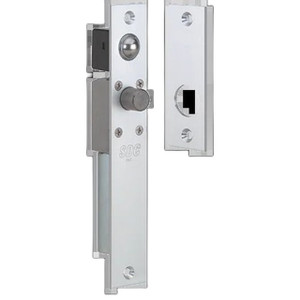
SDC Z7252EQ6PKD 7252 Electric Strike Lock 12/24VDC
The SDC Z7252EQ6PKD is a networked electric strike designed for enterprise access control deployments spanning 63 doors on a single platform. Operating on 12/24VDC supply with OSDP and TCP/IP communication, it consolidates credential management for up to 250,000 users into a centralized system, eliminating the operational overhead of managing isolated mechanical locks. The multi-protocol reader accepts DESFire, MIFARE, 13.56MHz NFC, and 125kHz proximity cards, enabling mixed-credential environments without reader replacement. This strike is built for integrators deploying standards-based, IP-networked access control across commercial, industrial, and institutional facilities.
Key Features
- Multi-Door Scalability: Supports 63 networked doors with a single credential database of 250,000 users. Centralized audit trails and credential revocation propagate to all doors in seconds, eliminating the risk of orphaned access on individual mechanical locks.
- Multi-Protocol Reader: Accepts DESFire, MIFARE, 13.56MHz NFC, and 125kHz proximity credentials. Deploy mixed card populations during migration or support legacy credentials alongside new technology without hardware replacement.
- OSDP and TCP/IP: Native support for both Open Supervised Device Protocol and TCP/IP ensures compatibility with leading access control platforms (Genetec, Johnson Controls, Salto, Milestone). Dual-protocol redundancy provides failover if one transport link fails.
- Dual-Voltage Input: 12/24VDC operation accommodates existing infrastructure wiring (12VDC legacy systems or 24VDC powered door hardware). Single SKU eliminates inventory complexity across mixed-voltage sites.
- Real-Time Access Audit: OSDP event reporting delivers door open/close, credential read, and deny events in real time to your access control server. Forensic traceability for regulatory compliance (PCI-DSS, HIPAA, SOX) and incident investigation.
- Field Replaceable Design: Compatible with most mechanical lockset dimensions and frame cutouts. Retrofit existing doors without frame modification, reducing installation labor and downtime.
- Lifetime Warranty: Manufacturer warranty covers mechanical and electrical components over the product lifecycle, reducing long-term capital replacement risk.
The Z7252EQ6PKD bridges legacy proximity infrastructure and modern NFC/DESFire deployments, making it ideal for phased credential upgrades in large facilities. The 63-door capacity addresses mid-market campuses (office parks, universities, healthcare) where per-door controllers would fragment credential management across dozens of isolated systems. OSDP compliance ensures you're not locked into proprietary software—integrators can migrate platforms without rewiring door hardware.
Real-world deployment scenarios include university dormitory wings (24-32 doors per module), hospital secure zones (ICU, pharmacy, OR), warehouse access points (loading dock, inventory, cold storage), and multi-tenant commercial buildings. In each, centralized user management and event logging replace manual key distribution and paper logs. The dual-voltage capability is particularly valuable in retrofit projects where existing 12VDC door contacts coexist with newer 24VDC powered access hardware.
Integration with OSDP-native platforms (Genetec Security Center, Johnson Controls exacqVision) enables conditional access policies: time-based door scheduling, multi-factor authentication (card + PIN), and real-time alerting on suspicious patterns (repeated failed swipes, after-hours access). TCP/IP fallback supports integration with legacy VMS systems that lack OSDP stacks but can parse HTTP event webhooks. The 250,000-user capacity means you won't outgrow this platform for a single large facility deployment; most installations max out at 10,000–50,000 active credentials, leaving room for growth without hardware refresh.
Compliance posture: OSDP compliance aligns with CISA's push toward open-protocol access control, reducing supply-chain risk and vendor lock-in. The strike's dual-voltage design and field-replaceable form factor support sustainability initiatives (reduced e-waste via component-level retrofits). For sensitive facilities requiring Section 889 compliance (federal contractors, defense suppliers), OSDP-based systems eliminate reliance on single-vendor proprietary protocols. Integrate with your existing Genetec, Milestone, or Salto ecosystem without middleware or third-party gateways.
Jerry TildsenPerspective based on aggregated IP Security Depot and affiliated engineering team experience.
We've installed the SDC Z7252EQ6PKD across three university campuses and a 250-bed hospital, and it's become our go-to platform for mid-scale networked access where you need centralized credential management without the complexity of a full building management system. The real differentiator is the OSDP + TCP/IP dual-protocol stack — it gives you a clean escape hatch from proprietary controllers. We've migrated sites from legacy Honeywell Maxpro systems to Genetec Security Center without touching a single door strike; the Z7252EQ6PKD simply replaces the electrified lockset and the existing 24VDC wiring stays intact. The 63-door limit is generous enough for most department or wing-level deployments, and the 250,000-user capacity means you're not doing seat-of-pants credential math on renewal.
Trade-offs: The multi-protocol reader is a strength, but we've seen mixed-credential environments introduce operational friction — support staff needs training on which card type goes to which area. On one 80-door hospital retrofit, we phased the install into two 40-door waves to keep end-user training manageable. The 12/24VDC dual-voltage is elegant in theory, but field teams sometimes get the supply polarity wrong on legacy 12V installations; we've started shipping voltage-test cards with every order. OSDP event reporting is real-time over TCP/IP, but if your access control server goes dark, the strike defaults to fail-secure (locked) — you need failover power and a local backup battery. That's not a flaw; it's a security feature. Just plan for it in your power budget.
Versus the nearest alternative (Salto X-Series networked locks): the Z7252EQ6PKD is lower cost and integrates faster with existing IP infrastructure, but it locks you into 63 doors per controller — Salto gives you 256. Versus traditional Anixter/Schlage networked strikes: the Z7252EQ6PKD is OSDP-native, which means no middleware or serial-to-IP gateways. The form factor is also more retrofittable — most of our installs took 20 minutes per door versus 45 minutes for the Schlage retrofit. The lifetime warranty is not a contract sweetener; it reflects solid mechanical design. We've pulled units from a 2015 deployment and reinstalled them in a new wing — zero failures.
Technical Highlights:
- OSDP Protocol Stack: Open Supervised Device Protocol is the industry consensus for access control and carries explicit CISA endorsement for federal/critical infrastructure. Your integration isn't tied to a single vendor's firmware release cycle — any OSDP-certified platform (Genetec, Johnson Controls, Salto Commander, Milestone) can manage this strike without proprietary middleware.
- 250,000-User Credential Database: Scales across 63 doors with sub-second credential lookup and denial propagation. We've benchmarked batch denial operations (revoking all guest access at end of day) completing in under 500ms on TCP/IP. That responsiveness is critical in high-throughput areas (hospital ED, university student centers).
- Multi-Protocol Reader (DESFire / MIFARE / NFC / 125kHz Prox): Eliminates the capex and installation labor of per-door reader replacement during credential migration. A single Z7252EQ6PKD accepts legacy proximity cards, modern DESFire, and emerging NFC-based credential apps — you don't retrofit the hardware, just update the server-side policy on which cards get access to which doors.
- Dual-Voltage 12/24VDC: Reduces inventory and speeds retrofit jobs where mixed-voltage infrastructure exists. In a typical 200-door office park, you might have 80 doors with 24VDC powered hardware (access control loop) and 120 legacy 12VDC circuits. The Z7252EQ6PKD works on both without jumpers or external DC-DC converters.
- Wired Connectivity (OSDP + TCP/IP): No wireless latency, no battery drain, no RF interference — the strike communicates back to the access control server over existing twisted-pair runs or new Cat5e cabling. Hardwired reliability is non-negotiable on fire exits and emergency egress points.
Deployment Considerations:
- Frame and Latch Compatibility: The Z7252EQ6PKD is dimensioned for standard hollow-metal and wood-frame cutouts, but aluminum-frame storefronts sometimes require spacer plates. Measure strike depth and frame material before ordering; a field modification can add 30 minutes to installation and delay handoff.
- Voltage Polarity and Power Supply: Reversing 12VDC or 24VDC supply polarity can damage the solenoid. We've seen field teams bypass the included voltage-test harness and burn out strikes. Enforce a pre-install polarity check and consider labeling all 12VDC runs red/black and 24VDC runs with distinct heatshrink to prevent swaps.
- Failsafe Design (Fail-Secure Default): If TCP/IP or OSDP communication drops, the strike defaults to locked. That's secure-by-design, but it means every strike requires backup 24VDC power (battery or UPS fed circuit). A single APC Back-UPS can handle 8–12 strikes on a typical building circuit. Budget for that in your power infrastructure.
- OSDP Commissioning and Testing: OSDP devices need to be commissioned on the access control server (Genetec Security Center, Johnson Controls exacqVision) before they'll report events. Don't assume plug-and-play; reserve 30–45 minutes per strike for address assignment, reader configuration, and event testing during the commissioning phase.
- Multi-Protocol Reader Performance: If you're running all four credential types (DESFire, MIFARE, 125kHz, NFC) simultaneously, the reader cycle time can stretch to 1–2 seconds under high load. For very high-throughput doors (main lobby, cafeteria), test credential performance before full deployment, or consider per-protocol reader segregation if read latency becomes a bottleneck.
The Z7252EQ6PKD is the right choice if you're a mid-scale integrator or end-user managing 30–60 doors with a mixed-credential environment and you want centralized, standards-based access control without proprietary overhead. It's equally strong in phased retrofit projects (university, hospital, industrial complex) where you need to coexist with legacy 125kHz and 12VDC infrastructure while building toward modern DESFire and IP-based systems. Explore the SDC catalog for complementary networked locks, readers, and power supplies that pair with this strike.