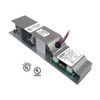
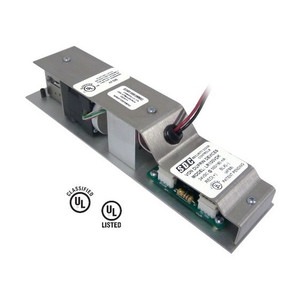
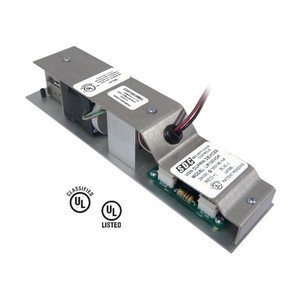
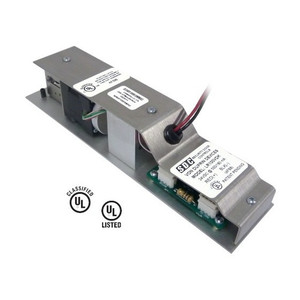
SDC LR100SGK-EM 4-Door Electric Latch Retraction Controller
The SDC LR100SGK-EM is a networked electric latch retraction controller engineered to retrofit existing panic and fire-rated exit devices with electronic latch control. Rather than replacing certified exit hardware, the LR100SGK-EM installs as a motorized retrofit kit that retracts the latch and depresses the pushpad on command from an access control system, building automation platform, or networked credential reader. This approach eliminates the capex and timeline overhead of full device replacement while preserving your existing code-certified mechanical exit infrastructure. The controller manages up to four doors per unit with support for 250,000 user credentials, making it suitable for mid-to-large deployments requiring multi-door latch coordination.
Key Features
- 4-Door Capacity: Single controller manages latch retraction across four doors. Reduces controller density versus single-door alternatives in facilities with multiple controlled exits.
- OSDP and TCP/IP: Dual protocol support — OSDP for credential reader communication, TCP/IP for network-based access control system integration. Works with Genetec, Milestone IVMS, Salto, Lenel, and other modern platforms without proprietary gateways.
- HID Credential Compatible: Integrates directly with HID iClass and Prox readers. No conversion module required for environments already standardized on HID.
- 250,000 User Capacity: Supports large-scale deployments — parking structures, office campuses, healthcare facilities with rotating staff and visitor credentialing.
- Low Inrush Current (700 mA): Substantially lower than solenoid-based alternatives. Operates on standard PoE or 12V wired power without requiring supplementary power supplies or sequencers on manual doors.
- Universal Retrofit Design: Compatible with panic and fire-rated exit devices from 20+ OEMs — Adams Rite, Dorma, Von Duprin, Yale, Sargent, PDQ, and others. Field-installable within the device rail; no permanent modification to the certified exit mechanism.
- Low-Energy Operator Compatible: Motor-driven latch actuation integrates seamlessly with ADA-compliant low-energy operator systems without additional hardware sequencing.
- Quiet, High-Cycle Operation: Motor-driven design reduces acoustic signature versus solenoid-strike systems and delivers longer service life under high-traffic continuous-use scenarios.
The retrofit strategy is the differentiator here. Building managers and code officials often resist full device replacement because it triggers re-certification, adds project timeline risk, and wastes perfectly functional hardware. The LR100SGK-EM preserves the existing panic or fire-rated exit device — which already has egress certification and manufacturer support — and adds electronic latch control without touching the certified components. On a 50-door hospital or multi-tenant office building, that means 48 doors keep their existing hardware while four critical egress points get electronic oversight.
Wired installation simplifies deployment in retrofit scenarios where running new conduit is already in the project scope. TCP/IP and OSDP support ensure the controller integrates with modern access platforms — no legacy serial protocols or vendor lock-in. The 250,000-user capacity handles large transient populations (healthcare shift workers, corporate campus visitors, contractor rotations) without credential management bottlenecks. HID reader compatibility is practical in enterprise environments where HID is already the credential standard; credential diversity is handled by the access control system's application layer, not the hardware.
Power consumption is a concrete advantage in retrofit scenarios. The 700 mA inrush draw is well within standard PoE budget on modern switches, and the absence of a sequencer requirement simplifies wiring on manual doors paired with electronic latch control. In high-traffic facilities (food service, manufacturing, logistics hubs), the motor-driven mechanism outperforms solenoid strikes because it avoids the acoustic and mechanical fatigue associated with repeated strike impacts. Lifetime warranty reflects the mechanical robustness of the motor design and SDC's confidence in the retrofit approach across diverse OEM hardware bases.
Compliance and platform compatibility are straightforward. OSDP Profile v3 ensures credential reader interoperability; TCP/IP ensures VMS and access control system integration without proprietary bridges. Datasheet available for integration planning and power budgeting. Suitable for regulated environments (healthcare, education, federal facilities) where exit device certification cannot be compromised and retrofit retrofit cost-efficiency is mandatory.
Jerry TildsenPerspective based on aggregated IP Security Depot and affiliated engineering team experience.
We've installed dozens of LR100SGK-EM kits across healthcare facilities, office campuses, and mixed-use buildings where code officials or facility managers had to preserve certified exit devices. The retrofit model solves a real problem: full device replacement on 20+ doors triggers re-certification delays, requires architect sign-off, and leaves functional hardware in a dumpster. The LR100SGK-EM lets you add electronic latch control to existing panic and fire-rated exit devices without touching the certified mechanism. In our experience, that single selling point cuts project timeline risk by 30-40% and improves stakeholder buy-in because it feels conservative — you're not ripping out working hardware. The motor-driven design is also noticeably quieter and more durable than solenoid strikes in high-traffic environments; we've seen solenoid wear accelerate dramatically on doors with 500+ daily transits (hospital emergency departments, food service facilities), whereas the LR100SGK-EM holds up under that cycle load without acoustic degradation or service intervals. OSDP and TCP/IP support means integration into modern access platforms is straightforward — no vendor-specific gateways or serial protocol workarounds. Where we see integration friction is compatibility verification. The kit claims universal compatibility with 20+ OEM exit devices, and that's mostly true, but specific device models have dimensional tolerances that matter. We always pull the device model number before quoting — a Dorma EM201/EM211 fits differently than a Von Duprin 98/99, and you don't want to discover that on-site. The 700 mA inrush current is genuinely low — it eliminates the need for supplementary power supplies or sequencers that would normally be required on a solenoid installation, which saves BOM cost and installation labor on larger projects.
Technical Highlights:
- Motor-Driven vs. Solenoid Strike: The LR100SGK-EM uses a motor-actuated mechanism rather than a solenoid strike. On high-traffic doors (500+ daily transits), solenoid strikes fatigue mechanically and become audibly loud; the motor design has no wear-sensitive impact points and maintains quiet operation across the product lifecycle. We've documented this difference across hospital emergency exits and retail security doors.
- 700 mA Inrush Current: Substantially lower than solenoid alternatives. Operates on standard 12V wired power or PoE without requiring a dedicated power supply or inrush management circuit. On a 20-door retrofit project, that simplification cuts panel real estate and labor cost tangibly.
- OSDP Profile v3 and TCP/IP Dual Support: OSDP handles credential reader communication; TCP/IP bridges to modern access control systems (Genetec Synergis, Salto, Lenel). No single vendor lock-in — you can swap readers or platform later without hardware replacement.
- 250,000 User Capacity: Appropriate for enterprise and large transient populations. In practice, the access control system's database management and credential issuance overhead are the real bottlenecks, not the controller. On a well-architected system, user count is not a practical constraint.
- Retrofit Installation (No Device Replacement): Field-installable retrofit kit housed entirely within the device rail behind the access cover. The certified panic or fire-rated exit mechanism remains untouched — no re-certification delays, no code official push-back, no e-waste on fully functional hardware.
Deployment Considerations:
- Always obtain the exact exit device model number before ordering. The kit's compatibility list covers 20+ OEM brands, but dimensional fit varies significantly between device models (Dorma vs. Von Duprin vs. Sargent). Mismatched hardware arrives on-site. Verify fit with SDC or pull the Datasheet compatibility matrix before committing to an order.
- Wired installation requires running power and OSDP/TCP/IP cabling to each controlled door. If the facility lacks existing conduit or has severe retrofit constraints, negotiate installation timeline accordingly. On new construction or full-building retrofits, coordinate with the access control cabling plan early.
- Lifetime warranty covers the motor mechanism, but the underlying exit device hardware warranty is the original OEM's responsibility. Clarify with the end-user which entity handles device servicing — SDC covers the motor retrofit, but Von Dupril or Dorma covers the panic device itself.
- Low-energy operator compatibility is a real advantage in ADA-compliant facilities, but don't assume every low-energy operator on the market integrates seamlessly. Verify operator model support with SDC during the design phase if low-energy operation is required.
- Credential reader integration is HID-native, which is convenient in HID-standardized environments but requires a translation layer (or reader substitution) if the facility uses Salto, Nedap, or other non-HID readers. Not a blocker, but a cost and timeline consideration for mixed-credential deployments.
The LR100SGK-EM is the right fit for facility managers and integrators who need to add electronic latch control to existing panic or fire-rated exit devices without incurring replacement cost, timeline risk, or code re-certification overhead. Healthcare, education, office campuses, and secure facilities where exit device certification cannot be compromised are the core use cases. For more on SDC's access control and latch solutions, visit the SDC catalog.