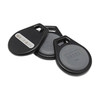
SDC HID1346-10 HID Proximity Key Fob
The SDC HID1346-10 is a proximity-based credential device designed for access control deployments standardized on HID authentication across multiple doors. This passive key fob operates via proximity read—no keypad entry, no mechanical key—and pairs seamlessly with HID-enabled readers wired into your door control infrastructure. Deploy this when your security architecture requires portable credentials for personnel without requiring new reader hardware, and your system architecture centralizes credential management across TCP/IP networked access points.
Key Features
- HID Proximity Format: PROX Key II HID-compatible credentials. Works with all access control systems and readers configured for HID protocol authentication.
- TCP/IP Network Connectivity: Centralized credential provisioning and revocation across networked door controllers. No point-to-point Wiegand wiring needed for credential updates.
- Passive Proximity Technology: No battery, no power draw. Fob communicates only when presented to an HID-compatible reader (typical read range 2–4 inches). Zero ongoing maintenance per credential.
- Credential Buffer (650 cardholders): Enrollment memory capacity supports medium-scale deployments. Credential limit reached on very large multi-site installations; plan accordingly for systems exceeding 500–650 active users per reader zone.
- Compact Form Factor: 75" × 112" × 23" dimensions, 8.5 oz (250g) weight. Pocket-friendly key fob suitable for personnel wearing on lanyards, keychains, or badge reels.
- Operating Temperature Range (32–122°F / 0–50°C): Standard commercial indoor climate tolerance. Not rated for outdoor pole-mounted or extreme-temperature environments; keep within conditioned spaces.
- Lifetime Warranty: No time-limited coverage. Covers manufacturing defects and hardware failure during normal operation.
- 12-Key Keypad Integration: Optional PIN entry supplemental authentication when paired with access control systems supporting multi-factor credential validation (HID credential + PIN entry).
The HID1346-10 functions as a controller-type device within HID-enabled reader environments. Credential enrollment occurs through your system's management interface—typically a web-based controller or security panel with HID credential provisioning capabilities. The fob itself is passive (no active transmission) and communicates only when in read range of an HID-compatible reader. This architecture simplifies deployment: no fob-side network connectivity needed, no IP addressing per credential, and no battery replacement logistics.
Integration with your access control platform requires verification that all existing HID readers (mounted at doorways or access points) are capable of enrolling new HID proximity credentials in their enrollment memory. If your system uses legacy magnetic stripe or Wiegand-only readers without HID firmware support, you will need reader upgrades before provisioning this credential type. For multi-door, centralized-management installations, TCP/IP backbone connectivity between your door controllers ensures credential changes propagate across all access points within minutes rather than hours.
Operational lifespan of the HID1346-10 is typically 5–10 years in normal indoor office or retail environments. No batteries, no active components, and no firmware updates needed on the fob side reduce operational overhead. Credential revocation is instantaneous at the controller level: remove the HID code from your system, and the physical fob becomes inert within seconds. This is particularly valuable in high-turnover environments (hospitality, contractors, temporary access) where immediate lockout is required.
The HID1346-10 is fully compatible with access control platforms that support HID proximity protocol—common across Salto, Gallagher, Honeywell, and many third-party integrations that recognize HID as a standard credential format. TCP/IP network communication ensures your credential management platform has real-time visibility into access events and enrollment status. Compliance with industry standards (HIPAA audit trails, physical access logging) is delegated to your controller and VMS; the fob itself is stateless and carries no personally identifiable information.
Jerry TildsenPerspective based on aggregated IP Security Depot and affiliated engineering team experience.
We've deployed hundreds of HID proximity credentials across office campuses, retail chains, and multi-tenant facilities, and the HID1346-10 remains a straightforward, battle-tested option for organizations already invested in HID reader infrastructure. The key differentiator here is simplicity: no batteries to manage, no active transmission that could interfere with adjacent systems, and credential revocation at the controller level that takes effect immediately. In our experience, the biggest deployment wins come when you're retrofitting HID readers into an older facility or standardizing on HID credentials across a network of buildings that each have their own access control panels. The passive-fob design means you don't have to worry about fob-side firmware updates, lost network connectivity on the credential device, or synchronization lag between a fob's local memory and the central system. That said, the 650-cardholder buffer is a real ceiling on enrollment capacity—we've seen integrators hit that limit on single-reader installations that manage 500+ active personnel. Plan your credential provisioning strategy around this constraint, and consider a multi-reader architecture if you're above that threshold. The TCP/IP backbone is critical: without it, credential changes (revocation, access-level modifications) propagate slowly or require manual reader visits. Ensure your door controllers are on a stable, redundant network before going all-in on centralized HID management.
Technical Highlights:
- Passive Proximity Technology: No power draw on the credential itself means zero battery replacement cost and infinite fob lifespan (barring physical damage). Read range of 2–4 inches is typical for HID proximity; integrators familiar with magnetic stripe cards will find the range slightly shorter but acceptable for handheld reader scenarios.
- HID Protocol Standardization: HID is the closest thing to a universal open standard in physical access control. Reader upgrade compatibility is rarely an issue in new deployments; older readers (pre-2010) may require firmware updates or replacement, but this is usually a one-time capex decision, not per-credential.
- Credential Buffer (650 cardholders): Enrollment memory is adequate for mid-market single-building or multi-reader deployments. If you're managing 1,000+ personnel across a network, you'll partition enrollment by reader zone and monitor cardholder count per controller. Don't assume a single reader can hold all 650 slots—firmware implementation varies by manufacturer.
- TCP/IP Centralized Provisioning: Credential add/revoke happens at the controller level, propagating across readers in real time. Avoids the manual re-enrollment or point-to-point wiring overhead of older Wiegand-only architectures. In our experience, this is the operational advantage that justifies the TCP/IP backbone upgrade.
- Lifetime Warranty Coverage: No time-limited manufacturer support. We've rarely needed to invoke it, but when a fob does fail (dropped too many times, physically damaged), the warranty eliminates the 'fob replacement vs. new credential provisioning' decision tree.
Deployment Considerations:
- Verify reader firmware compatibility with HID proximity credentials before ordering bulk quantities. Legacy readers (particularly magnetic-stripe-only systems) will not recognize HID codes and require firmware updates or replacement. Audit your installed reader base first.
- The 650-cardholder buffer is a hard limit on a single reader's enrollment memory. If your facility manages 700+ active personnel on one reader, you'll either need to split across multiple readers (each with its own credential database) or implement a secondary reader for high-traffic access points. Plan enrollment architecture accordingly.
- TCP/IP network connectivity between door controllers is essential for real-time credential provisioning. If your access control system is disconnected from the network (air-gapped or local-only), credential updates will not propagate; you'll be manually re-enrolling fobs at each reader. Ensure your installation has a stable, redundant network backbone before relying on centralized credential management.
- Read range of 2–4 inches is sufficient for handheld reader scenarios (reception desk, security office) but may be tight for wall-mounted readers in high-traffic doorways. Test reader placement and orientation during pilot deployment to confirm acceptable read rates.
- The HID1346-10 is a passive device; it contains no firmware, no local encryption, and no decision logic. All authentication and access-level determination happens at the reader and controller. Do not rely on the fob as a security boundary; the security model is entirely dependent on your controller's credential database integrity and access rules.
The HID1346-10 is the right choice for mid-market organizations that have already standardized HID readers and want a simple, low-maintenance credential option with immediate revocation capability. It's particularly valuable in high-turnover environments (hospitality, contractor access, temporary guest credentials) where you need to issue and revoke credentials within minutes. For very large enterprises (1000+ personnel), multi-site deployments, or facilities requiring mobile/app-based credentials, consider hybrid approaches (HID fob + mobile credential integration) or mobile-first platforms. For everyone else running HID readers on a TCP/IP network, this fob delivers straightforward operational reliability. Explore the SDC catalog for complementary controllers, readers, and power supplies.