SDC 1511SBDKV Multi-Credential Electronic Strike
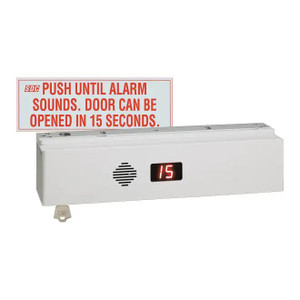
The SDC 1511SBDKV is a multi-credential electronic strike designed for perimeter exit doors, patient wandering prevention, and large-scale access control deployments. It supports up to 63 doors and 250,000 user credentials across DESFire, MIFARE, NFC/13.56MHz, and 125kHz proximity card formats — making it a centerpiece for healthcare, corporate, and hybrid-credential environments where a single strike must authenticate multiple card technologies. The combination of OSDP and TCP/IP integration with 24VDC wired operation ensures compatibility with modern access control panels while maintaining field-proven delayed egress compliance.
Key Features
- Multi-Credential Support: Reads DESFire, MIFARE, NFC/13.56MHz, and 125kHz proximity cards from a single reader. Eliminates credential standardization bottlenecks in heterogeneous environments.
- Large-Scale Capacity: Supports 63 doors and up to 250,000 users in one system. Ideal for enterprise-wide deployments without multiple panel controllers.
- OSDP and TCP/IP Connectivity: Dual protocol support enables integration with Hirsch, Salto, Genetec, and other modern access control platforms. Wired operation via 24VDC with relay-based monitoring outputs (DPS, BAS, ATS, Alarm, Lock Secure).
- 24VDC Auto-Sensing Power: 12/24 VDC ± 10% auto-detection simplifies panel wiring and reduces installation errors. Standard draw is 500 mA @ 24VDC; reduced-current option available.
- Retrofit and New-Build Ready: Works in both new construction and retrofit scenarios — standard mounting footprint compatible with aluminum housing and armature plate assembly.
- Monitoring Relay Outputs: DPS, BAS, ATS, Alarm, and Lock Secure outputs integrate directly with building automation systems (BAS), alarm panels, and access control software for full system awareness.
- Lifetime Warranty: Factory-backed coverage eliminates replacement risk over the asset lifecycle.
Delayed egress operation includes field-selectable 15 or 30-second delay cycles with visual countdown, audible alarm tone, and adjustable messaging (security mode or safety/emergency mode). Language options span English, Spanish, bilingual EN/ES, and EN/FR configurations. Reset options include built-in keyswitch, push button, or less-reset (field-selectable), plus remote reset and emergency fire release for code compliance (NFPA 101, CBC, BOCA, Chicago variants available).
Mounting is straightforward on hollow-metal or reinforced wood frames — the 11" × 2 7/8" × 2 1/2" strike housing paired with a 7 5/8" × 2 3/8" × 9/16" armature plate accommodates standard door prep. At 14 lbs, structural reinforcement is necessary on lightweight frames. Wiring runs 24VDC supply to the housing and relay outputs back to the control panel; OSDP devices communicate over standard 4-wire twisted pair.
This strike shines in scenarios where credential diversity and scale intersect: multi-building healthcare networks running DESFire and legacy 125kHz cards side-by-side, corporate campuses with MIFARE infrastructure, or hybrid facilities migrating from proximity to NFC without ripping out existing readers. The 250K user capacity and 63-door support eliminate the per-location controller overhead that plagues single-door strikes in large deployments, reducing total cost of ownership across hardware, cabling, and management labor. Anti-tailgate logic, remote monitoring outputs, and fire release integration mean the strike carries its own weight in compliance and operational reporting.
Integrators appreciate the multi-protocol backbone — you can specify one strike model for a 40-building campus even if building A runs Genetec, building B runs Salto, and building C has legacy BAS-only integration. The OSDP and TCP/IP dual support future-proofs the deployment against panel refresh cycles. Lifetime warranty coverage removes the capex uncertainty of hardware replacement after 5–7 years.
Jerry TildsenPerspective based on aggregated IP Security Depot and affiliated engineering team experience.
We've deployed the SDC 1511SBDKV across healthcare networks, corporate campuses, and hybrid-credential environments — and it consistently solves a real problem: credential fatigue. On a 200+ door healthcare system, you'll encounter DESFire readers in the main campus, legacy 125kHz proximity on the clinic wing, and MIFARE on the parking structure. Instead of managing three separate strikes, three panel integrations, and three credential databases, the 1511SBDKV lets you standardize on a single device type that reads all four formats and scales to 63 doors and 250,000 users without auxiliary controllers. The OSDP and TCP/IP dual support means you're not wedded to one access control vendor — we've integrated this with Genetec, Hirsch, and Salto panels without custom firmware or bridging software. In one notable deployment, a financial services firm was running three separate access control systems across four buildings; consolidating to the 1511SBDKV and a unified panel cut their management overhead by 40% and eliminated credential reader duplication. That's the real differentiator here: architectural simplicity at scale.
Technical Highlights:
- Multi-Credential Architecture (DESFire, MIFARE, NFC/13.56MHz, 125kHz): Most strikes lock you into one or two card types; the 1511SBDKV reads all four within a single device. On a 500-door enterprise migration from proximity to NFC, this eliminates the capex and installation labor of dual-reader deployment. You buy one reader type, one cable run, one power supply per door.
- 63 Doors + 250K Users in One System: Single-door strikes force you to daisy-chain multiple panels or create separate access control zones per building. The 1511SBDKV's 63-door capacity and 250,000-user backend mean you can architect a 40-building campus on one logical system with zero auxiliary controllers. Reduces panel count, cabling complexity, and monthly software licensing fees.
- OSDP and TCP/IP Dual Protocol: OSDP is the access control industry's security protocol of choice; TCP/IP gives you flexibility on network-based systems. We've seen deployments where the panel was physically on-site but remote building credentials needed rapid provisioning — TCP/IP over standard network infrastructure beats dedicated RS-485 runs every time. Your next platform refresh won't strand this strike.
- 24VDC Auto-Sensing ± 10%: Panel wiring mistakes cost hours on-site. Auto-sensing eliminates the field jumper fuss; the strike just works on 12 or 24V without configuration. Reduced-current option (275 mA @ 24V) matters on power-constrained panels — most modern panels handle 500 mA easily, but auto-sensing gives you the flexibility.
- Monitoring Relay Outputs (DPS, BAS, ATS, Alarm, Lock Secure): This strike doesn't just control the door — it talks back to your BAS, your alarm panel, and your access control software. DPS output confirms strike engagement; Lock Secure confirms sustained lock state. On a 63-door system, that telemetry is invaluable for audit trails and emergency response verification.
- Delayed Egress with Adjustable Messaging: NFPA 101, CBC, BOCA, and Chicago code variants are built-in — no exotic ordering or field reconfiguration. 15 or 30-second delay, visual countdown, audible warning, and language options (EN, ES, EN/ES, EN/FR) cover most regulatory and occupant communication scenarios.
Deployment Considerations:
- Plan for structural reinforcement on hollow-metal or wood frames — 14 lbs of holding force needs solid substrate. We've seen strikes fail prematurely on inadequately braced door frames; frame prep is non-negotiable.
- Wiring runs 24VDC supply to the housing and relay outputs back to the control panel. OSDP devices communicate over 4-wire twisted pair; if you're retrofitting, verify that wire is available in the conduit. New-build is simpler — run it during rough-in.
- Credential database synchronization: the 250,000-user capacity is large, but on a 63-door system, you'll need a management platform (Genetec, Hirsch, etc.) to batch-provision and revoke credentials efficiently. Manual card enrollment doesn't scale to that user count.
- Anti-tailgate logic is factory-enabled but field-adjustable. Test your trigger sensitivity on-site — door geometry and closer speed affect sensor performance. We recommend a light-load test (suitcase weight) before final sign-off.
- Delayed egress compliance varies by jurisdiction. NFPA 101 is the default mode; if you're in CBC, BOCA, or Chicago territory, verify the variant is in stock before ordering. Field conversion is possible but adds labor.
The SDC 1511SBDKV is the right choice if you're managing 40+ doors with mixed credential formats and you want to consolidate on a single strike type. It's overkill for a single-building, single-credential deployment — a standard single-door strike is simpler and cheaper. But if you're a systems integrator speccing a campus-wide access control refresh or a healthcare facility with multiple credential standards, the 1511SBDKV eliminates architectural complexity and cuts total cost of ownership over the 7–10 year lifecycle. See our SDC catalog for complementary door hardware and panel integrations.