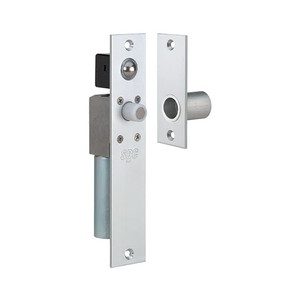
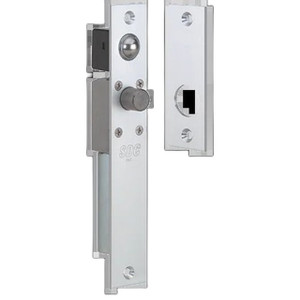
SDC 1490AIV Narrow Style Bolt Lock Strike
The SDC 1490AIV is a 24VDC wired bolt lock strike engineered for compact installations where space and scalability matter equally. Rated to manage up to 63 doors and 250,000 user credentials in a single deployment, this strike is purpose-built for commercial, institutional, and enterprise access control systems that demand reliable electronic locking without oversized footprints.
Key Features
- Narrow Form Factor: Compact profile fits door frames and frame assemblies where standard-width strikes won't fit — reduces structural modifications and retrofit costs.
- 24VDC Wired Operation: Straightforward DC voltage supply means no complex power negotiation or protocol overhead. Direct integration into traditional access control power distribution.
- OSDP and TCP/IP Compatibility: Communicates via open standards, eliminating vendor lock-in and ensuring interoperability with multi-manufacturer control panels and card readers. OSDP is the modern access control standard, TCP/IP allows network-distributed strike control for larger campuses.
- Multi-Credential Support: Accepts DESFire, MIFARE, NFC/13.56MHz, and 125kHz proximity cards — you're not forced to migrate all credentials at once. Deploy new credential types gradually while legacy systems remain functional.
- 63-Door Scalability: Can manage up to 63 doors in a coordinated system without separate controllers per door, reducing hardware footprint and simplifying wiring.
- 250,000 User Credentials: Sufficient credential storage for mid to large enterprises; avoids frequent database rebuilds or credential cycling.
- Standards-Based Integration: OSDP and TCP/IP protocols ensure this strike works with modern access control systems from multiple manufacturers — a genuine advantage if you're integrating legacy and new hardware on the same site.
Integration & Compatibility
The 1490AIV speaks OSDP and TCP/IP, making it compatible with contemporary access control panels that support these protocols. Credential readers — whether card, proximity, NFC, or DESFire — can be paired freely, provided they output compatible data to the control panel. This decoupling of strike, reader, and control logic is deliberate and valuable: if you need to upgrade a reader or swap brands, the strike doesn't force a wholesale system redesign.
For integrators managing mixed-generation deployments (older 125kHz proximity systems alongside newer NFC/DESFire), the 1490AIV's credential flexibility is a genuine deployment win. You achieve credential modernization on your schedule, not the lock manufacturer's.
Consult your control panel and access control documentation for explicit OSDP/TCP/IP command compatibility before commissioning.
Deployment Context
Use the SDC 1490AIV when you're deploying multi-door access control on a modest to large scale and cannot afford to lose space to wide strike profiles. Warehouses with narrow door frames, institutional buildings with strict renovation budgets, and retrofit projects where space is scarce are natural fits. The credential flexibility means you can prioritize credential modernization separately from hardware refresh cycles — a real budget advantage for large organizations.
Do not assume all control panels support OSDP or TCP/IP; confirm compatibility with your chosen panel vendor before purchase.
Ted PerryPerspective based on aggregated IP Security Depot and affiliated engineering team experience.
The SDC 1490AIV is a straightforward, pragmatic choice for integrators who value standards compliance and credential agility over flash. The narrow profile is genuinely useful — I've installed full-sized strikes in tight spaces before, and it's a pain. The 1490AIV's support for OSDP and TCP/IP means you're not betting on proprietary extensions; you can swap control panels or readers without redesigning the lock side of the system.
Technical Highlights:
- 24VDC Direct Supply: No PoE negotiation, no power-budget arithmetic — wire it to a traditional 24VDC bus and move on. Simplifies power distribution in large multi-door deployments.
- OSDP Protocol: The modern access control standard; eliminates the Wiegand/RS-485 messiness of older systems. Your control panel talks directly to the strike without intermediate conversion hardware.
- Up to 63 Doors per System: Credential management doesn't fragment across multiple controllers. One database, one audit trail, one logical access point.
- Dual Credential Standards (13.56MHz + 125kHz): Run DESFire and MIFARE readers alongside legacy proximity — useful for phased migrations without rip-and-replace.
Deployment Considerations:
- Confirm your control panel explicitly supports OSDP or TCP/IP communication before specifying. Not all panels do, and a mismatch between strike and panel protocol will not resolve itself.
- The narrow form factor assumes your door frame can accommodate the physical depth and width of the strike housing. Verify frame geometry and hinge placement on-site — retrofit installations often surface surprises.
- 24VDC wiring must be properly fused and run to a dedicated power supply; do not attempt to daisy-chain across unrelated 24VDC circuits without confirming total amp draw.
The 1490AIV shines in institutional and enterprise settings where you're managing tens of doors and want to avoid credential standardization deadlines. It's also the right call for integrators who value open protocols over proprietary ecosystems. Skip it if your control panel speaks only Wiegand or legacy RS-485, or if you're locked into a single-vendor credential ecosystem by contract or legacy infrastructure.
Frequently Asked Questions
Q: Does the SDC 1490AIV require a separate power supply, or can it run off a standard 24VDC bus?
A: It requires a dedicated 24VDC power supply capable of supplying the strike's steady-state and inrush current. Do not attempt to power it from an insufficient or shared bus; consult the datasheet for exact amperage and cross-reference your power supply capacity.
Q: Can the 1490AIV work with my existing 125kHz proximity card system?
A: Yes, provided your access control panel supports OSDP or TCP/IP and is wired to send unlock commands to the strike. The 1490AIV accepts the unlock signal regardless of credential type; the reader and panel handle credential validation. Verify panel compatibility before installation.
Q: What is the warranty on the SDC 1490AIV?
A: Refer to the manufacturer's documentation or contact the distributor for warranty terms, coverage, and exclusions.
Q: Is the 1490AIV suitable for outdoor installations or high-humidity environments?
A: Review the environmental ratings and operating temperature range in the datasheet. If your deployment requires outdoor or high-humidity service, confirm enclosure and coating specifications against your environment before specifying.
Q: How many credentials can the 1490AIV store, and can it operate in standalone (offline) mode?
A: The system supports up to 250,000 user credentials across 63 doors. Offline/standalone operation depends on your control panel's architecture and firmware — the strike itself is a simple solenoid actuator that responds to unlock signals. Confirm offline capability with your panel vendor.
Q: Can I upgrade my existing access control system to use the 1490AIV without replacing the control panel?
A: Only if your control panel supports OSDP or TCP/IP communication. If your panel uses only Wiegand or legacy RS-485, the 1490AIV will not integrate. Verify protocol support before specifying.