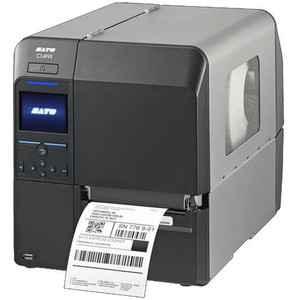
Sato WWCLP1101-NAN CL4NX Plus 203dpi Industrial Thermal Printer
The Sato WWCLP1101-NAN is a mid-range industrial label printer engineered for logistics, manufacturing, and warehouse operations requiring consistent, high-volume barcode and text output. Running at 14 inches per second (ips) with 203 dpi resolution, it strikes a practical balance: crisp barcodes and alphanumeric content readable by standard scanners without overkill resolution that would slow throughput. Cast aluminum construction withstands the vibration and thermal swings typical of warehouse floors and factory environments.
Key Features
- Dual Thermal/Transfer Capability: Eliminates the need for separate equipment. Direct thermal mode runs media costs down for temporary labels; thermal transfer handles durable synthetic and high-temperature media when labels must survive harsh handling or outdoor exposure. No changeover downtime for mode switching—one printer adapts to supply chain shifts.
- 203 dpi Resolution at 14 ips: Sufficient for GS1-128 barcodes, UPC codes, and shipping label text without sacrificing speed. At this resolution, printhead life is extended compared to higher-dpi competitors, reducing consumable costs per label across high-volume runs.
- Media Flexibility: Accepts rolls from 0.87" to 5.04" wide with up to 10" diameter, and prints up to 4.09" width. Covers everything from small item labels to full-size parcel stickers without requiring separate SKUs of equipment.
- 3.5" Full-Color LCD Display: Status monitoring and template navigation without a tethered workstation. Reduces training overhead for warehouse staff; operator diagnostics are visible on-device instead of requiring IT escalation.
- Tool-Free Printhead and Platen Replacement: Field service becomes a five-minute task instead of a scheduled technician visit. Downtime drops significantly, and replacement parts cost less than contract labor for a service call.
- Local Storage and Autonomous Operation: 2 GB Flash and 256 MB SDRAM with 100 MB user-accessible space for fonts and label forms. Pre-load templates and barcodes; the printer runs independently if network connectivity drops. Real benefit in warehouses with spotty Wi-Fi or during shift handovers.
- Multi-Protocol Connectivity: Ethernet, Wi-Fi, and USB allow deployment in environments with legacy serial/Ethernet infrastructure alongside modern cloud-connected shipping systems. Wi-Fi is particularly valuable for mobile label stations or temporary packing areas without fixed cabling.
- Ribbon Capacity: Up to 1,968 feet (600 m) of ribbon per spool reduces ribbon changes during high-volume production shifts, lowering labor overhead and keeping operators focused on throughput rather than consumable swaps.
Integration and Connectivity
The WWCLP1101-NAN (often searched as WWCLP1101 NAN) connects via Ethernet, Wi-Fi, or USB. Ethernet is standard for fixed dock installations; Wi-Fi unlocks mobile labeling carts and temporary stations. USB is useful for direct integration with shipping software or barcode generation tools on a single PC before fleet deployment. Its 100 MB onboard storage is enough for dozens of label templates, allowing the printer to function without constant network calls—beneficial in environments where database queries introduce latency or where network downtime would halt operations.
Operating Environment
Operating range of 41°F to 104°F (5°C to 40°C) is standard for climate-controlled warehouses and manufacturing floors. This is not a sub-zero or high-heat device—verify your facility's temperature profile before deployment. If your environment experiences regular excursions outside this range (cold storage, outdoor shipping docks, or proximity to heat sources), consult the full technical documentation to confirm suitability or explore alternative models.
Frequently Asked Questions
Q: Can the WWCLP1101-NAN switch between direct thermal and thermal transfer without manual intervention?
A: Yes. The printer supports both modes, and you can switch media and ribbon types without requiring hardware reconfiguration. This makes it flexible for operations that use both temporary direct thermal labels and durable thermal transfer labels.
Q: What is the maximum label width this printer can handle?
A: The WWCLP1101-NAN prints up to 4.09" width and accepts media rolls between 0.87" and 5.04" wide. This covers small item tags through full-size parcel labels in a single SKU.
Q: Does the WWCLP1101-NAN work offline if the network goes down?
A: Yes. With 100 MB of user-accessible onboard storage, you can pre-load label templates and barcode forms. The printer will continue printing autonomously if Ethernet or Wi-Fi connectivity is lost, making it reliable for shift handovers or spotty warehouse Wi-Fi.
Q: How often do I need to replace the printhead and platen?
A: Tool-free design means field replacement takes approximately five minutes. Exact replacement intervals depend on label volume and media type, but the design minimizes downtime compared to traditional service visits.
Q: What connectivity options are available for the WWCLP1101-NAN?
A: The printer supports Ethernet (for fixed dock installations), Wi-Fi (for mobile labeling carts and temporary stations), and USB (for direct PC integration). This multi-protocol approach works with both legacy warehouse infrastructure and modern shipping software.
Q: Is the WWCLP1101-NAN suitable for outdoor shipping docks?
A: The operating range is 41°F to 104°F (5°C to 40°C), which covers climate-controlled facilities. If your shipping dock experiences regular temperature swings outside this range, verify suitability before deployment.
Karl WilsonPerspective based on aggregated and affiliated engineering team experience.
The Sato WWCLP1101-NAN hits a practical middle ground for warehouse operations that need speed without sacrificing barcode quality. At 14 ips with 203 dpi, this printer delivers readable GS1-128 and UPC codes across high-volume shifts while keeping printhead wear reasonable compared to 300+ dpi competitors. The dual thermal/transfer capability is worth the attention—it eliminates the inventory overhead of maintaining two separate printers, which matters when you're scaling across multiple shipping stations.
Technical Highlights:
- 14 ips at 203 dpi: Fast enough for standard logistics labeling (500+ labels per shift easily achievable) without the printhead degradation you'd see from higher-resolution models operating at the same speed. Total cost of ownership improves measurably when you factor in consumable replacement frequency.
- 2 GB Flash + 100 MB user storage: Pre-load dozens of label templates and run autonomously. This is critical in warehouses where network latency or Wi-Fi dead zones would otherwise halt operations. A single label template can be 50–100 KB; 100 MB gives you real flexibility without needing a tethered PC.
- Wi-Fi + Ethernet + USB: Deploy this across fixed dock stations (Ethernet), mobile carts (Wi-Fi), and direct integration with individual PC-based shipping software (USB). That flexibility lets you stage deployments incrementally rather than forcing a parallel infrastructure overhaul.
- 1,968-foot ribbon capacity: A full spool easily covers 5,000+ label cycles depending on label size and thermal transfer demand. In high-volume shifts, fewer ribbon changes mean operators stay focused on throughput instead of consumable swaps—a genuine labor multiplier.
Deployment Considerations:
- Temperature range 41°F–104°F is standard for climate-controlled facilities but hard-stops at outdoor docks or near heat-generating equipment. If your environment regularly dips below freezing or exceeds 40°C (104°F), this printer is not the fit—escalate to an industrial-rated variant.
- Tool-free printhead/platen replacement is a genuine time-saver, but it assumes you stock spares on-site. Without spare printheads within reach, you're back to scheduling downtime. Budget for consumables upfront.
- The 4.09" print width handles most parcel labels but not oversized shipping tags. Verify your largest label footprint before committing to this model.
Position the WWCLP1101-NAN in mid-volume parcel logistics, warehouse labeling, or manufacturing operations where you need 203 dpi clarity, Wi-Fi mobility, and the ability to run offline. It's overkill for simple barcode generation on a fixed dock, but it's the right choice if you're consolidating multi-site labeling infrastructure and need both speed and template flexibility under one hardware SKU.