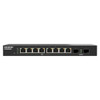
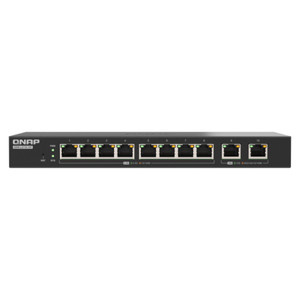
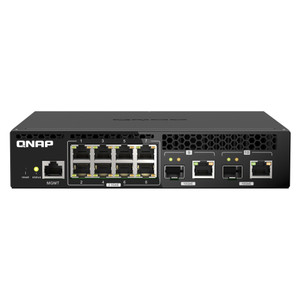
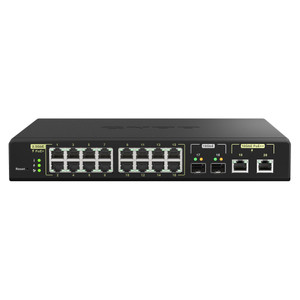
QNAP QSW-L2110-2S8T-US Lite Managed 10-Port 2.5GbE Network Switch
The QNAP QSW-L2110-2S8T-US is a lite managed switch that puts eight 2.5GbE Base-T access ports and two 10GbE SFP+ uplink ports in a single unit — purpose-built to break the 1GbE bottleneck that chokes high-throughput NAS arrays, multi-camera IP surveillance systems, and server-dense edge deployments. If you're still routing NAS traffic over gigabit infrastructure while your drives and NAS are capable of 2.5x that throughput, this switch is the direct fix.
Overview
QNAP's QNAP network switching line targets environments where throughput between storage, servers, and uplinks actually matters. The QSW-L2110-2S8T-US slots into that category squarely: the 2.5GbE access tier handles client and device connections at speeds most modern NAS units and workstations can fully utilize, while the pair of 10GbE SFP+ ports provide dedicated high-speed uplinks to core switching or NAS aggregation. The result is a managed network switch that scales beyond a flat gigabit infrastructure without requiring a full 10GbE-to-the-edge investment.
Key Features
- 8 x 2.5GbE Base-T Access Ports: Each port runs at 2.5 times the speed of standard gigabit — critical when connecting multi-bay NAS devices, 2.5GbE-capable workstations, or IP cameras generating high-bitrate streams. A single 2.5GbE link handles approximately 312 MB/s sustained, which keeps pace with modern NVMe-backed NAS read speeds that gigabit can no longer service.
- 2 x 10GbE SFP+ Uplink Ports: The fiber-based SFP+ uplinks let you connect directly to a 10GbE core switch or a NAS with an SFP+ expansion card — no RJ45 adapter required. Fiber uplinks also eliminate ground-loop issues that appear on long copper runs in multi-building or rack-to-rack scenarios. Use these for aggregated uplink or direct NAS-to-switch high-speed backplane connectivity.
- Lite Managed Feature Set: Unlike unmanaged switches, the QSW-L2110-2S8T-US provides management capabilities for VLAN segmentation, traffic monitoring, and port-level control without the configuration overhead of a full L3 managed switch. For integrators deploying IP cameras alongside NAS-based recorders, basic VLAN separation between surveillance and production traffic is achievable here.
- Eliminates Bandwidth Bottlenecks: The architecture is explicitly designed to address scenarios where 1GbE infrastructure creates congestion on NAS, server, or storage-dense workloads. Eight 2.5GbE downlinks feeding into two 10GbE uplinks provides a 20Gbps aggregate uplink ceiling — enough headroom for simultaneous high-throughput client access without saturating the spine.
- Flexible Uplink Connectivity: The SFP+ ports support DAC cables for short rack-to-rack runs, standard SFP+ transceivers for longer fiber runs, or direct connection to a NAS or server's 10GbE SFP+ interface. This flexibility matters in mixed-media environments where fiber and copper infrastructure coexist.
- NAS and Server Integration: Pairing this switch with a network-attached storage device equipped with a 10GbE SFP+ port delivers near line-rate storage performance for multiple simultaneous 2.5GbE clients — the design intent behind QNAP's portfolio pairing between their NAS and QSW switching families.
Integration and Compatibility
The QSW-L2110-2S8T-US is designed to integrate with NAS devices, servers, and uplink switches that support 2.5GbE or 10GbE interfaces. The 2.5GbE Base-T ports are backward-compatible with 1GbE and 100Mbps devices, so mixed-speed environments work without separate unmanaged gigabit switches. The SFP+ uplinks support standard 10GbE transceivers and DAC cables, making integration with existing 10GbE infrastructure straightforward. For surveillance deployments, pairing this switch with a network video recorder connected via SFP+ uplink while cameras attach to the 2.5GbE access ports is a practical architecture for high-channel-count installs.
Frequently Asked Questions
Q: What is the difference between the QSW-L2110-2S8T-US and the QSW-L2110-10T?
A: Both models share the same eight 2.5GbE Base-T access port configuration. The key difference is the uplink type: the QSW-L2110-2S8T-US uses two 10GbE SFP+ fiber ports, while the QSW-L2110-10T uses two 10GbE Base-T copper uplink ports. Choose SFP+ if you need fiber runs or are connecting to an existing SFP+-equipped NAS or core switch; choose Base-T if your upstream device only has RJ45 10GbE ports.
Q: Does the QSW-L2110-2S8T-US support PoE on the 2.5GbE ports?
A: The available evidence does not confirm PoE delivery on this model's access ports. Verify with the manufacturer's specification sheet before planning camera or VoIP deployments that depend on PoE power sourcing from this switch.
Q: Can I use DAC cables on the SFP+ uplink ports?
A: The SFP+ form factor supports standard DAC (Direct Attach Copper) cables for short-distance rack-to-rack or NAS-to-switch connections, which is a cost-effective option compared to fiber transceivers for in-rack deployments. Confirm DAC cable compatibility with QNAP's supported transceiver list for this model.
Q: Is the QSW-L2110-2S8T-US a full Layer 3 managed switch?
A: No. This is a Lite Managed (Layer 2) switch. It provides management capabilities including VLAN and port control, but does not include full Layer 3 routing features. For pure access-tier and uplink aggregation use cases — the primary deployment scenario for this switch — L2 management is sufficient.
Q: What NAS devices pair well with the QSW-L2110-2S8T-US?
A: Any NAS or server with a 10GbE SFP+ expansion or built-in port can connect directly to the uplink ports. QNAP NAS devices supporting 10GbE SFP+ interfaces are a natural pairing given shared platform management. The 2.5GbE access ports match current-generation workstations, single-board computers, and network cameras that include 2.5GbE NICs.
The QSW-L2110-2S8T-US addresses a very specific and common infrastructure gap: environments where NAS arrays and workstations have outgrown gigabit but can't justify a full 10GbE-to-the-desktop rollout. The eight 2.5GbE Base-T access ports combined with dual 10GbE SFP+ uplinks give you a 3:1 oversubscription ratio on the uplink, which is workable for NAS-heavy storage traffic where not all eight clients are saturating simultaneously.
Technical Highlights:
- 2.5GbE Access Tier: 2.5Gbps per port means each client gets 312 MB/s theoretical — enough to stop NAS sequential reads from being switch-limited rather than drive-limited, which is the dominant bottleneck on modern SATA and NVMe NAS arrays.
- 10GbE SFP+ Uplinks: Two fiber uplinks support direct DAC or transceiver-based connection to a 10GbE core switch or a NAS SFP+ port. In a two-switch rack stack, you can bond both uplinks for 20Gbps aggregate — doubles the uplink ceiling without adding hardware.
- Lite Managed (L2): VLAN tagging lets you isolate surveillance camera traffic from NAS client traffic on the same physical switch — reduces broadcast domain noise and provides a basic security boundary that an unmanaged switch cannot offer.
Deployment Considerations:
- The SFP+ uplink ports require matching transceivers or DAC cables — these are not included. Budget for two SFP+ modules or DAC cables when specifying this switch for a new install. Verify QNAP's compatibility list before purchasing third-party optics.
- PoE sourcing is not confirmed from available specifications — do not spec this switch as a power source for cameras or access control readers without verifying PoE support directly with QNAP's datasheet for this model.
The QSW-L2110-2S8T-US is the right call for a NAS-centric media production or surveillance storage environment where 1GbE is the proven bottleneck and a full 10GbE access rollout isn't in budget — it upgrades eight client connections to 2.5GbE and ties the whole access tier to a 10GbE backbone in a single managed unit.