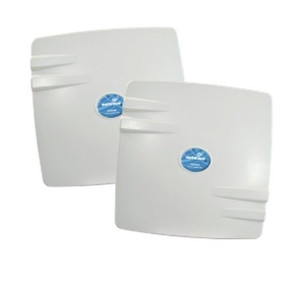
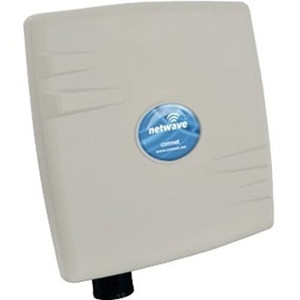
Comnet NWK1-P5T Point-to-Point Wireless Switch
Overview
The Comnet NWK1-P5T is a compact point-to-point wireless bridge designed for surveillance system integrations where hardwired ethernet isn't feasible or cost-effective. It operates in both Access Point (AP) and Client modes, making it adaptable to various network topologies — whether you're bridging a remote camera array back to a central NVR or daisy-chaining multiple sites. Power input is 48 VDC, which integrates cleanly with standard PoE-derived DC supplies common in surveillance installations. Default configuration ships with IP 192.168.10.100, admin/admin credentials, and SSID NetWave-1, allowing rapid deployment once you've commissioned the unit in your test environment.
Key Features
- Dual-Mode Operation (AP/Client): Deploy as a wireless access point to serve remote cameras, or configure as a client to connect upstream to an existing network. This flexibility eliminates the need for separate hardware depending on your site topology — a real cost saver when you're retrofitting older facilities without backbone ethernet.
- 20/40 MHz Channel Spectrum Width: Dynamic spectrum allocation lets you optimize for throughput (40 MHz in clear RF environments) or reliability (20 MHz in congested urban/industrial settings where interference is a concern). Narrower channels punch through noise better, though at the cost of raw bandwidth.
- 48 VDC Power Input: Designed to integrate with standard 48V DC distribution systems typical in telecom and surveillance backbone infrastructure. No separate 110/220V wall supply needed on-site — a significant advantage in remote or outdoor locations where power is already provisioned as DC.
- FCC Part 15 Compliance: Operates in unlicensed ISM spectrum under FCC Part 15 rules, meaning no spectrum licensing fees or coordination overhead. Deployment is straightforward for integrators in North America; confirm local RF regulations in your jurisdiction before commissioning.
- Factory Default Configuration: Ships with a known default IP (192.168.10.100), username (admin), and password (admin) — intentional for initial setup simplicity. Change credentials immediately in production to prevent unauthorized access; this default state is not suitable for live deployments without credential hardening.
- NetWave-1 SSID: Preconfigured SSID on the 2.4 GHz band allows rapid pairing with compatible client devices during commissioning. Rename the SSID in production to avoid confusion across multi-site deployments and reduce broadcast beacon overhead.
Integration & Compatibility
The NWK1-P5T is a layer-2 bridge — it transparently passes ethernet frames between the wireless link and wired ports, making it compatible with any surveillance system that speaks standard IP (ONVIF cameras, RTSP streams, NVR management protocols). No vendor lock-in; configure it as an unmanaged wireless extension of your existing LAN. Integration points include provisioning the 48 VDC supply (via PoE injector or dedicated DC feed), setting the AP/Client mode via the default web interface (192.168.10.100), and configuring wireless security (WPA2/WPA3 recommended over the insecure default). If your site uses DHCP across the wireless bridge, assign a static IP to the NWK1-P5T itself to avoid configuration drift during reboots.
Frequently Asked Questions
Q: What is the maximum wireless range of the NWK1-P5T?
A: Range is not specified in the product evidence. Actual range depends on RF environment, antenna gain, transmit power (not documented), and interference. Test on-site before final deployment, especially across outdoor spans where foliage and weather degrade signal. Line-of-sight paths always outperform obstructed paths.
Q: Does the NWK1-P5T support WPA3 encryption?
A: Wireless security modes are not documented in the available evidence. Confirm with the manufacturer or field documentation whether WPA2, WPA3, or both are supported before assuming a specific encryption standard for production deployment.
Q: Can I power the NWK1-P5T via PoE instead of 48 VDC?
A: The NWK1-P5T requires 48 VDC input. Standard PoE (802.3af at 15.4W, 48V) can supply this if you use a compatible injector, but confirm polarity and current capacity with the manufacturer's power specifications before connecting.
Q: Is the NWK1-P5T NDAA Section 889 compliant?
A: NDAA compliance is not documented in the product evidence. If this is a procurement requirement, contact the manufacturer or your integrator partner directly for a compliance statement.
Q: Does the NWK1-P5T work with 5 GHz wireless, or is it 2.4 GHz only?
A: The default SSID (NetWave-1) and spectrum width (20/40 MHz) suggest 2.4 GHz operation. Confirmation of dual-band (2.4/5 GHz) capability is not in the available evidence — verify band support before selecting this unit for interference-prone urban environments where 5 GHz isolation is beneficial.
Q: What warranty does the NWK1-P5T carry?
A: Warranty information is not documented in the product evidence. Contact the manufacturer or your supplier for warranty duration, coverage terms, and any regional limitations.
I've installed the NWK1-P5T (also searched as NWK1 P5T) on several multi-site surveillance rollouts where trenching fiber or running cat6 back to the main office wasn't in the budget. The dual AP/Client mode is the real win here — it lets you avoid buying two different SKUs depending on whether you're bridging from a camera cluster back to your core network or extending a wireless mesh to a secondary site. The 48 VDC requirement integrates naturally with standard telecom backbone supplies, eliminating the need for redundant power feeds in outdoor cabinets.
Technical Highlights:
- 48 VDC Power Input: Direct compatibility with telecom-grade DC distribution; no separate AC/DC converter needed on-site. Reduces complexity in remote locations and pairs well with battery backup systems already present in surveillance infrastructure.
- 20/40 MHz Adaptive Spectrum: Choose 20 MHz (more robust in interference-heavy RF environments like factories or parking garages with metal structures) or 40 MHz (higher throughput in clean RF zones). I've had to dial back to 20 MHz in industrial settings to avoid collision with WiFi networks in adjacent facilities.
- AP and Client Modes: Single hardware unit handles both roles — no need to stock separate units or reconfigure firmware. Simplifies logistics across multiple sites and reduces training overhead for field techs.
Deployment Considerations:
- The default credentials (admin/admin) and factory SSID (NetWave-1) must be changed before any production deployment. Running these defaults live exposes your wireless bridge to rogue access and is a common compliance failure in external audits.
- Actual wireless range and transmit power are not documented in the product specs — always field-test your RF path before declaring a site ready. Tree cover, rain, and metal structures degrade 2.4 GHz range significantly; expect 30–50% of theoretical line-of-sight distance in real outdoor deployments.
The NWK1-P5T is well-suited for remote camera clusters or secondary sites where wired backbone ethernet is unavailable or prohibitively expensive. Size your link budget for the weakest RF condition at your site, configure security hardening immediately post-deployment, and test failover if you're relying on this for critical 24/7 recording upstream.