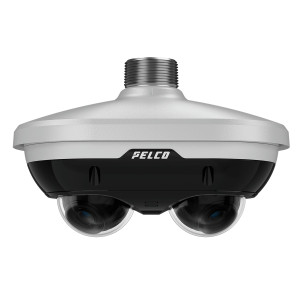
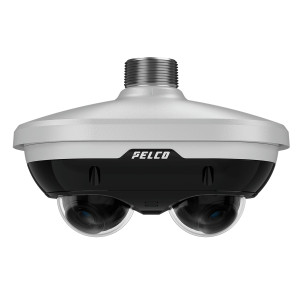
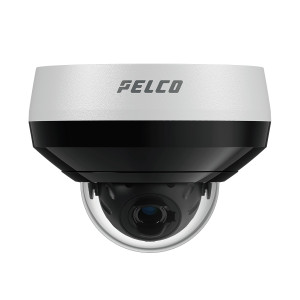
Pelco SBDE1-16V7-E2H-IR Sarix Enhanced Duo 16MP Dual-Sensor Camera
The Pelco SBDE1-16V7-E2H-IR is a professional dual-sensor IP camera delivering 16MP total resolution through two independent 8MP sensor heads mounted in a single outdoor-rated housing. This architecture lets you capture two distinct surveillance zones simultaneously from one network cable drop and power source — a significant infrastructure advantage when you need multi-area coverage without doubling your cabling, switch ports, or NVR licensing for separate single-sensor cameras.
Key Features
- Dual independent 8MP sensors with motorized 3.24-7.33mm varifocal lenses. Each head zooms and pans independently, so you can monitor a wide hallway on one sensor while keeping a narrow focus on an entrance on the other. No pan-tilt-zoom mechanics — just pure dual streams from one box.
- 30-meter integrated infrared illumination. Works 24/7 without ambient light. Covers typical corridor and loading dock distances; beyond 30m, supplement with external IR or assume daytime-only monitoring for that zone.
- 130 dB Wide Dynamic Range (WDR). Handles backlit entrances and mixed indoor-outdoor transitions where one sensor sees bright sunlight and another sees deep shadow. You won't need to manually adjust exposure between zones.
- H.265 and H.264 compression support. H.265 cuts storage requirements roughly 40–60% compared to H.264, depending on scene complexity — a real cost factor when running 24/7 dual 8MP streams. H.264 available as fallback for legacy VMS systems or bandwidth-constrained networks.
- PoE+ power (802.3at, 95.3W maximum). Single cable drop supplies both sensors and IR. No separate power supplies. Confirm your PoE+ switch has headroom; dual-sensor designs draw more than single-head cameras.
- ONVIF Profile S, T, and G compliance. Integrates with Milestone, Genetec, Axis Camera Station, and other ONVIF-certified VMS platforms. Avoids vendor lock-in and simplifies multi-camera deployments.
- IP66, IP67, and IP68 ingress protection with IK10 vandal rating. IP66 handles rain and dust; IP67 adds brief submersion tolerance; IP68 extends that further. IK10 resists deliberate physical attack. Choose mounting location accordingly — outdoor wall-mount works fine; submersed deployments require IP68 confirmation from engineering.
- Audio input and two-way audio support. Enables intercom functionality at entry points or loading zones. HTTPS encryption secures the audio stream.
- Operating range -40°C to +65°C. Handles Arctic cold-storage environments down to -40°C and heat-stressed industrial spaces up to +65°C. Verify thermal performance in your specific climate and mounting orientation.
- microSD card slot for local backup. Useful for edge recording when NVR connectivity drops; cards rated up to 512GB for extended retention on a single device.
- 5-year manufacturer warranty. Standard professional-grade coverage; does not cover user damage or misapplication.
Integration and Deployment Context
The SBDE1-16V7-E2H-IR belongs to the Pelco Sarix Enhanced Duo camera line, which also offers lower-resolution dual-sensor variants (5MP and 3MP per head). Choose 16MP when you need maximum detail for facial recognition, license-plate capture, or fine evidence review. Accept lower megapixel counts if bandwidth or storage budgets are tight; a 3MP dual-sensor model cuts throughput by roughly 75% compared to 16MP.
Plan your network video recorder and storage architecture assuming 16MP aggregate throughput — two simultaneous 8MP streams. VMS licensing typically bills per camera (one device = two streams), so confirm your software supports dual-stream licensing on a single physical camera before purchase.
For single-zone applications, consider single-sensor alternatives like the Sarix Pro 4 or Enterprise line; they eliminate dual-stream licensing overhead and reduce bandwidth to a single 4MP or 5MP stream, which simplifies smaller deployments.
Compliance and Security
NDAA Section 889 compliant, supporting U.S. government procurement and critical infrastructure projects. Signed firmware and secure-boot mechanisms protect against unauthorized code execution.
Frequently Asked Questions
Q: What is the actual megapixel output per sensor on the SBDE1-16V7-E2H-IR?
A: Each of the two independent sensors delivers 8MP resolution, for a 16MP aggregate. You record two simultaneous 8MP streams, not a single 16MP image.
Q: Does the SBDE1-16V7-E2H-IR work with Milestone XProtect or Genetec Security Center?
A: Yes. ONVIF Profile S, T, and G compliance ensures compatibility with any major VMS platform that supports ONVIF. Confirm with your VMS vendor that dual-stream licensing is available for this model.
Q: What is the maximum infrared range on the SBDE1-16V7-E2H-IR?
A: 30 meters (approximately 98 feet). Sufficient for typical indoor corridors and outdoor loading docks. Beyond 30m, you will need external infrared supplementation or daytime-only reliance.
Q: Is the SBDE1-16V7-E2H-IR rated for outdoor installation?
A: Yes. IP66, IP67, and IP68 ratings plus IK10 vandal resistance qualify it for outdoor wall or ceiling mounting. Verify that your mounting surface and bracket meet IP and vandal-resistance requirements as well.
Q: Does the SBDE1-16V7-E2H-IR support PoE+ power from a standard PoE switch?
A: Yes, it is PoE+ (802.3at) powered. Standard PoE (802.3af) is insufficient. Confirm your PoE+ switch has available budget; the camera draws up to 95.3W maximum, leaving limited headroom for other devices on the same switch port.
Q: What is the warranty period for the SBDE1-16V7-E2H-IR?
A: 5-year manufacturer warranty covers defects in materials and workmanship under normal operating conditions. Does not cover physical damage, misapplication, or environmental mishandling.
Ted PerryPerspective based on aggregated IP Security Depot and affiliated engineering team experience.
The Pelco SBDE1-16V7-E2H-IR solves a real problem: how to monitor two separate zones without running dual camera infrastructure. Most dual-sensor cameras are novelty pieces, but this one genuinely simplifies multi-zone deployments. The 16MP aggregate (8MP per sensor) is the highest resolution in the Sarix Duo lineup, so if you need readable faces or plate numbers across two independent coverage areas, this is your hardware.
Technical Highlights:
- Dual varifocal 3.24-7.33mm lenses: Each sensor independently zooms from wide (3.24mm, roughly 95° horizontal) to narrow (7.33mm, roughly 35° horizontal). This means you can deploy one head as a perimeter monitor and the other as a door/entrance detail camera without mechanical PTZ complexity.
- 130 dB WDR on both sensors: High-contrast scenes like a loading dock entrance (bright exterior, dark interior) don't saturate or crush one sensor while the other struggles. Both heads maintain usable detail simultaneously.
- H.265 compression reduces storage 40–60%: Running 24/7 dual 8MP streams over a year adds up fast. H.265 is not optional here if you're budget-conscious on storage; it's a necessity.
- 30m IR on both sensors: Adequate for most indoor/outdoor transition zones. Beyond 30m, external IR or supplemental lighting becomes non-negotiable.
- 95.3W max draw via PoE+: Single cable, but verify your PoE+ injector or switch has the headroom. Stacking multiple high-power cameras on one switch can trigger power-budget limits faster than you'd expect.
Deployment Considerations:
- Dual-stream VMS licensing: Most VMS platforms charge per camera, not per stream. One SBDE1-16V7-E2H-IR = two streams = one camera license. Confirm this detail with your VMS vendor before scaling beyond a pilot deployment.
- NVR storage math: Two simultaneous 8MP streams at 30 fps in H.265 will consume roughly 50–70 GB per day depending on scene complexity. Plan storage accordingly; the savings from H.265 are real, but a 16MP dual-sensor camera is not a lightweight recording load.
- Mounting rigidity: Dual-sensor heads are heavier and place more vibration/flex stress on brackets than single-sensor cameras. Use solid wall mounts and confirm bracket load ratings; wobble kills image quality on varifocal lenses.
The SBDE1-16V7-E2H-IR shines in warehouse/logistics environments where you need both perimeter and detail coverage from a single cable drop, or retail/banking entrances where interior and exterior monitoring must happen side by side. It is overkill for single-zone sites and a headache for VMS platforms that don't handle dual-stream cameras gracefully. Size your deployment carefully.
Key Specifications:
Color: White