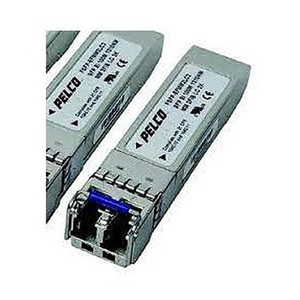
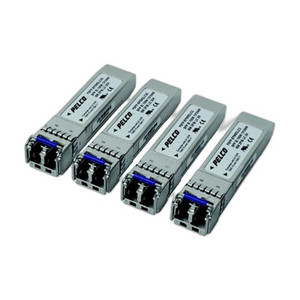
Pelco FSFP-EFSM2LC20 Fast Ethernet SFP Transceiver Module
Overview
The Pelco FSFP-EFSM2LC20 is a single-mode fiber SFP transceiver designed to extend Fast Ethernet (100 Mbps) surveillance camera feeds up to 20 kilometers over OS1/OS2 single-mode fiber infrastructure. Operating at 1310 nm wavelength with duplex LC connectors, this module solves a specific problem: when standard multimode fiber reaches its distance limit, you need single-mode range without replacing your entire network architecture. Campus perimeters, inter-building links, and remote satellite camera installations are where this module earns its cost.
Key Features
- 100 Mbps Fast Ethernet (100BASE-FX): Delivers sufficient throughput for standard-definition and lower-bitrate HD camera streams. At 100 Mbps, plan for roughly 1–3 simultaneous camera feeds depending on compression (H.264 vs H.265) and resolution. Multi-megapixel 24/7 recording to a central NVR over this link requires careful bitrate budgeting.
- 20 km Single-Mode Reach: Eliminates the 2 km practical limit of multimode fiber. Critical for sprawling industrial facilities, university campuses, or perimeter security where buildings or camera positions are separated by several kilometers of dark fiber.
- 1310 nm Wavelength: Standard for long-distance single-mode transmission; aligns with common carrier-grade fiber infrastructure and reduces cost of fiber lease or internal backbone provisioning compared to proprietary wavelengths.
- LC Duplex Connectors: Industry standard for security and telecom; ensures compatibility with most fiber termination panels and reduces field connector failures versus older SC or ST types. Verify your switch or media converter has LC-compatible SFP slots before ordering.
- OS1/OS2 Single-Mode Fiber Compatibility: Works with both OS1 (indoor plant) and OS2 (outdoor/underground) single-mode fiber. OS2 is more common for long runs; confirm your fiber plant standard before installation.
- NDAA Section 889 Compliant: No Chinese-origin concerns for federal or defense-adjacent installations. Matters if your customer list includes government agencies, critical infrastructure, or regulated sectors requiring domestic supply chain assurance.
- 5-Year Warranty: Pelco's standard warranty covers component failure and transceiver defects. Does not cover fiber damage, connector degradation, or link budget failures caused by poor splicing or bent fiber.
Integration & Compatibility
This FSFP-EFSM2LC20 module fits any switch or media converter with an open SFP slot rated for single-mode fiber. Check your device specifications—not all SFP slots are equal, and some switches auto-negotiate only multimode modules. Paired with a matching single-mode SFP transceiver on the remote end (camera site or central recorder), you form a point-to-point link. For longer campus deployments with multiple camera locations, consider cascading through fiber switches or media converters at intermediate points rather than star-wiring everything to one centralized switch.
Bitrate planning is essential. At 100 Mbps, a single high-resolution (5+ MP) camera streaming H.264 at 10 Mbps will consume 10% of your available bandwidth, leaving 90 Mbps for other traffic or additional cameras. Multistream recording, VMS traffic, and NMS polling eat into that margin. Use a network analyzer or your VMS bandwidth calculator before committing to this module for mission-critical links.
When to Choose a Different Module
If you require more than 100 Mbps—for example, multiple high-resolution cameras, redundant feeds, or mixed surveillance + access control + building systems traffic—consider a Gigabit single-mode SFP (1000BASE-LX or 1000BASE-ZX depending on range). Gigabit variants cost more upfront but eliminate bandwidth bottlenecks and future upgrades. For distances under 2 km or simpler deployments, multimode SFP modules are cheaper and sufficient.
Frequently Asked Questions
Q: Does the FSFP-EFSM2LC20 work with all network switches?
A: No. Your switch must have an available SFP slot designed for single-mode fiber transceivers. Most enterprise switches and media converters do, but budget surveillance-grade network devices (some ruggedized PoE switches) may not. Verify the switch datasheet lists SFP compatibility and single-mode support before purchase.
Q: What is the maximum distance for this module?
A: 20 kilometers over OS1/OS2 single-mode fiber. At very long distances, you may encounter signal attenuation if the fiber has poor splice quality or excessive bends. Most installations work reliably at 10–15 km; verify actual fiber plant condition with a light meter if distance is near the limit.
Q: Is this NDAA Section 889 compliant?
A: Yes. The FSFP-EFSM2LC20 is NDAA Section 889 compliant, meaning it does not contain banned Chinese-origin components. Suitable for federal, defense, and critical infrastructure projects with supply-chain requirements.
Q: Can I use this module for 100 Mbps video plus other network traffic?
A: Yes, but plan carefully. 100 Mbps is shared. A single 5 MP camera at 15 Mbps leaves 85 Mbps for access control, management, and redundancy. Run a network load test or ask your VMS vendor for bandwidth estimates before finalizing the design.
Q: Do I need matching transceivers on both ends of the link?
A: Yes. The FSFP-EFSM2LC20 must be paired with an identical or compatible single-mode 100BASE-FX transceiver on the remote end (typically in another switch, media converter, or camera encoder). Mismatched wavelengths or modes will cause link failure.
Q: What warranty does this module include?
A: Pelco provides a 5-year warranty covering the transceiver hardware and electronics. Warranty does not cover fiber-plant damage, splicing errors, or bent-fiber signal loss.
Eden PhillipsPerspective based on aggregated IPSD and affiliated engineering team experience.
The FSFP-EFSM2LC20 is a straightforward workhorse—it does one job and does it well: carries 100 Mbps surveillance traffic 20 km over single-mode fiber. If your network architect has already specified OS1/OS2 fiber for the long haul between buildings or to a perimeter camera cluster, this module eliminates the need for costly multimode-to-single-mode conversion or expensive long-haul media converters. The 1310 nm wavelength is standard carrier gear, which means spares are cheap and compatible transceivers from multiple vendors exist if you ever need redundancy.
Technical Highlights:
- 100BASE-FX at 1310 nm: Industry-standard long-distance wavelength; pairs with any carrier-grade single-mode SFP supporting the same spec. Means you're not locked into Pelco spares for remote-end transceivers if you buy from other vendors.
- 20 km reach on OS1/OS2: Practical limit for multimode is 2 km; single-mode buys you a 10x distance multiplier. For a 15 km inter-building link, you avoid a $3k–5k media converter array and just plug one transceiver into each switch.
- LC duplex connectors: Lower field failure rate than older SC/ST types. Most modern fiber plants and distribution panels already terminate LC, so no connector adapter tax.
Deployment Considerations:
- 100 Mbps is a shared pipe—multiple cameras, management traffic, and redundancy all compete for bandwidth. For a 5 MP camera at 15 Mbps, you have 85 Mbps left; that's tight if you're also running access control or a second surveillance feed on the same fiber.
- The module is passive (no power supply needed), but you must confirm your switch's SFP slot is rated for single-mode. Many budget PoE switches support only multimode slots—a datacenter switch will have both, but a field edge device might not.
Use this for campus or industrial multi-building perimeter surveillance where single-mode fiber is already in place or cost-justified. Overkill for co-located buildings; underpowered for multi-stream 4K workflows. Pair it with bitrate planning and a matching transceiver on the far end, and it will run trouble-free for years.