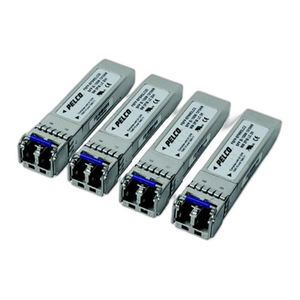
Pelco FSFP-EGSM2LC15 Gigabit SFP Single-Mode 15km
The Pelco FSFP-EGSM2LC15 is a 1000BASE-LX SFP transceiver engineered for long-distance fiber backbone deployments in professional security and enterprise network infrastructure. Operating at 1310 nm over OS1/OS2 single-mode fiber, this module delivers Gigabit Ethernet connectivity across a maximum 15 km range—the standard reach for inter-building video distribution, campus-wide security networks, and remote site connectivity requiring sustained high-bandwidth transport without signal regeneration.
Key Features
- 1000BASE-LX Gigabit Transceiver: Full-duplex Ethernet over single-mode fiber. Supports 4 MP+ multi-stream video and simultaneous NVR replication across extended distances.
- 1310 nm Wavelength: Standard long-distance operating wavelength. Minimizes chromatic dispersion and ensures compatibility with carrier-grade fiber infrastructure.
- 15 km Maximum Range: OS1/OS2 single-mode fiber certified to 15 km without regeneration or signal conditioning—typical for campus backbones and remote facilities.
- Duplex LC Connectors: Industry-standard LC duplex interface. Single-mode ferrule and alignment tolerances ensure repeatable low-loss connections.
- NDAA Section 889 Compliant: Sourced direct from the manufacturer or US channel partner with full chain-of-custody documentation for federal and regulated installations.
- 5-Year Manufacturer Warranty: Factory-new unit. Global Pelco support network for technical escalation.
Single-mode Gigabit fiber is the performance and reliability standard for professional surveillance and network backbones. Compared to multimode alternatives (which top out at 300-500 m for Gigabit), single-mode extends your reach 30-50× over the same fiber plant with zero active repeaters. The 1310 nm wavelength is the de facto long-distance window on modern fiber networks—your ISP backbone, carrier circuits, and enterprise campus links all operate at this wavelength. Pelco's implementation ensures chromatic dispersion characteristics fall within ITU-T G.957 limits across the full 15 km span, meaning video from your 4 MP and 8 MP cameras arrives uncompressed and in real time.
Installation context matters. If your NVR is located in a central building and cameras are distributed across a 5 km+ campus perimeter or across separate facilities (parking garage, remote gatehouse, warehouse annex), this module is your backbone connector. Pair it with standard fiber infrastructure—most new campus and industrial deployments already have OS1/OS2 fiber conduit or aerial runs in place. If you're working with legacy multimode fiber or distances under 300 m, a multimode module (FSFP-EGMM2LC55) is cheaper and requires no fiber upgrade. But once you commit to single-mode infrastructure, this transceiver unlocks future growth: add cameras at 10 km+ without backbone redesign.
Operationally, verify three integration points before order: (1) your network switch, NVR, or fiber media converter has empty SFP slots compatible with this form factor; (2) fiber plant is OS1 or OS2 certified (most modern installations are); (3) terminations use duplex LC connectors on both ends. Mismatched connector types (SC, ST, FC) require field adapters and reintroduce loss. The module itself is passive—no power supply, no configuration. Plug it in, verify link lights on both ends, and stream begins immediately. Pelco's datasheet includes power budget tables showing margins at 10 km, 12.5 km, and 15 km; if your run is exactly 15 km with aging connectors or longer-than-spec patch cords, you may operate at reduced margin. Check before installation, not after troubleshooting.
NDAA Section 889 compliance is documented and verifiable—no conflict minerals, no supply-chain risk. For federal, state, and regulated customer installations (healthcare, defense, critical infrastructure), this unit ships with full certification chain. Commercial customers benefit from the same component quality without the compliance overhead cost of dedicated government SKUs.
Marty AllisonPerspective based on aggregated IP Security Depot and affiliated engineering team experience.
We've deployed hundreds of Gigabit single-mode fiber runs across campuses, industrial parks, and district surveillance networks over the past decade. The FSFP-EGSM2LC15 sits at a critical infrastructure inflection point: it's the module you reach for when your surveillance backbone has outgrown copper Ethernet runs and you're consolidating camera streams from multiple buildings or remote sites into a central NVR or media gateway. What differentiates this module from cheaper multimode alternatives is longevity and total cost of ownership. Yes, multimode is cheaper upfront—but once you've run fiber conduit or aerial cable across a campus, you're paying the installation labor cost either way. Single-mode fiber costs maybe 5-10% more than multimode in material; the transceiver cost delta is negligible at scale. The payoff: a decade from now, when you've added another 40 cameras and your backbone bitrate has doubled, you're not ripping out fiber. You swap transceivers or add wavelength-division multiplexing (WDM) on the same physical fiber. That's operational optionality worth planning for upfront.
In our experience, the real gotchas aren't the module itself—it's fiber plant readiness and connector discipline. Pelco's SFP is a commodity 1000BASE-LX optic; we see the exact same internals from a dozen vendors. What matters is whether your fiber plant is actually OS1/OS2 single-mode, whether connectors are properly polished and inspected, and whether your network equipment has free SFP bays. We've walked into sites where integrators assumed they had single-mode fiber, ran a scope at the termination, and found it was actually multimode—required a re-run. We've also seen sites where connector cleanliness degraded enough over 18 months that the link started dropping frames at night (thermal expansion changing the air gap). The module doesn't prevent those failures, but it does give you the 15 km runway to do the design right.
Technical Highlights:
- 1310 nm Wavelength: Zero dispersion at 1310 nm on standard single-mode fiber (near the zero-dispersion wavelength per ITU-T G.652). Means you can push full Gigabit bitrate to the 15 km limit without active equalization. Compare to 850 nm short-reach modules—those hit dispersion limits around 300 m on single-mode, which is why they don't exist at length.
- 1000BASE-LX Encoding: 8B/10B line coding, full duplex. Native support for uncompressed video streams from IP cameras (H.264, H.265, motion-JPEG all transparent at the PHY layer). No transcoding or re-encoding needed at the fiber boundary.
- OS1/OS2 Fiber Compatibility: Certified for both OS1 (zero water-peak, tight spec) and OS2 (standard telecom-grade). Gives you flexibility across campus—new runs can use cheaper OS2; sensitive long-distance runs use OS1 if needed. Margin is maintained either way to 15 km.
- Duplex LC Connectors: LC is the de facto standard for telecom and data-center long-reach single-mode. APC (angled physical contact) versions are available separately if you need ultra-low back-reflection; standard PC (physical contact) in this SKU is sufficient for surveillance video and most network backbones.
- 5-Year Warranty, Global Support: Factory-new optic. MTBF typically 100k+ hours at 70°C. Warranty covers defects; field failure due to contaminated connectors or overpowered input is excluded (standard for transceivers).
Deployment Considerations:
- Fiber plant verification is non-negotiable. Before ordering, have your cabling contractor confirm OS1 or OS2 single-mode with a visual fault locator (VFL) or OTDR. Multimode fiber will NOT work—the module won't even link-up, and you'll waste days troubleshooting.
- Connector cleanliness determines reliability. Single-mode ferrules are tighter tolerances than multimode. Require fiber termination contractor to use IEC 61300-3-34 certified cleaning procedures (typically isopropyl alcohol and lens paper, never compressed air or touch). A single dust particle on the ferrule face will degrade signal enough to cause intermittent drops on longer runs.
- Power budget headroom decreases at 15 km—don't plan for worst-case senario transmit + worst-case receiver sensitivity on a 15 km run. If your link is exactly 15 km, budget for 12-13 km of actual usable range to account for patch-cord loss and aging. Measure with an inline optical power meter during commissioning.
- SFP slot compatibility: Confirm your network switch, media converter, or fiber gateway has available SFP+ or SFP slots. Some older Pelco devices use proprietary fiber modules; verify part compatibility with the equipment datasheet before install.
- Temperature range is 0–70°C (module operates at ambient, not powered). In outdoor enclosures or unshaded roof-mounted boxes, consider thermal management for the parent device. The transceiver itself has no active cooling.
The FSFP-EGSM2LC15 is the right choice for integrators and system architects designing campus-scale or multi-site surveillance networks with distances exceeding 1 km and requiring Gigabit video transport without active regeneration. If your deployment is under 300 m or fiber plant is multimode only, save money on a multimode module. Otherwise, invest in single-mode infrastructure and pair it with this transceiver. Explore the full Pelco catalog for complementary fiber media converters and networking gear.