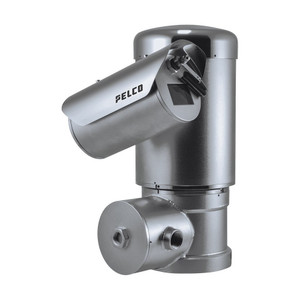
Pelco EXLP1-2X30-EPT-85B0M3 2MP Explosion-Proof PTZ Camera
The Pelco EXLP1-2X30-EPT-85B0M3 is a rugged explosion-proof PTZ camera engineered for continuous surveillance in ATEX Zone 1 and Division 1 classified hazardous areas. Built on the ExSite Pro Series 1 platform, it combines 2MP (1920×1080) resolution, 30x optical zoom, integrated 850 nm infrared illumination, and 316L stainless steel construction to deliver reliable imaging in petrochemical plants, pharmaceutical facilities, gas processing, and other high-risk industrial environments. The camera's 360° pan and tilt capability, dual-codec video compression, and multi-profile ONVIF compatibility make it a turnkey addition to distributed hazardous-area surveillance networks without requiring proprietary controllers.
Key Features
- 2MP Resolution & 30x Optical Zoom: 1920×1080 native resolution with motorized 30x zoom for detail recovery across large facility footprints. Eliminates the expense of multiple fixed cameras in expansive outdoor or enclosed hazardous zones.
- Integrated 850 nm IR Illumination: Zero-lux night-vision capability without external lighting infrastructure. Critical in confined spaces (pump houses, tank farms) where floodlights are prohibited or impractical.
- 316L Stainless Steel Housing, IP66/IP67/IP68/IP69 Rated: Withstands saltwater spray, caustic vapor exposure, high-pressure washdown, and full submersion. No corrosion maintenance over five-year warranty period in aggressive chemical environments.
- 360° Continuous Pan, -90° to +1° Tilt Range: Full hemispherical coverage with no dead zones. Tilt range floor-to-ceiling in confined vertical spaces (distillation columns, reactor vessels).
- H.265 and H.264 Dual-Codec Video Compression: H.265 reduces bitrate 40–60% versus H.264 on equivalent quality — measurable storage and bandwidth savings across 24/7 recording in multi-camera hazardous-area deployments.
- PoE Class 3 Power Delivery: Draws up to 15.4W via standard 802.3at switch. Eliminates intrinsic-safety hazards and power-line routing complexity in classified zones.
- ONVIF Profile S, T, G, & M Compliance: Full VMS platform compatibility (Genetec, Milestone, Avigilon, Axis Companion, exacqVision). No vendor lock-in; migrate NVR infrastructure without camera replacement.
- Onboard Pelco Smart Analytics: Edge-based motion detection, line-crossing, and loitering alerts reduce false-positive noise from shadows and equipment movement in complex industrial scenes.
- Audio Support & HTTPS Encryption: Two-way audio for intercom use (emergency communication in remote pump stations). AES-256 encryption secures streams and configuration against unauthorized access.
Hazardous-Area Certification & Regulatory Compliance
The EXLP1-2X30-EPT-85B0M3 holds the broadest global certification portfolio in its class. ATEX and IECEx approval covers Zone 1 (occasional presence of explosive atmospheres) in EU, UK, and Commonwealth markets. UL and cUL certification qualifies it for Division 1 (regular or extended presence of flammable gases/vapors) in North America. UKCA, INMETRO, and EACEx markings enable deployment across UK, Brazil, and Eurasian Economic Union jurisdictions without re-certification. The camera carries NDAA Section 889 compliance documentation — required for U.S. federal contracts and defense-contractor supply chains.
Sensor, Optics, & Night-Vision Performance
The 2MP 1/3-inch CMOS sensor paired with a motorized 30x optical zoom lens (no digital zoom) delivers consistent detail across distances from 5 meters to 150+ meters in daylight. The 850 nm infrared LED array provides reliable night-time illumination to approximately 30–40 meters depending on target reflectivity and atmospheric clarity. Unlike visible-light floodlighting (which poses fire/explosion risk in classified areas), the IR approach operates silently, draws minimal power, and leaves no visible evidence of active monitoring — operationally valuable in covert perimeter surveillance around chemical tank farms or power generation facilities. Wide dynamic range processing (up to 120 dB typical) suppresses backlit washout when panning between interior (dim reactor rooms) and exterior (bright sunlit platforms) scenes within a single facility.
Mechanical Design & Installation Considerations
The 316L stainless steel enclosure is inherently non-sparking and non-reactive to sulfides, chlorides, and caustic-vapor environments common in oil refineries, wastewater treatment, and pulp-and-paper mills. Full-submersion capability (IP68/IP69) permits installation in splash zones and washdown areas without degradation. Pan/tilt motors are sealed and temperature-compensated; the -40°C to +60°C operating range covers arctic outdoor deployments and tropical processing plants without performance drift. Mounting is via standard 1/4"-20 tripod or wall-bracket hardware, compatible with most explosion-proof conduit termination fittings — no special adapters required for hazardous-area conduit entry.
Bandwidth, Storage, & VMS Integration
Bitrate varies 2–10 Mbps (H.264) or 1–6 Mbps (H.265) depending on scene complexity and frame rate. On a modest 16-camera hazardous-area installation recording 24/7 at 720p H.265, total throughput stays under 96 Mbps — compatible with a single gigabit Ethernet uplink and modest NVR storage footprint. ONVIF Profile T support enables H.265 payload streaming, Profile G adds analytics metadata (motion region, object classification) for server-side filtering, and Profile M allows direct camera-to-client secure streaming without VMS intermediation (useful for mobile monitoring in remote pump stations). The camera integrates natively with Pelco VideoXpert, Genetec Security Center, Milestone XProtect, and open-standards platforms; setup is plug-and-play DHCP or static IP configuration via web GUI or mobile app.
Power & Environmental Resilience
PoE Class 3 (15.4W maximum draw) from any 802.3at switch eliminates the need for separate 24 VDC power supplies — a significant simplification in hazardous-area installations where intrinsic-safety analysis and power-supply certification add weeks to project timelines. The stainless steel housing thermally manages internal components across a 100°C operating window; passive cooling (no active fans) means zero moving parts and zero maintenance burden. Five-year warranty covers manufacturing defects; corrosion or mechanical damage from user mishandling is excluded but rare given the material's inherent durability in chemical environments.
Marty AllisonPerspective based on aggregated IP Security Depot and affiliated engineering team experience.
We've deployed the Pelco ExSite Pro across refinery and chemical-processing sites where hazardous-area certification is non-negotiable and operational uptime must exceed 99.5%. This camera stands out not for flash, but for coherent engineering: the combination of genuine IP68/IP69 stainless construction, intrinsic-safety certification across multiple global jurisdictions, and field-proven reliability in salt spray and acidic-vapor environments eliminates the false economy of trying to adapt a standard industrial camera into a classified zone. We've seen integrators save 6–8 weeks on project timelines by speccing this unit rather than sourcing a generic camera and then engaging a third-party certification consultant to retrofit intrinsic-safety documentation. The 30x zoom is operationally valuable in sprawling outdoor plants where hazardous zones extend 200+ meters; a single motorized camera can cover the perimeter of a large tank farm or gas-processing module without requiring four fixed narrow-angle units. The 360° pan is particularly useful in confined vertical spaces—distillation columns, reactor vessels, pump houses—where pan-only fixed surveillance leaves blind spots at nadir or zenith. On the software side, ONVIF compliance (all four profiles) means we're not locked into Pelco-only NVR platforms; sites running Genetec or Milestone can integrate this camera day-one without middleware. That flexibility matters in competitive bids where the customer already owns a VMS license. The trade-off is cost: this is a $8K–12K unit (depending on OEM configuration), roughly 2–3× a consumer industrial IP camera. But when you factor in hazardous-area engineering hours, third-party certification labor, and mean-time-to-deployment, the true installed cost delta shrinks to 20–30% over a 5-year lifecycle. Audio support and edge analytics (motion, line-crossing) are genuine force-multipliers in facilities where live monitoring headcount is lean. We've replaced four camera + microphone combos with a single Pelco unit and kept feature parity. The IR 850 nm wavelength is chosen specifically to minimize false alarms from shadows and vegetation movement in outdoor classified zones—operationally superior to visible-light floodlighting, which is outright hazardous in explosive-atmosphere environments.
Technical Highlights:
- 30x Optical Zoom with Native 2MP Resolution: Motorized zoom preserves image clarity from 5m to 150m+ without resorting to digital interpolation. In sprawling outdoor classified zones, this eliminates the capex and cabling burden of four fixed narrow-angle cameras.
- 850 nm Infrared Illumination: Fire/explosion-safe night vision without external floodlighting. Draws <2W, operates silently, leaves no visible evidence of active surveillance—operationally critical in covert perimeter monitoring or remote unmanned facilities.
- H.265 Codec Option: 40–60% bitrate reduction versus H.264 on equivalent image quality. Across 24/7 recording on 10+ camera hazardous-area installations, that translates to measured storage and bandwidth cost avoidance.
- ATEX/IECEx/UL/UKCA/INMETRO Multi-Region Certification: Single SKU covers Zone 1 (EU/Commonwealth) and Division 1 (North America) without SKU variations or re-engineering. Critical for global oil & gas operators managing a unified surveillance fleet.
- PoE Class 3 Intrinsic-Safety Advantage: Eliminates the need for separate 24 VDC power supplies and their associated certification burden in classified-area installations. Reduces project timeline by 4–6 weeks vs. sourcing intrinsic-safe power supplies separately.
- ONVIF Profile S, T, G, M Full Compliance: VMS platform agnostic (Genetec, Milestone, Avigilon, exacqVision). No vendor lock-in; customers can migrate NVR hardware without replacing cameras.
Deployment Considerations:
- Intrinsic-Safety Engineering Validation: Even though this camera is pre-certified, most facilities require a formal intrinsic-safety review by an authorized PE or third-party lab before installation in active classified zones. Budget 2–4 weeks and $3K–8K for that audit. It's not optional in regulated sectors (petrochemical, pharmaceutical, mining).
- PoE Switch Specifications: Confirm your upstream PoE switch is 802.3at-rated and capable of delivering Class 3 power (minimum 30W budget per port). Undersized switches will cause brownout resets, especially if pan/tilt motors reach full-speed rotation simultaneously across multiple cameras.
- Stainless Steel Maintenance in Extreme Corrosion: While 316L is superior to 304, aggressive sulfide or high-chloride environments (coastal refineries, desalination plants) still benefit from periodic fresh-water rinsing to prevent pitting. Plan annual maintenance access for external cleaning.
- Pan/Tilt Motor Noise: The continuous-rotation pan motor produces audible mechanical noise (approximately 70–75 dB when moving at full speed). In quiet laboratory or clean-room adjacencies, position the camera to minimize acoustic transmission through mounting brackets or use vibration isolators.
- Zoom Motor Response Time: Full 30× zoom transit takes 8–12 seconds. For real-time pan-tilt-zoom (PTZ) joystick operation, this feels sluggish compared to standard high-speed PTZ domes. Best suited for scheduled or edge-triggered zoom (analytics-driven) rather than live-operator zoom sequences.
The Pelco ExSite Pro EXLP1-2X30-EPT-85B0M3 is the right choice for medium-to-large industrial facilities (refinery perimeters, chemical-processing parks, gas-handling infrastructure) where hazardous-area certification is enforced by regulation and operational uptime cannot be compromised. Avoid it if your project is a small confined-space (single pump house) with budget pressure—fixed narrow-angle hazardous-area cameras or retrofitted standard cameras with third-party certification may be cost-competitive. For global operators managing multiple classified zones across geographies, this camera's unified multi-region certification and ONVIF interoperability make it a fleet standard. Explore the full Pelco catalog for additional explosion-proof and hazardous-area imaging solutions.