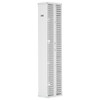
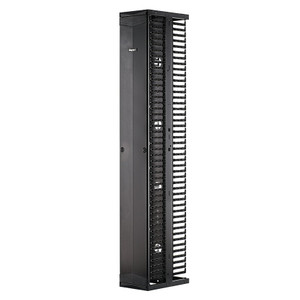
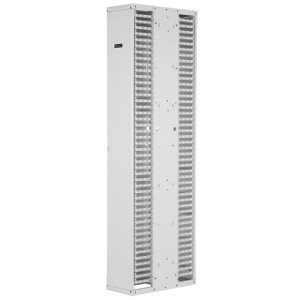
Panduit PR2VD1296WH PatchRunner 2 Vertical Dual-Sided Cable Manager
The Panduit PR2VD1296WH addresses the core challenge in high-density data center and telecom rack deployments: managing hundreds of Category 6A, fiber trunk, and power cables in limited vertical space without creating service bottlenecks or airflow restrictions. This 52RU dual-sided vertical manager delivers 24 inches of combined cable routing capacity (12 inches per side) in a single 12-inch-wide footprint, effectively doubling your cable management real estate compared to single-sided designs while consuming the same floor space. The fully pre-assembled construction eliminates field assembly time—mount the unit, swing open the dual-hinging doors, dress your cables, and close. No finger installation, no hardware sorting, no callbacks for loose components. For integrators billing T&M or working fixed-price rack builds, this translates to 2-3 hours of labor savings per rack versus finger-style managers that ship in pieces.
Key Features
- 52RU height spans full-height racks (95.88 inches / 2435mm) with continuous cable routing from top to bottom
- Dual-sided design provides independent front and rear cable pathways—ideal for separating network/fiber (front) from power/KVM (rear) or segregating production and management networks
- 12-inch width (304.8mm) fits standard 19-inch and 23-inch EIA racks with adequate clearance for door operation
- Metal backbone construction withstands repeated door cycling and cable pulling forces without flexing or sagging over service life
- Molded plastic fingers with rounded edges protect cable jackets during moves/adds/changes—no sharp metal edges that nick Category 6A or damage fiber buffering
- Dual-hinging push-to-close doors on both sides secure cables during transport or seismic events while allowing quick access without tools
- Factory-assembled design ships ready to mount—no field assembly of fingers, doors, or hardware required
- White finish matches common rack and cable tray color schemes in healthcare, education, and corporate data centers
- RoHS compliant, UL 2416 listed, and CSA C22.2 certified for North American electrical safety and material compliance
The PatchRunner 2 architecture uses a structural steel backbone with integrated mounting rails and finger retention channels. Each side features a full-length array of flexible plastic fingers spaced to accommodate standard patch cable bend radius requirements per ANSI/TIA-568. The fingers are molded from a semi-rigid polymer that holds cables in place under normal handling but flexes outward when you need to add or remove a cable mid-stack—eliminating the need to unlace an entire bundle to service one connection. The metal backbone provides the vertical load-bearing structure, so the assembly remains rigid even when fully loaded with 200+ cables and under the stress of technicians pulling bundles taut during dressing operations. This hybrid construction delivers the durability of all-metal managers with the cable-friendly handling of plastic designs.
The dual-hinging door system is where this manager separates from economy models. Each door uses a continuous piano hinge along the vertical edge and a push-latch mechanism at multiple points along the door height. Push the door to close—the latches engage automatically without requiring you to turn handles or thumb-screws at every latch point. This matters during initial rack builds when you're cycling doors open and shut dozens of times per rack as you dress cables in stages: pull slack, secure with Velcro, check port assignments, adjust, repeat. Thumb-screw latches slow you down and create repetitive-strain issues over a 20-rack deployment. The push-latch design also means the doors stay closed during rack transport from staging to the data center floor—you're not chasing loose doors or retightening hardware after every move. The doors are removable if you need unobstructed access for large connector terminations or re-cabling projects, then reinstall on the same hinges without realignment.
Deployment context: this manager is spec'd for 19-inch and 23-inch EIA-compliant racks, which covers the installed base from APC NetShelter and Chatsworth CPI racks to relay rack and two-post Panduit frames in telecom central offices. The 12-inch width is the practical maximum for racks installed in 24-inch-wide hot aisle / cold aisle rows—wider managers create door-swing interference with adjacent rack rows or require excessive aisle width. For integrators working in colocation facilities with standardized 42U or 45U racks, the 52RU height (designed for 48U or taller frames) ensures you have continuous vertical cable management from the bottom PDU rail to the top patch panel without gaps. The dual-sided design is particularly effective in end-of-row aggregation racks where you're terminating 10GbE or 40GbE uplinks on one side and distributing access-layer connections on the other—the physical separation reduces the chance of accidentally disconnecting a core uplink when servicing an access port.
Installation workflow: mount the manager to the rack using the supplied hardware (compatible with square-hole, round-hole, and threaded-hole rack rails). The unit ships as a single assembly, so you're lifting and aligning one piece rather than installing a mounting channel, then fingers, then doors in separate steps. Anchor at the top and bottom, then install intermediate mounting points at 10RU intervals for seismic compliance if required by local code. Once mounted, open both doors, dress your cables using the finger channels, and secure bundles with hook-and-loop straps at regular intervals (Panduit Pan-Ty or equivalent). Close the doors—the push-latches hold them shut without additional effort. For racks with cable entry from the top (overhead ladder rack) or bottom (raised floor), the full 52RU height provides continuous routing so you're not splicing into a mid-rack manager and creating a transition point that adds bulk and requires extra slack management.
The white finish is a practical choice for environments where rack aesthetics matter—corporate data centers with glass-wall NOC viewing areas, hospital server rooms visible from adjacent staff areas, or university data centers in occupied buildings. White matches common rack and cable tray finishes in these settings and provides better visibility for cable identification under standard fluorescent or LED lighting compared to black managers that absorb light. The finish is a baked powder coat over the steel backbone, resistant to chipping during cable installation and rack handling. For integrators managing color-coded cable plants (blue for network, yellow for fiber, red for KVM, etc.), the neutral white background improves visual contrast compared to black, making it easier to trace individual cables during troubleshooting or audit.
Compatibility note: the manager is designed for vertical mounting between two rack rails. It does not include horizontal cable routing—pair it with Panduit horizontal cable managers (such as the WMPF or WMPSE series) at each patch panel and switch location to create a complete pathway system. The 12-inch depth accommodates modern shielded Category 6A patch cables (thicker than Cat 6 or Cat 5e) and OM3/OM4 fiber trunks with standard LC or SC connectors. For high-density fiber applications using MTP/MPO connectors, verify that your trunk breakout length allows for the bend radius inside the manager—MTP-to-LC breakouts typically need 18-24 inches of slack, so plan your horizontal manager placement accordingly to avoid crushing the breakout zone.
The pre-assembled design also reduces the risk of missing hardware or incorrect finger installation—common issues with field-assembled managers that ship as kits. Every finger is factory-installed in the correct position and orientation. Every door hinge is aligned and lubricated. Every push-latch is tested for engagement before the unit ships. This matters for integrators working on fixed-price projects where a missing bag of screws or a misaligned door hinge costs you a truck roll and 2 hours of billable time that you can't recover. It also matters for projects with tight installation windows—data center cutovers, after-hours maintenance, or construction projects with occupancy deadlines. You're not troubleshooting assembly instructions at 2 AM; you're mounting, dressing, and closing.
UL 2416 and CSA C22.2 certification confirm that the materials and construction meet North American safety standards for cable management accessories in electrical environments. This is a requirement for installations in facilities with strict electrical inspection protocols—hospitals, government buildings, financial data centers, and any project requiring Authority Having Jurisdiction (AHJ) signoff. RoHS compliance addresses material content restrictions, particularly lead and cadmium in finishes and plastics—required for projects with environmental procurement mandates or installations in California, where Prop 65 disclosure rules apply. These certifications are not optional checkboxes; they're the baseline for professional-grade infrastructure.