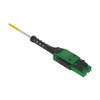
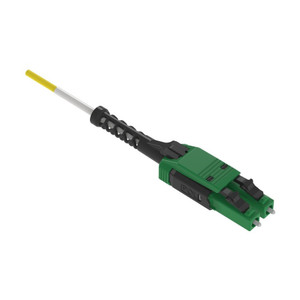
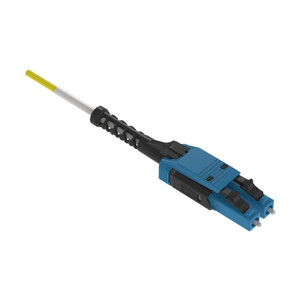
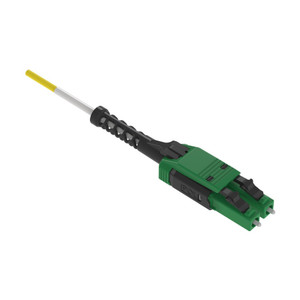
Panduit F92RLU2U2ONM020 Opti-Core OS2 Singlemode LC Duplex APC Uniboot Fiber Patch Cable
The Panduit F92RLU2U2ONM020 delivers 20 meters of OS2 9/125µm singlemode fiber in a space-saving LC duplex APC Uniboot design, purpose-built for high-density datacenter patching, long-reach telecom room interconnects, and enterprise structured cabling deployments where cable management density, low back-reflection, and code-compliant materials are non-negotiable. The pull-boot Uniboot connector design consolidates two fibers into a single compact boot, cutting patch-panel congestion by roughly 50% compared to traditional dual-boot duplex cables while the 2.0mm LSZH jacket meets plenum and riser code requirements without the bulk of 3.0mm constructions. Optimized insertion loss and factory-certified APC polishing make this cable the go-to choice for 10GBASE-LR, 40GBASE-LR4, and 100GBASE-LR4 links where return loss budgets leave no room for field-termination variability.
Key Features
- OS2 9/125µm singlemode fiber rated for distances up to 10km at 10Gb/s, 20 meters factory-terminated
- LC duplex APC connectors in pull-boot Uniboot housing for 50% space savings vs. dual-boot designs
- 2.0mm LSZH (Low Smoke Zero Halogen) jacket compliant with IEC 60332-1 and plenum/riser fire codes
- Optimized insertion loss spec ensures reliable link budgets in long-reach and cascaded patch scenarios
- Yellow cable jacket for instant visual identification of singlemode fiber paths
- TIA-568-C.3, ISO/IEC 11801, TIA-604-3 (FOCIS-3), TIA-604-10 (FOCIS-10), and RoHS compliant
- Factory-terminated and tested for consistent performance, certified insertion loss and return loss per cable
Uniboot connector design solves two persistent problems in high-density fiber patching: port congestion and polarity management. Traditional duplex LC patch cables use two separate boots—one for transmit, one for receive—occupying roughly 12mm of horizontal space at the adapter. The Panduit Opti-Core Uniboot consolidates both fibers into a single 6.5mm-wide boot, effectively doubling the usable port density on LC duplex panels and reducing the snagging risk when routing cables through congested vertical managers. The integrated pull-tab allows field polarity reversal without re-termination: a single tug swaps the A and B fibers inside the boot, critical when adapting to TIA-568 polarity methods A, B, or C mid-deployment or correcting transmit/receive mismatches during troubleshooting. APC (Angled Physical Contact) polishing cuts the fiber ends at an 8-degree angle, directing back-reflected light into the cladding rather than back toward the source—essential for high-bitrate protocols like 10GBASE-LR, 40GBASE-LR4, and 100GBASE-LR4 where return loss below -60dB is required to prevent bit errors and link flapping. APC connectors are not backward-compatible with UPC (Ultra Physical Contact) polished connectors due to the angle mismatch; mixing APC and UPC in a link causes physical damage to the connector endfaces and insertion loss spikes above 1dB. OS2 fiber meets the ITU-T G.652.D specification for singlemode fiber, with maximum attenuation of 0.4dB/km at 1310nm and 0.3dB/km at 1550nm; at 20 meters, intrinsic fiber loss is negligible (under 0.01dB), so total link loss is dominated by connector insertion loss and any intermediate adapters or splice points. This makes OS2 the correct choice for any link requiring bandwidth above 1Gb/s over distances beyond 300 meters—typical scenarios include rack-to-rack patching across datacenter rows (15–30m), building entrance facility to main telecom room (10–50m), and horizontal cross-connect to equipment room in large campus installations.
The 20-meter length fits a specific sweet spot in enterprise and datacenter structured cabling: long enough to span adjacent telecom rooms on the same floor, cross a raised-floor datacenter aisle with vertical pathway routing, or connect a building entrance terminal to a first-floor MDF, but short enough to avoid the coil-management problems of 30m+ cables when actual run distances fall closer to 15 meters. LSZH jacket construction is mandatory in European installations per CPR (Construction Products Regulation) Euroclass requirements and increasingly required in North American commercial buildings where cable is routed through air-handling spaces (plenum ceilings, under-floor HVAC plenums) per NEC Article 770. LSZH jackets produce significantly less smoke and zero halogenated acid gases (hydrochloric acid, hydrofluoric acid) during combustion compared to PVC, reducing toxic exposure risk during fire evacuation and minimizing corrosive damage to servers, switches, and cable infrastructure in adjacent spaces. The 2.0mm cable diameter—versus the 3.0mm standard on older duplex cables—reduces bundle cross-section by roughly 56% when patching 24- or 48-port LC panels, improving airflow through vertical cable managers and simplifying moves/adds/changes in congested patch fields. In blade server environments or high-density switch fabrics where 96-fiber or 144-fiber LC panels are common, the Uniboot + 2mm combination can reduce total patch-cable volume by 60–70% compared to legacy 3mm dual-boot designs, a measurable difference in airflow temperature deltas and cabinet power density limits.
Panduit Opti-Core factory-terminated assemblies undergo automated insertion loss and return loss testing at 1310nm and 1550nm wavelengths, with per-cable certification documents available for Tier 1 TIA-568-C.3 link compliance verification. Insertion loss is optimized through controlled ferrule geometry (endface radius of curvature, apex offset, fiber height) and factory-applied epoxy curing schedules, delivering typical connector losses between 0.15dB and 0.25dB per mated pair—significantly tighter than the TIA-568-C.3 maximum of 0.75dB and far more consistent than field-terminated connectors, which average 0.3–0.5dB with wider variability depending on technician skill and termination tooling calibration. Return loss on APC connectors exceeds -60dB (typical -65dB to -70dB), well above the -55dB minimum required for 10GBASE-LR and 40GBASE-LR4. For deployments requiring documented performance—financial trading floors, healthcare imaging networks, government/defense installations, or any project with formal acceptance testing per TIA-526-14 OFSTP-14 methodology—factory certification eliminates the field testing labor and re-termination rework cycles associated with installer-applied connectors, typically cutting fiber deployment time by 40–60% on projects with more than 100 fiber links. RoHS compliance ensures the cable meets EU Directive 2011/65/EU restrictions on lead, mercury, cadmium, hexavalent chromium, and brominated flame retardants, required for equipment sold or deployed in European Union member states and increasingly mandated by corporate procurement policies in North America for environmental supply-chain audit purposes.