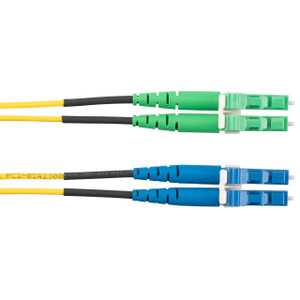
Panduit F91EL1NB1SNM010 Opti-Core OS2 Single-Mode Fiber Patch Cord
The Panduit F91EL1NB1SNM010 is a 10-meter OS2 single-mode fiber optic patch cord engineered for high-performance data center, telecom, and enterprise backbone installations. Terminated with LC Simplex on one end and LC/APC (angled physical contact) on the other, this 1.6mm LSZH-jacketed cable delivers the low insertion loss and minimal back reflection required for 10G, 40G, 100G, and emerging 400G optical links. Yellow jacketing follows TIA-598-C single-mode color standards, and the LSZH formulation meets EN 60332-1-2 flame-spread requirements for occupied spaces and air-handling pathways where PVC smoke and halogen emissions are restricted.
Key Features
- OS2 9/125μm single-mode fiber – supports transmission distances up to 10 km at 10 Gbps, 40 km at 1 Gbps, with headroom for 100G and coherent optics
- LC Simplex to LC/APC termination – APC's 8° angle cuts return loss to -60 dB typical, critical for DWDM, PON, and RF-over-fiber applications where back reflection degrades signal integrity
- 1.6 mm cable diameter – flex-friendly for dense patch panels and tight bend radii; boot fits standard LC duplex footprints without blocking adjacent ports
- LSZH outer jacket (EN 60332-1-2) – zero-halogen, low-smoke compound required by IBC, NFPA 90A, and most European building codes for indoor telecom risers and data halls
- Standard insertion loss spec – factory-tested to ≤0.3 dB typical, with <0.5 dB max guarantee, ensuring reliable link budgets on 10GBASE-LR, 40GBASE-LR4, and 100GBASE-LR4 optics
- Yellow single-mode jacket – TIA-598-C color code instantly identifies OS2 fiber in mixed-mode environments, preventing cross-patching errors that cause link failures
- 10-meter length – ideal for intra-rack, top-of-rack to aggregation switch, and adjacent-bay cross-connects where pre-terminated assemblies eliminate field splicing and fusion work
- Panduit Opti-Core quality – precision-polished ferrules, strain-relieved boots, and 100% factory IL/RL testing ensure out-of-box reliability on day one
Single-mode fiber is the backbone of every high-speed optical network, and the F91EL1NB1SNM010 addresses the three failure modes integrators encounter in production deployments: excessive insertion loss, catastrophic back reflection, and code violations. OS2 fiber's 9-micron core and 1310/1550 nm operating windows support attenuation under 0.4 dB/km, enabling 10 km runs at 10 Gbps (10GBASE-LR, 10GBASE-ER) and 40 km at 1 Gbps without inline amplification. The LC/APC termination on the destination end delivers return loss below -60 dB—ten times better than UPC polish—by angling the ferrule endface 8° to deflect reflected light into the cladding instead of back down the core. This matters acutely in DWDM systems, passive optical networks (GPON, XGS-PON), and distributed antenna systems (DAS) where even -40 dB return loss can destabilize lasers, corrupt FEC thresholds, or introduce multi-path interference. Integrators working with coherent 100G optics, analog RF transport, or bidirectional transceivers (BiDi, WDM-PON) will find APC termination non-negotiable; the Panduit F91EL1NB1SNM010 ships APC on the destination LC connector while keeping the source end UPC-compatible, allowing mixed-polish topologies without adapter mismatches or additional attenuators.
The 1.6 mm cable diameter strikes the practical balance between mechanical protection and density. Unlike 3 mm or 2 mm round cordage, 1.6 mm assemblies bend to 10× the cable diameter (16 mm radius) without kinking or microbending loss, a necessity in zero-U vertical patch managers and high-density breakout panels where routing space is constrained to 1.5–2 inches. The LC Simplex boot profile is narrow enough to fit single-row LC adapters on 7.5 mm centers—common in blade server fabrics and modular SFP+ arrays—without forcing you to leave every other port empty or resort to angled boots that complicate moves/adds/changes. Standard insertion loss certification (≤0.3 dB typical per connector pair, ≤0.5 dB maximum) is verified at Panduit's factory using calibrated test references at 1310 nm and 1550 nm; the included test report documents IL and RL for each jumper serial number, giving you auditable proof of performance for SOW acceptance and warranty claims. When your link budget allocates 1.5 dB for two patch cords (0.75 dB each end), a 0.3 dB measured loss leaves 1.2 dB margin—enough headroom to absorb a dirty connector, an aging transceiver, or a future splice without triggering BER alarms.
LSZH jacketing is the fire-code answer to PVC's chlorine and acid-gas emissions. When PVC burns, it releases hydrochloric acid vapor that corrodes electronics, obscures egress lighting, and poses acute respiratory hazards—why the International Building Code (IBC), NFPA 90A (air-handling spaces), and EN 50575 (CPR Euroclass) now mandate low-smoke, zero-halogen cables in occupied plenums, risers, and data halls. The F91EL1NB1SNM010's outer sheath is compounded from halogen-free polymers that self-extinguish per EN 60332-1-2 vertical flame testing and emit <0.5% HCl by mass, meeting the IEC 60754-1 halogen-content ceiling. This makes the cable code-compliant for installation above suspended ceilings (plenum-rated spaces), inside vertical telecom shafts (riser pathways), and within equipment rooms where building inspectors enforce NFPA 70 (NEC) Article 770. For hyperscale data centers and colocation facilities targeting LEED, BREEAM, or WELL certifications, LSZH cordage is often a green-building prerequisite; specifying F91EL1NB1SNM010 across your fiber plant eliminates the need to segregate PVC jumpers into dedicated conduit or J-hooks, simplifying both installation and future audits.
The 10-meter length maps directly to the 32.8-foot distances seen in top-of-rack to end-of-row aggregation switch runs, cross-aisle storage-area-network fabrics, and ODF-to-equipment patch fields where pre-terminated assemblies beat field fusion on cost, speed, and reliability. A fusion splice introduces 0.05–0.1 dB loss, requires a $15K splicer, takes 90 seconds per fiber, and demands OTDR verification; a Panduit pre-terminated jumper installs in under 10 seconds with a lint-free wipe and arrives factory-tested with serialized IL/RL documentation. The yellow jacket follows TIA-598-C single-mode color convention (yellow = OS2, aqua = OM3/OM4, orange = OM1/OM2), preventing the mode-mismatch failures that occur when a technician accidentally patches 850 nm multimode transceivers into 1310 nm single-mode fiber or vice versa. In mixed-mode environments—common in legacy campus networks migrating from OM3 to OS2—color-coding is the last line of defense against a $400 optic burnout or a Tier-1 application outage caused by a 30 dB link-budget shortfall. Opti-Core assemblies ship in cartons of ten, each individually bagged with dust caps on both connectors; the LC Simplex form factor is keyed to prevent upside-down insertion, and the push-pull boot design allows single-handed release even in back-to-back adapter plates where finger access is limited to 0.5 inches.
Panduit's Opti-Core line has been the go-to for enterprises and service providers who need insertion-loss predictability and APC polish consistency across thousands of jumpers. Every F91EL1NB1SNM010 assembly leaves the factory with IL measured on calibrated Tier-2 test equipment (per IEC 61300-3-4 and TIA-526-14A methodologies), RL verified using an optical return-loss meter, and endface geometry inspected under 400× interferometry to confirm the APC angle, apex offset, and fiber height meet IEC 61755-3-2 Zone-A criteria. This level of QC is why Panduit can warrant standard IL performance without requiring you to over-purchase premium-grade jumpers or build 1 dB of slack into every link budget. For integrators deploying 100GBASE-LR4 QSFP28 optics (1.5 dB typical link budget), 10GBASE-ER SFP+ modules (1.0 dB budget), or CWDM/DWDM mux/demux arrays (where 0.1 dB matters), the F91EL1NB1SNM010 delivers the insertion-loss consistency and return-loss floor that keeps bit-error rates below 10⁻¹² and eliminates the truck rolls caused by marginal jumpers that pass at commissioning but fail under temperature cycling or vibration.