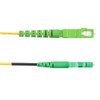
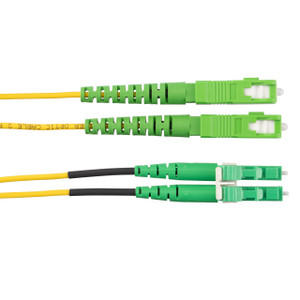
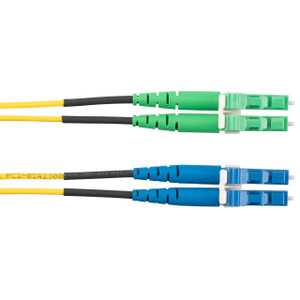
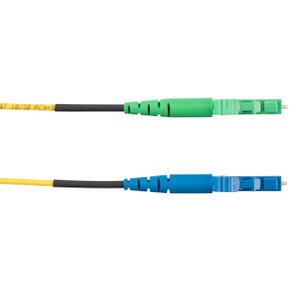
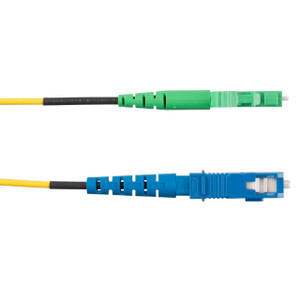
Panduit F91ELANB1SNM010 Opti-Core OS2 Single-Mode Fiber Patch Cord
The Panduit F91ELANB1SNM010 is a 10-meter OS2 single-mode fiber optic patch cord engineered for high-performance datacenter, campus backbone, and long-haul network applications where insertion loss, back-reflection control, and flame safety are non-negotiable. Built on Panduit's Opti-Core platform, this simplex jumper features factory-terminated SC/APC and LC/APC connectors with angled physical contact end-faces, a 1.6 mm tight-buffered yellow cable assembly, and LSZH jacketing compliant with EN 60332-1-2 flame propagation standards. Designed for installers running 10G/40G/100G Ethernet, Fibre Channel SAN links, or CWDM/DWDM transport systems, it delivers guaranteed standard insertion loss performance across 9/125 μm single-mode fiber at lengths suitable for intra-rack, cross-connect, or inter-building spans.
Key Features
- OS2 Single-Mode Fiber (9/125 μm): ITU-T G.652.D compliant core supports 10 Gb/s to 100+ Gb/s data rates over distances exceeding 10 km at 1310 nm and 40 km+ at 1550 nm, future-proofing datacenter and metro network builds
- SC/APC & LC/APC Connectors: Angled Physical Contact (8° end-face polish) on both simplex connectors reduces back-reflection to -60 dB or better, critical for high-speed coherent optics, PON deployments, and RF-over-fiber applications sensitive to return loss
- 1.6 mm Tight-Buffered Construction: Compact cable diameter and flexible bend performance enable high-density patching in shallow-depth panels, fiber distribution units, and zero-U cable managers without minimum bend radius violations
- LSZH Jacket (EN 60332-1-2): Low Smoke Zero Halogen outer sheath meets European flame propagation and toxicity standards for enclosed spaces, air-handling plenums (when used with appropriate cable pathways), and public assembly occupancies requiring reduced smoke and corrosive gas emission
- Standard Insertion Loss Rating: Factory testing and certification ensure each patch cord meets or exceeds TIA-568 and IEC 61300-3-4 maximum insertion loss limits, with full test reports available upon request for mission-critical fiber audits
- Yellow Industry-Standard Jacket: OS2 single-mode color coding per TIA-598-D simplifies fiber type identification during adds/moves/changes, preventing costly cross-connects between incompatible multimode and single-mode infrastructure
- Simplex 1-Fiber Design: Single strand configuration supports Bi-Directional (BiDi) transceivers, simplex monitoring taps, or point-to-point links where separate TX/RX fibers run on dedicated strands, common in structured cabling breakout applications
- 10-Meter (32.8 ft) Length: Ideal for row-to-row datacenter connections, cross-connect field jumpers, or equipment-to-patch-panel links where 3 m and 5 m cords fall short and 15 m+ lengths introduce unnecessary cable management complexity
- Panduit Opti-Core Quality: Manufactured under ISO 9001 quality systems with automated connector inspection, end-face geometry verification, and 100% insertion loss / return loss testing to ensure Day One performance and long-term reliability
- Factory-Terminated & Tested: Eliminates field termination labor, consumable costs, and the risk of contamination or poor polish geometry from on-site connector installation—each cord ships ready to deploy with protective dust caps installed
Single-mode OS2 fiber is the workhorse of modern datacenter and wide-area networks, offering modal bandwidth that effectively eliminates distance limitations within campus and metro environments while supporting current 100GBASE-LR4 and future 400GBASE-DR4 optics without fiber infrastructure replacement. The F91ELANB1SNM010's 9/125 μm core and cladding dimensions conform to ITU-T G.652.D specifications, delivering attenuation no greater than 0.4 dB/km at 1310 nm and 0.3 dB/km at 1550 nm—enabling multi-kilometer links with ample optical power budget margin even after accounting for connector pairs, splices, and passive optical splitters. The SC and LC connectors employ angled physical contact (APC) ferrule end-faces polished to an 8-degree angle, which directs Fresnel reflections into the cladding rather than back toward the transmitter. This design is essential for analog RF transport, CATV distribution, GPON/XGS-PON fiber-to-the-premises systems, and coherent 100G/400G DWDM links where back-reflection above -55 dB degrades bit error rate performance or trips laser safety interlocks. The SC connector—a push-pull 2.5 mm ferrule design—provides secure latching in patch panels and bulkhead adapters without the insertion force variability of threaded ST connectors, while the LC connector's small form factor (SFF) doubles port density in high-count fiber distribution units and switch faceplates compared to legacy SC duplex footprints. Both connectors feature ceramic ferrules with <0.3 μm bore concentricity tolerance and <50 nm end-face radius of curvature deviation, ensuring repeatable sub-0.2 dB mated insertion loss across temperature cycling and hundreds of connect/disconnect cycles per TIA-568.3-D durability requirements.
The 1.6 mm cable assembly uses a tight-buffered fiber architecture where the 900 μm secondary coating directly encapsulates the 250 μm primary-coated fiber without intermediate gel or loose-tube construction. This makes the jumper significantly more flexible and kink-resistant than distribution cables, with a minimum bend radius of 10× cable diameter (16 mm / 0.63 in) under no-load conditions—permitting routing through 1U horizontal cable managers, zero-U vertical organizers, and shallow-depth wall boxes without inducing macrobend attenuation spikes above 1550 nm. The outer jacket is compounded from LSZH (Low Smoke Zero Halogen) thermoplastic that releases less than 0.5% hydrogen chloride gas and produces smoke optical density below 0.5 when exposed to flame per EN 60332-1-2 vertical flame propagation testing. This formulation is specified throughout the EU for building cabling and increasingly adopted in North American healthcare, transportation, and critical infrastructure projects where life safety codes (NFPA 90A, IBC Chapter 8) mandate reduced toxic combustion products in air-return pathways and egress corridors. Note that LSZH jacketing alone does not confer plenum rating under UL 910 (OFNP); verify local AHJ requirements and consider pairing with plenum-rated innerduct or conduit when installing above suspended ceilings used for environmental air circulation. The yellow jacket color follows TIA-598-D Appendix A guidance designating OS2 single-mode fiber, preventing accidental cross-patching with aqua OM3/OM4 or lime OM5 multimode jumpers that would cause immediate link failure due to core diameter and modal bandwidth mismatch. This color-coding discipline is non-optional in converged fiber plants supporting both 850 nm VCSEL multimode links (10GBASE-SR, 40GBASE-SR4) and 1310 nm / 1550 nm single-mode transport—a mis-patch can appear to establish link on some transceivers but will exhibit catastrophic insertion loss (>15 dB) and fail within hours of deployment.
Panduit's Opti-Core manufacturing incorporates automated connector assembly with robotic epoxy dispensing, precision ferrule polishing, and interferometric end-face inspection to ISO/IEC 61300-3-35 (IEC-style) or ANSI/TIA-455-240 (SC/LC-style) standards, ensuring apex offset, fiber height, and radius of curvature meet Grade B or better geometry before the cord is packaged. Each jumper undergoes 100% insertion loss and return loss testing with results recorded in Panduit's traceability database—copies of individual test reports are available upon request for hyperscale datacenter acceptance testing, government contract compliance, or Tier III/IV datacenter certification audits requiring serialized component documentation. The standard insertion loss rating guarantees maximum 0.3 dB loss per mated connector pair (0.6 dB total for the cord assembly) when measured with calibrated reference-grade test equipment per TIA-526-7 / IEC 61280-4-1 Method B single-ended loss testing, providing headroom against the typical 0.15–0.25 dB field-measured values most installers observe with clean, properly mated connectors. This margin accommodates normal connector wear over the product's service life and ensures links remain within optical power budget when designed using conservative 0.75 dB per connection point assumptions common in TIA-568 Annex B worst-case channel models for 10GBASE-LR (10.3 dB budget) and 100GBASE-LR4 (6.2 dB budget) applications. The 10-meter length fits the gap between 5 m jumpers—often too short for top-of-rack to middle-of-rack spans—and 15 m cords that introduce unnecessary slack and cable management challenges in structured row-based datacenter layouts where cabinet spacing rarely exceeds 8 meters. Installers working in enterprise server rooms, colocation cages, or central office DWDM transport shelves will find this length optimal for cross-connect field jumpers linking passive fiber distribution panels to active switch ports, or for equipment-side patch cords running from rack-mounted media converters to overhead cable tray drop points.
Simplex 1-fiber patch cords serve specialized applications distinct from duplex 2-fiber assemblies: BiDi (bidirectional) SFP/SFP+ transceivers that use WDM multiplexing to transmit and receive on a single strand (1270 nm TX / 1330 nm RX, or vice versa), fiber monitoring systems employing optical time-domain reflectometry (OTDR) or optical return loss test sets requiring single-ended connections, and breakout applications where a 12-fiber trunk fans out to twelve simplex SC connections at a wall-mount enclosure for individual subscriber drops. The SC-to-LC connector combination is particularly common in hybrid patching scenarios: SC connectors predominate in legacy fiber distribution frames and outside plant termination panels installed before 2010, while LC connectors dominate modern high-density switch modules (Cisco Nexus 9000, Arista 7050X, Juniper QFX10000) and 10G/25G server NICs where QSFP28 breakout cables terminate to LC duplex. A simplex SC/APC-to-LC/APC jumper enables direct connection from an older SC-terminated backbone riser to a contemporary LC-based switch without requiring costly panel replacements or duplex adapter gymnastics. The angled physical contact polish on both ends maintains the low back-reflection performance critical when either end connects to PON OLT optics, externally modulated DWDM lasers, or erbium-doped fiber amplifiers (EDFAs) where reflected light can cause laser instability or amplified spontaneous emission (ASE) noise floor degradation. Standard (UPC) physical contact connectors polished perpendicular to the fiber axis exhibit -40 to -50 dB return loss, whereas APC connectors routinely achieve -60 to -65 dB—a 10–15 dB improvement that directly translates to higher receiver sensitivity margin and lower forward error correction overhead on coherent optical links operating near the Shannon limit. Installers must never mate APC and UPC connectors together; the 8-degree angle mismatch causes severe insertion loss (>1 dB) and potential ferrule end-face damage from the non-parallel contact surfaces, a mistake the yellow APC dust caps and green-colored APC adapter sleeves are designed to prevent through visual differentiation from blue UPC dust caps and standard beige/aqua UPC adapters.
The F91ELANB1SNM010 ships from Panduit in cartons of 10 patch cords (package quantity = 1 cord per sealed bag), with each connector protected by snap-on dust caps that must remain installed until the moment of deployment to prevent airborne particulate contamination of the ferrule end-face. Even a single 5 μm dust particle—smaller than a human red blood cell—can create a 0.5+ dB insertion loss spike and permanent ferrule scratching if trapped between mated connector faces, making end-face cleaning with lint-free wipes and isopropyl alcohol or purpose-built fiber cleaning cassettes (Panduit FOCCS-PKT) a mandatory step before every connection in production environments. Installers should verify adapter sleeve cleanliness with a fiber inspection scope (400× magnification minimum) and reject any adapter showing debris, oil residue, or cladding damage inside the 2.5 mm split-sleeve barrel. The LSZH jacket's reduced halogen content (<2000 ppm chlorine + bromine + fluorine) and flame-retardant filler system provide EN 60332-1-2 compliance without the plasticizer migration and UV degradation issues associated with legacy PVC compounds, but the jacket remains vulnerable to notching or abrasion if dragged across sharp rack edges or pinched in vertical cable manager doors—always use bend radius limiters and protective grommets at cabinet entry points to preserve the 1.6 mm cable's mechanical integrity over its installed life. For outdoor or industrial applications subject to moisture, temperature cycling beyond -20°C to +70°C, or UV exposure, Panduit offers armored and ruggedized patch cord variants; the F91ELANB1SNM010 is optimized for controlled-environment indoor installations typical of datacenter white space, telco central offices, and enterprise IDF/MDF rooms where HVAC maintains 18–27°C and relative humidity below 80% non-condensing per ANSI/TIA-569 pathway and spaces standards.
This Opti-Core patch cord integrates seamlessly into structured cabling systems designed to TIA-568.3-D and ISO/IEC 11801-1 standards, supporting permanent link and channel configurations where field-installed connectors (fusion spliced pigtails, mechanical splices, or adhesive/polish field terminations) on backbone cables mate to factory-terminated jumpers for the equipment and cross-connect cord segments. The OS2 fiber type is backward-compatible with older ITU-T G.652.A/B single-mode fiber installed in the 1990s and forward-compatible with emerging G.652.D low-water-peak specifications that extend usable wavelength range from 1260–1625 nm (E+S+C+L bands) for coarse and dense wavelength-division multiplexing applications, enabling a single fiber pair to carry 40+ lambda channels at 100G each—4+ Tbps aggregate capacity—without installing additional strands. Panduit's commitment to end-to-end fiber performance includes complementary products such as FMT cassettes and modules for high-density MTP-to-LC breakouts, FAP adapter panels and bulkheads with low-profile SC and LC configurations, and FQJ enclosures for wall-mount or rack-mount fiber distribution, all engineered to maintain the sub-0.3 dB insertion loss and sub-0.1 dB variability required for modern 100G and 400G optics operating with 2–6 dB total link budgets.