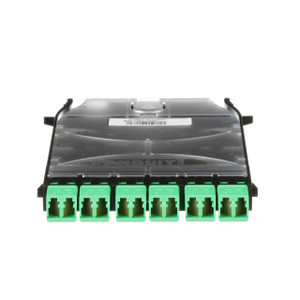
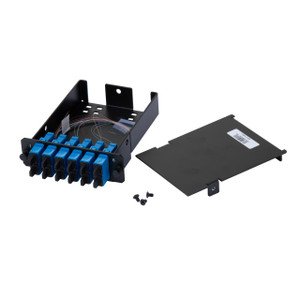
Panduit FCS9N-12-LAP Opticom® 12-Fiber OS2 Single-Mode Cassette
The Panduit FCS9N-12-LAP is a factory-terminated fiber cassette delivering twelve single-mode OS2 fibers in a plug-and-play steel enclosure designed for structured cabling deployments in enterprise edge closets, IP camera aggregation racks, and small-to-midsize data centers. One end ships with six LC Duplex APC connectors ready for immediate connection to 10G/40G/100G switches, media converters, or patch panels; the opposite end arrives unterminated for fusion splicing to your incoming trunk cable. This hybrid architecture eliminates field polishing on the connector side—removing insertion-loss variability and endface contamination risk—while preserving splice flexibility on the trunk side for landing ribbon cables, loose-tube assemblies, or breakout furcation kits. The steel cassette housing integrates fiber management, splice tray retention, and bend-radius protection in a compact module compatible with Panduit FHD series enclosures and standards-compliant 19-inch rack housings. For integrators running IP surveillance backhauls, storage-area networks, or inter-building links where OS2 reach and APC return-loss performance are non-negotiable, the FCS9N-12-LAP provides a field-proven balance of installation speed and long-term optical reliability.
Key Features
- Twelve 9/125 μm OS2 single-mode fibers (ITU-T G.652.D compliant) rated for 10GBASE-LR, 40GBASE-LR4, 100GBASE-LR4, and coherent optics at distances exceeding 10 km per duplex link
- Factory-terminated LC Duplex APC connectors on one end—typical insertion loss ≤0.25 dB, return loss ≥60 dB per TIA-604-10-C (FOCIS-10) APC polish specifications
- Unterminated 900 μm tight-buffered pigtails on splice end, color-coded per TIA-598-C for fusion or mechanical splicing to 12-fiber trunk cable
- Steel cassette housing with integrated splice tray—accommodates fusion splice protectors, heat-shrink sleeves, or mechanical splice bodies while maintaining ≥30 mm bend radius throughout routing path
- Black powder-coat finish; designed for Panduit Opticom® FHD fiber housings (1U/2U/4U) and universal rack-mount fiber enclosures following de facto cassette form factor
- Six duplex single-mode circuits in compact module—supports parallel 10G uplinks, redundant paths, or mixed-rate deployments (1G/10G/25G) on common infrastructure
- Sub-brand: Panduit Opticom® fiber system—engineered for interoperability with Opticom panels, adapters, trunk assemblies, and pre-terminated MTP/MPO solutions
- UPC 61305676513 for asset tracking in DCIM platforms; ships ten cassettes per carton with individual protective packaging to prevent fiber endface contamination during storage
Single-mode OS2 fiber remains the backbone choice for IP surveillance aggregation, inter-building links, and storage-area networks where reach exceeds multimode OM3/OM4 distance limits (typically 300–400 meters at 10G) or where future migration to 40G/100G coherent optics is anticipated. The FCS9N-12-LAP removes field-polishing risk from the customer-facing connector end: LC Duplex APC connectors arrive pre-polished to 8° angled geometry, ensuring return loss exceeds 60 dB—a critical threshold when feeding directly into SFP+, QSFP+, or QSFP28 optics that are intolerant of back-reflection. APC polish directs reflected light out of the fiber core, protecting laser transmitters from noise and preventing bit-error-rate degradation in long-haul or high-speed links. The unterminated tail grants splice flexibility; whether you are landing a 12-strand ribbon from a campus backbone, a loose-tube cable from a building entrance facility, or a breakout assembly from an outdoor OSP run, fusion splicing to the cassette's color-coded 900 μm tight-buffered pigtails is straightforward and yields typical splice loss below 0.1 dB per junction when executed with a core-alignment fusion splicer and proper cleaving technique.
The steel enclosure is engineered as a fiber-routing and splice-protection platform, not merely a mechanical shell. Internal guides enforce the 30 mm minimum bend radius mandated by TIA-568.3-D and ISO/IEC 11801-1 throughout the cassette, preventing macrobending loss (signal attenuation from excessive fiber curvature) even under full cable-loading conditions. The integrated splice tray secures up to twelve fusion splices with retention clips compatible with 40 mm or 60 mm heat-shrink protection sleeves; alternatively, the tray accepts mechanical splice bodies (Panduit FSMC series or equivalent) for field repairs without fusion equipment. In live environments where vibration from HVAC systems, airflow turbulence in hot aisles, or accidental contact during adjacent rack work is a concern, steel rigidity outperforms polymer alternatives—the housing will not deform under typical rack-mount compression or side-load forces, and the black powder-coat finish resists corrosion in HVAC-adjacent spaces, light-industrial areas, or coastal installations with elevated humidity. Cassette dimensions conform to the industry-standard form factor adopted by structured cabling vendors, ensuring drop-in compatibility with Panduit FHD fiber housings (models FHE1U, FHE2U, FHE4U) as well as third-party enclosures from Leviton, Corning, CommScope, and others that follow the same mounting-hole pattern and depth envelope.
Installation workflow: the integrator mounts the cassette into the fiber enclosure's sliding tray or fixed panel, routes the unterminated pigtails to the splice tray area, and brings the incoming 12-fiber trunk cable into the enclosure through a strain-relief grommet or bulkhead entry. Fusion splicing proceeds fiber-by-fiber or ribbon-style (if the trunk is a 12-fiber ribbon and your splicer supports ribbon mode), matching colors per TIA-598-C (blue, orange, green, brown, slate, white, red, black, yellow, violet, rose, aqua). After splicing, protect each junction with a 40 mm heat-shrink sleeve (recommended for outdoor-rated or plenum trunks) or a 60 mm sleeve (for added mechanical strength in high-vibration environments), then secure the protected splices into the cassette's splice tray using the integrated retention clips. Close the cassette cover, dress excess fiber slack into the enclosure's cable-management fingers, and patch the LC Duplex connectors to your switch or media converter using standard LC-LC single-mode duplex patch cords. Total installation time for a skilled technician, including fusion splicing and testing, typically runs 45–60 minutes per cassette when working with ribbon cable, or 90–120 minutes for loose-tube assemblies requiring individual fiber breakout and management.
Deployment context: this cassette fits IP camera networks that aggregate PoE switches over fiber backhaul—imagine a parking-structure edge closet with eight 24-port PoE+ switches feeding 180 cameras back to a core network operations center via a pair of 40GBASE-LR4 uplinks. You would deploy two FCS9N-12-LAP modules (one for transmit wavelengths, one for receive, consuming four fibers per 40G duplex pair) with the remaining fibers reserved for future 10G out-of-band management links or redundant paths per campus resilience standards. Similarly, enterprise IT teams use these cassettes in intermediate distribution frame (IDF) fiber distribution: a 12-fiber OS2 trunk from the main distribution frame (MDF) lands in the IDF closet, splices into the cassette's unterminated end, and the LC side patches directly into top-of-rack switches, eliminating the need for field-installable connectors and the associated insertion-loss variability that comes from handheld polishing. AV integrators running 10G video-over-IP backbones for 4K multi-screen displays, LED video walls, or broadcast studio infrastructure also rely on OS2 cassettes when HDMI-over-fiber extenders, SDVoE encoders, or SMPTE 2110 IP video gateways require single-mode uplinks beyond the 300-meter OM4 multimode limit. In storage-area network (SAN) deployments, particularly those using 16G/32G Fibre Channel or NVMe-over-Fabrics, the cassette's APC connectors and low insertion loss ensure that link budgets remain within transceiver specifications even after accounting for patch-cord loss, connector mating loss, and splice loss across the end-to-end optical path.
Testing and acceptance: after installation, verify each duplex circuit using an optical loss test set (OLTS) at both 1310 nm and 1550 nm wavelengths per TIA-526-7 single-tier or TIA-526-14 two-tier test methods. Acceptable total channel loss for a cassette-based link (including trunk cable, fusion splices, cassette insertion loss, and patch cords) should remain below 1.5 dB for distances under 500 meters, or below 2.5 dB for campus backbone runs up to 2 kilometers. Return loss measured with an optical time-domain reflectometer (OTDR) should exceed 50 dB across the link; the cassette's APC connectors alone contribute ≥60 dB return loss, so any measurement below 50 dB indicates a dirty or damaged connector, a poor fusion splice, or an improperly mated patch cord requiring rework. Document test results in your as-built fiber records, noting cassette serial number (if labeled), splice-tray location within the enclosure, and port assignment on the LC adapter panel for future troubleshooting and adds/moves/changes. The FCS9N-12-LAP's factory test reports (available from Panduit upon request) provide baseline insertion-loss and return-loss values for each LC connector, enabling you to distinguish field-induced issues from factory variances during acceptance testing.
Comparison to alternatives: integrators often weigh cassettes against fully pre-terminated trunk assemblies (sometimes called "plug-and-play" or "rapid-deploy" trunks) that ship with connectors on both ends. Pre-terminated trunks eliminate all field splicing but require precise length measurement and restricted routing paths—if your actual pull distance differs from the ordered cable length, you must coil excess slack or abandon the assembly. The FCS9N-12-LAP hybrid approach (factory connectors on one end, splice tail on the other) tolerates length variability: you pull the trunk cable to match actual conduit runs, cut to length in the enclosure, and splice. This flexibility is critical in retrofit projects where as-built drawings are outdated, in multi-floor vertical risers with unpredictable distances between telecom rooms, or in outdoor campus links where conduit depth and bend counts affect final cable length. Additionally, cassettes support ribbon-to-loose-tube or ribbon-to-breakout transitions that pre-terminated assemblies cannot accommodate without expensive custom fanout kits. For greenfield data centers with precise CAD models and controlled cable paths, pre-terminated trunks offer faster deployment; for retrofit, campus, or IP surveillance projects with routing uncertainty, cassettes deliver superior adaptability without sacrificing connector quality on the active-equipment side.
Compliance, standards, and warranty: the cassette's OS2 fiber meets ITU-T G.652.D specifications (chromatic dispersion ≤18 ps/nm·km at 1550 nm, attenuation ≤0.4 dB/km across the C-band), which underpins vendor-neutral interoperability with 10G/40G/100G optics from Cisco, Arista, Juniper, Dell, HPE, and transceiver vendors following MSA (multi-source agreement) standards. APC polish is the mandated connector geometry for passive optical LAN (POL) architectures per IEEE 802.3ah/av, for GPON/XG-PON deployments, and for many single-mode duplex links feeding coherent DWDM or CWDM optics where return loss below −50 dB would cause laser instability. The black cassette finish and steel construction align with NFPA 75 and ASHRAE TC 9.9 thermal-management guidance for rack environments, and the 900 μm tight-buffered pigtails carry plenum or riser flame ratings depending on trunk-cable selection (verify trunk cable jacket rating matches your installation's NEC Article 770 requirements). Panduit backs the Opticom line with a manufacturer warranty covering material and workmanship defects; the cassette ships in cartons of ten with each unit individually bagged to prevent fiber endface contamination during warehouse storage, staging, and transport to job sites. The UPC barcode (61305676513) integrates with inventory-management and DCIM platforms for lifecycle tracking, and Panduit's technical support provides connector endface inspection guidance, splice-loss troubleshooting, and interoperability confirmation for third-party trunk cables or enclosures when needed during deployment.