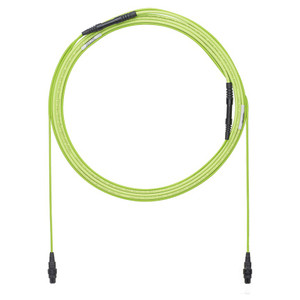
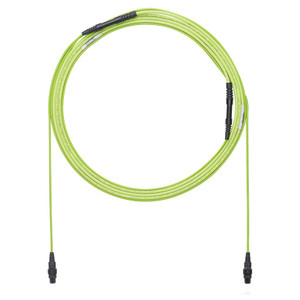
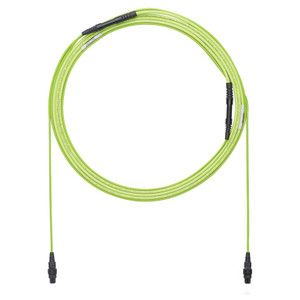
Panduit FWTYL7575LNM020 QuickNet OM5 12-Fiber Trunk Cable Assembly
The Panduit FWTYL7575LNM020 is a 20-meter OM5 trunk cable assembly engineered for high-density datacenter environments where space constraints and rapid deployment timelines intersect. Built on Panduit's QuickNet platform, this 12-fiber trunk uses PanMPO female-to-female connectors with HD Flex cable construction to deliver ultra-low insertion loss across all twelve fibers while consuming 30-40% less pathway space than traditional trunk assemblies. Method B polarity ensures straight-through compatibility with standard duplex breakout architectures. The LSZH jacket meets IEC 60332-3 flame propagation requirements for enclosed spaces without releasing corrosive halogen gases during fire events—a non-negotiable specification for insurance compliance in occupied buildings and critical infrastructure.
Key Features
- OM5 50/125 μm multimode fiber supporting 100G/200G/400G Ethernet over extended distances via shortwave wavelength division multiplexing (SWDM)
- 12-fiber PanMPO female-to-female connectors with ultra insertion loss grade (≤0.35 dB typical per mated pair)
- HD Flex cable design reduces bend radius to 7.5mm for high-density horizontal pathway fills and tight turns in overhead ladder rack
- Method B polarity configuration provides key-up-to-key-down orientation for direct connection to array modules and duplex breakout cassettes
- Low Smoke Zero Halogen (LSZH) jacket rated for plenum-equivalent installations in Europe, Asia-Pacific, and U.S. federal facilities requiring zero-halogen specifications
- Factory-terminated and tested to TIA-568-C.3 insertion loss limits with serialized test reports included in each package
- 20-meter length bridges typical datacenter row-to-row distances (equipment row to EOR/MOR aggregation switches) without requiring mid-span splice points
- Lime green cable jacket provides instant visual identification of OM5 infrastructure per TIA-598 color coding standards
OM5 fiber represents a generational upgrade from OM4 for organizations planning 400G spine deployments or future-proofing 100G access layer builds. While OM4 supports 100GBASE-SR4 to 100 meters using parallel optics, OM5's optimized modal bandwidth at 850/880/910/940 nm wavelengths enables SWDM transceivers to deliver 100G over duplex fiber (not quad) or push 400G to 150 meters using BiDi optics—effectively doubling usable reach compared to OM4 at the same speed grade. This trunk's ultra insertion loss grade further extends those distances by minimizing optical power budget consumption at each connection point. In a typical three-tier architecture (spine-leaf-ToR), the 0.35 dB connector loss plus 20-meter fiber attenuation (~0.06 dB) leaves 18+ dB margin for 100G links, allowing for dirty connections, aging fiber, or temperature-related power fluctuations without triggering transceiver resets. The PanMPO connector uses Panduit's enhanced ferrule geometry to maintain <0.5 μm average offset across all twelve fibers—critical when you're troubleshooting intermittent bit errors on a single lane within a 12-fiber trunk and need to isolate whether the issue is mechanical (connector/ferrule) or optical (fiber/transceiver). The connector endfaces are factory-polished and inspected per IEC 61300-3-35 standards, eliminating the field labor and certification time associated with field-terminated solutions.
The HD Flex cable construction uses a reduced-diameter central strength member and thinner buffer tubes to achieve a 5.5mm overall cable diameter—roughly 35% smaller than standard 12-fiber distribution cable. For a 42U rack with 1 RU horizontal cable managers every 4U (10 managers total), this diameter reduction translates to fitting 48 trunks in a 2-inch depth manager versus 28 trunks with conventional cable, directly impacting your ability to scale leaf switches from 24-port to 48-port configurations without reworking the entire row's cable management infrastructure. The 7.5mm minimum bend radius supports direct 90-degree turns off the back of switch MPO ports into vertical managers, eliminating the service loop slack that accumulates in standard 25mm bend-radius designs. On a 48-port leaf switch (4×12-fiber MPO uplinks), you save approximately 18 inches of depth per rack by removing those service loops—enough to fit 48-port switches in racks with rear-door heat exchangers or offset rear rails. The Method B polarity is wired key-up (transmit on fibers 1-12) to key-down (receive on fibers 1-12 at opposite end), which directly maps to Cisco/Arista/Juniper switch port transmit/receive pin assignments when using TIA-568 Method B duplex breakout cassettes. If you're running 40G or 100G SR4 optics (which expect parallel transmit on fibers 1/2/3/4 and receive on 5/6/7/8), this trunk connects to a Method B breakout cassette without requiring polarity-swap modules or field re-pinning—critical when you're standing on a ladder at 2 a.m. troubleshooting a failed uplink.
The LSZH jacket is rated for plenum-equivalent installations under IEC 60332-3 Category C vertical flame propagation tests and meets EN 50267 and EN 50268 for zero-halogen acid gas emissions. While U.S. National Electrical Code doesn't explicitly require LSZH in air-handling spaces (preferring CMP rating), federal agencies (DoD, VA, GSA) and international projects routinely mandate zero-halogen cable in all occupied buildings to prevent hydrogen chloride gas release during thermal events—HCl gas corrodes electronic components, contaminates HVAC ductwork, and poses acute respiratory hazards during evacuation. If your datacenter design includes hot-aisle containment with in-row cooling (air stays in the containment envelope rather than mixing with room air), building officials in jurisdictions adopting IBC amendments or NFPA 75 appendices may classify that space as a plenum, requiring either CMP or LSZH cable regardless of the overhead pathway rating. This trunk's LSZH rating covers both scenarios without requiring separate SKU procurement. The 20-meter length handles typical row-to-EOR distances in 12-rack pods (6 racks per side, EOR switch centered at rack 3/4) where ToR-to-EOR cable runs span 8-12 meters horizontally plus 4-6 meters of vertical rise, leaving 2-4 meters for dressing and service loops. Panduit's factory testing certifies insertion loss across all twelve fibers and provides a serialized test report in each package, giving you auditable documentation for ISO 9001 acceptance testing or warranty claims without requiring field OTDR verification on every trunk—field testing is still recommended for final link certification, but factory IL reports let you defer that work until after the entire row is cabled, reducing the number of truck rolls and specialized test equipment rental days.