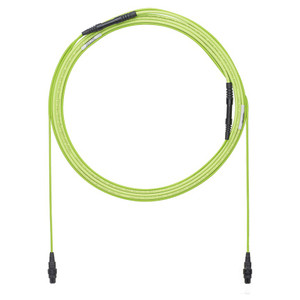
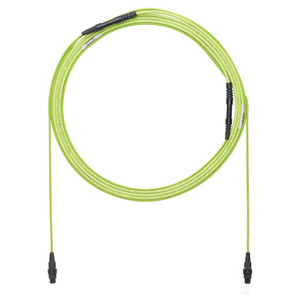
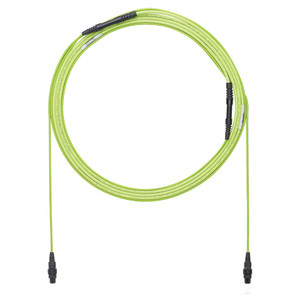
Panduit FWTYL7575LNM006 QuickNet OM5 12-Fiber Trunk Cable Assembly
Pre-terminated OM5 trunk cable engineered for 100G/400G datacenter infrastructure requiring rapid deployment with extended reach. Twelve 50μm wideband multimode fibers terminated with PanMPO female connectors on both ends deliver polarity-correct connectivity in a single pull. HD Flex small-diameter construction reduces pathway congestion by 30-40% compared to standard trunk assemblies, critical when you're maxing out overhead ladder rack or filling vertical cable managers in 42U spine-leaf builds. Method B polarity matches TIA-568 structured cabling standards for duplex LC breakout compatibility. Low smoke zero halogen jacket meets IBC plenum requirements without the cost premium of traditional plenum-rated cable. Ultra insertion loss spec ensures margin for 400GBASE-SR8 links operating at OM5's full 440-meter reach. Six-meter length suits typical top-of-rack to end-of-row switch runs in 45-48U racks with overhead distribution.
Key Features
- OM5 wideband multimode fiber (50/125μm) supports 100GBASE-SR4, 400GBASE-SR8, and emerging short-wave WDM protocols without re-cabling
- PanMPO female-to-female connectors with push-pull retention enable single-operator installation in zero-U horizontal cable managers
- HD Flex small-diameter trunk construction (30-40% space reduction) maximizes airflow in hot-aisle containment and high-density switch deployments
- Method B polarity delivers straight-through duplex connectivity when used with Method B cassettes or breakout harnesses
- LSZH jacket produces 60% less smoke and zero halogen acid gases during fire events, meeting European EN 50575 CPR and North American building codes for critical infrastructure
- Ultra insertion loss rating (typically <0.25 dB per connector) preserves optical budget on multi-tier spine-leaf fabrics with six or more interconnects
- Factory-terminated and tested assembly eliminates field polishing, epoxy cure time, and connector yield loss on job sites
- Lime-green OM5 jacket color provides instant visual identification in mixed-generation fiber plants (OM3/OM4/OM5 coexistence)
OM5 Wideband Multimode Architecture: Panduit's OM5 fiber extends multimode reach to 440 meters at 100 Gb/s (4×25G lanes) and 150 meters at 400 Gb/s (8×50G lanes) when deployed with 850nm VCSEL transceivers. The wideband design supports short-wave division multiplexing (SWDM) protocols that use four wavelengths (850/880/910/940nm) across a single fiber pair, delivering 100G over duplex LC connections without parallel optics. This matters when you're planning a five-year refresh cycle—current 100G-SR4 deployments migrate to 400G-SR8 or 200G-SWDM without trunk replacement, protecting the structured cabling investment. The 50μm core diameter maintains laser-optimized modal bandwidth (>3500 MHz·km at 850nm) while reducing differential mode delay, critical for error-free transmission on QSFP-DD and OSFP optics operating at 53.125 Gbaud PAM4 signaling. Panduit's manufacturing process controls core concentricity to ≤0.5μm and cladding diameter to ±0.7μm, ensuring <0.15 dB mated-pair insertion loss when connecting to standards-compliant MPO interfaces.
PanMPO Connector System: The female PanMPO terminations on both ends of this trunk integrate Panduit's push-pull housing with metal guide pins (removable) for alignment during mating. Female-female configuration requires a male flange adapter or male-pinned MPO port on the switch side—verify your transceiver module or cassette gender before ordering. Push-pull latching mechanism allows single-handed operation in congested patch fields where standard MPO bail-release housings require two hands and 40mm clearance behind the connector. Each MPO interface mates twelve fibers simultaneously in a 2.5mm-pitch array, reducing port count by 92% compared to individual LC simplex connections (critical when you're filling a 1U switch with 128×100G ports and have eight rack units of cable management to work with). Factory polishing to <250nm apex offset and <3° fiber angle ensures physical contact across all twelve fibers, preventing air-gap reflectance that degrades receiver sensitivity on 50G and 100G per-lane optics. Panduit tests each trunk for <0.35 dB insertion loss and >-35 dB return loss at 850nm before shipping, with serialized test reports available on request for projects requiring as-built documentation.
Method B Polarity and Breakout Compatibility: This trunk follows TIA-568 Method B polarity, where fiber positions flip between connectors to create transmit-to-receive crossover. In a Method B architecture, Position 1 on Connector A maps to Position 12 on Connector B, Position 2 to Position 11, and so forth. This straight-through polarity works with Method B cassettes (MPO-to-LC breakout modules) commonly used in enterprise datacenters, allowing duplex LC patch cords with standard A-to-B orientation to complete the link without crossover adapters. When connecting switch to switch using MPO transceivers, you'll need a Type B to Type A conversion (via cassette or keyed adapter) to maintain proper TX/RX alignment. The female-female trunk requires male flange adapters at the patch panel or switch module—most cassettes and QSFP transceivers ship with male MPO interfaces, making this the field-standard trunk gender. Fiber position numbering follows IEC 61754-7, with Position 1 identified by a white dot on the connector key (located on the pull-tab side when viewing the ferrule face). Install with key-up orientation on both ends unless your cassette or module specifies key-down—mismatched key positions rotate the fiber array 180° and reverse polarity.
HD Flex Small-Diameter Cable Construction: Panduit's HD Flex design reduces overall trunk diameter by 30-40% compared to traditional 12-fiber assemblies built with 3mm or 2mm distribution cable. The slim profile uses tight-buffered fibers in a compact round jacket (approximately 6mm OD for 12-fiber count) with aramid yarn strength members and a low-friction LSZH outer sheath. Smaller diameter translates directly to improved airflow in overhead cable trays—critical when you're running 40+ trunks above a hot-aisle containment row and every CFM matters for cooling delta-T. The reduced diameter also cuts bend radius requirements, allowing tighter routing around vertical cable managers and through tight-clearance knockout holes in ladder rack. Minimum bend radius under load is 10× cable diameter (approximately 60mm), enabling 90-degree turns within the width of a standard 19-inch rack. This matters when you're dressing cables into a zero-U horizontal manager on a fully populated 1U switch—HD Flex trunks stack cleanly without the bulge and spring-back you get with 2mm zipcord bundles. The tight-buffered fiber construction (900μm buffer over 250μm coated fiber) provides crush resistance and pulling tension capacity to 100N, suitable for installation through cable tray and conduit without intermediate pull boxes on runs up to 30 meters.
LSZH Jacket for Safety and Compliance: The Low Smoke Zero Halogen jacket compound meets IEC 60754 (halogen content <0.5%) and IEC 61034 (light transmittance >60% during combustion), required for enclosed pathways in European installations and increasingly specified in North American healthcare, transportation, and co-location facilities. During a fire event, LSZH cable produces 60-80% less smoke opacity than PVC-jacketed cable and releases no hydrochloric acid or other halogen gases that corrode active electronics and create toxic vapor. This matters in below-floor or above-ceiling pathways where smoke migration into occupied spaces is a life-safety concern, and in equipment rooms where a small fire can produce corrosive byproducts that destroy millions of dollars in infrastructure. The LSZH compound used in Panduit QuickNet trunks maintains flexibility to -20°C and tensile strength to 75°C, suitable for installation in unheated telco huts and thermally dense switch closets. Note that LSZH is not a flammability rating—this cable carries no plenum (CMP) or riser (CMR) certification under NEC Article 770, limiting use to equipment rooms, raised floor voids, and other spaces not used for environmental air. For air-handling pathways in North American installations, specify Panduit's OFNP-rated plenum trunk assemblies. Many datacenter operators accept LSZH in overhead tray and below-floor installations when the space is separated from the air-return plenum by solid barriers, but verify with the AHJ before installation.
Deployment Context and Installation: The six-meter length (19.7 feet) fits typical datacenter use cases: top-of-rack leaf switch to middle-of-row spine switch in a 45U rack configuration with 1.5 meters of vertical dressing, or cross-connect from edge-of-row patch panel to core switch in the next cold aisle with overhead routing. For spine-leaf fabrics, this trunk connects leaf switches at the bottom third of the rack to spine switches in the top 8U, allowing structured layer-3 boundary at the spine with all server-facing ports on the leaf. The pre-terminated assembly reduces installation time by 85% compared to field-terminated MPO connectors (no epoxy, no cure time, no polishing, no end-face inspection), critical when you're lighting up 120 racks in a six-week commissioning window. Factory testing eliminates the 5-15% connector yield loss typical of field terminations, ensuring every trunk meets insertion loss and return loss specs without rework. Install by routing the trunk through cable management, seating both MPO connectors with a firm push until the push-pull latch clicks (approximately 20N insertion force), and verifying physical contact with a visual fault locator or OTDR. Avoid tight-radius bends within 150mm of the connector boot—the fiber breakout inside the MPO housing is vulnerable to kinking if the trunk is dressed with less than 50mm bend radius immediately behind the connector. For projects requiring as-built documentation, request Panduit's serialized test reports showing insertion loss and return loss at 850nm and 1300nm for each fiber pair. RoHS compliant and TIA/ISO certified for structured cabling installations.