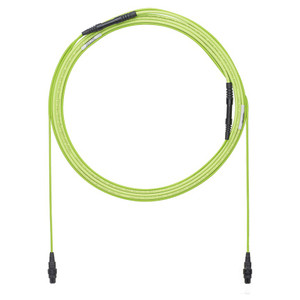
Panduit FWTYL7575KNM035 QuickNet OM5 12-Fiber Trunk Cable Assembly
The Panduit FWTYL7575KNM035 is a 35-meter OM5 wideband multimode trunk cable assembly engineered for high-density 40G/100G datacenter spine-leaf deployments. This 12-fiber PanMPO-to-PanMPO trunk features ultra-low insertion loss, HD Flex small-diameter construction that saves 30-40% conduit space compared to standard trunks, and Low Smoke Zero Halogen jacketing for installations requiring IBC Chapter 8 fire safety compliance. Pre-terminated QuickNet assemblies eliminate field splicing labor and insertion-loss variability, delivering guaranteed performance out of the box for integrators managing TOR-to-spine aggregation links, storage-area-network fabrics, or parallel-optics 40GBASE-SR4 / 100GBASE-SR4 runs. The lime jacket provides instant OM5 visual identification per TIA-598-D color coding, critical when troubleshooting mixed OM3/OM4/OM5 infrastructures during cutovers or adds-and-moves.
Key Features
- OM5 wideband multimode fiber supports 40GBASE-SR4 to 150m and 100GBASE-SR4 to 100m per IEEE 802.3, doubling OM4 reach for cost-effective leaf-spine scaling without singlemode migration
- 12-fiber PanMPO female connectors in Method A polarity configuration provide standard straight-through mapping for backbone trunks connecting like transceivers (QSFP+ SR4 to QSFP+ SR4) without adapter key-ups
- Ultra insertion loss grade guarantees ≤0.35 dB per mated connector pair, preserving link budget on long 35-meter runs where standard 0.5 dB MPO loss would approach receiver sensitivity limits
- HD Flex small-diameter trunk construction reduces cable bundle cross-section by 30-40%, increasing usable conduit fill in overhead ladder rack and under-floor pathways constrained by NEC 300.17 40% fill ratio
- Low Smoke Zero Halogen outer jacket meets IEC 60332-3-24 flame propagation and IEC 61034-2 smoke density requirements for plenum-equivalent installations in jurisdictions adopting European EN 50575 Cpr cable classifications
- Factory-terminated QuickNet assembly ships with insertion-loss test results and eliminates field fusion-splicing labor, reducing per-link install time from 90 minutes (splice/test/document) to under 10 minutes (route/plug/verify)
- Lime jacket color per TIA-598-D Annex A provides instant visual OM5 identification during MAC work, preventing accidental cross-patching with OM3 (aqua) or OM4 (erika violet) trunks that would limit application reach
- RoHS-compliant construction with TIA-492-AAAD fiber geometry and ISO/IEC 11801 Category OM5 channel certification supports procurement mandates for federal datacenters and ENERGY STAR-rated colocation facilities
OM5 wideband multimode fiber extends effective modal bandwidth to 3500 MHz·km at 850 nm compared to OM4's 4700 MHz·km, but OM5's defining advantage is wideband performance across 840-953 nm. This supports Shortwave Wavelength Division Multiplexing (SWDM), where a single 100G transceiver transmits four 25G lanes on four distinct wavelengths (850/880/910/940 nm) over a single duplex fiber pair instead of eight fibers. While SWDM adoption remains limited in 2026, specifying OM5 today future-proofs the physical layer for next-generation 200G/400G SWDM optics without rip-and-replace. For current 40GBASE-SR4 and 100GBASE-SR4 parallel optics, OM5 delivers measurable reach extensions: 40G SR4 to 150 meters (vs 100m on OM3), 100G SR4 to 100 meters (vs 70m on OM3). On a 35-meter run like this assembly, the performance headroom translates to insertion-loss budget for additional mating events—critical when trunks break out to duplex LC cassettes at both ends, adding four connector pairs per link. Method A polarity uses straight-through pin mapping (fiber 1 to fiber 1, fiber 12 to fiber 12) on both ends, standard for backbone trunks where transmit-to-receive flipping happens at the transceiver or breakout cassette. This differs from Method B (one end with key-up reversal) used in switch-to-switch direct-attach scenarios. The PanMPO female-to-female configuration mates with male pinned MTP/MPO adapters or cassettes; if your patch panel uses key-up/key-down Module cassettes, verify adapter gender before ordering. Ultra insertion loss grading guarantees each mated connector pair measures ≤0.35 dB, tighter than TIA-604-5 FOCIS-5's 0.5 dB maximum for MPO connectors. On a 12-fiber trunk with two connector pairs (24 endfaces), this 0.15 dB reduction per pair preserves 0.3 dB total link budget—equivalent to recovering 15 meters of OM5 fiber attenuation at 2.0 dB/km.
Datacenter spine-leaf architectures aggregate dozens of 40G/100G uplinks from top-of-rack switches to spine switches, creating dense fiber pathways between rack rows. A single spine switch with six 32-port 100G line cards requires 192 fibers (16 twelve-fiber trunks) landing in a 4RU patch panel, then breaking out to duplex LC for optics insertion. HD Flex cable construction reduces trunk outer diameter by using smaller 200-micron buffered fibers instead of 900-micron tight-buffered fibers common in premise-grade assemblies. The result: a twelve-fiber HD Flex trunk occupies roughly the same conduit space as a six-fiber standard trunk, effectively doubling pathway capacity without infrastructure modifications. NEC Article 300.17 limits conduit fill to 40% cross-sectional area for more than two cables; in a 2-inch EMT conduit (tubing ID ≈2.07 in, area ≈3.36 in²), you're allowed 1.34 in² of cable fill. Standard 12F trunks at 0.45-inch OD consume 0.159 in² each, capping the conduit at eight trunks (96 fibers). HD Flex trunks at 0.32-inch OD consume 0.080 in² each, fitting sixteen trunks (192 fibers) in the same EMT—exactly the fiber count for that six-card spine switch. This density advantage also reduces ladder-rack congestion and horizontal/vertical pathway bundle diameter, improving airflow around hot-aisle server exhaust. The 35-meter length handles typical datacenter row-to-EOR (end-of-row) distances with slack for service loops at both termination points. For longer runs (to MDF or cross-connect), consider Panduit's 50m, 70m, or 100m QuickNet SKUs in the same configuration. Low Smoke Zero Halogen jacketing meets IEC 60332-3-24 vertical flame propagation (Category C) and IEC 61034-2 smoke density (<60% light transmission) requirements. While NEC Article 770 in the US does not recognize "LSZH" as a plenum substitute (you need OFNP-rated cable for NEC 300.22(C) air-handling spaces), LSZH is widely specified for: 1) installations under International Building Code or NFPA 5000 where Authority Having Jurisdiction accepts European classifications, 2) submarines, ships, and offshore platforms under SOLAS or IMO regulations prohibiting halogenated cables, 3) mass-transit and hospital projects where smoke toxicity during fire is a life-safety concern. If your project is under NEC jurisdiction and requires plenum rating, specify Panduit's OFNP-jacketed QuickNet variant instead (typically "-F" suffix). For general-purpose raised-floor or cable-tray datacenter installations not in air-handling spaces, LSZH provides equivalent flame performance to OFNR riser cable with reduced hydrogen chloride emissions.
This assembly ships with factory insertion-loss test documentation traceable to NIST-certified reference standards, meets TIA/EIA-568-C.3 Annex A.4 MPO connector performance requirements, and carries RoHS compliance certification for lead-free solder and flame-retardant compounds. The QuickNet sub-brand represents Panduit's pre-terminated trunk portfolio engineered for plug-and-play deployment without field fusion splicing, a critical differentiator when you're managing a 2,000-fiber cutovers with a fixed labor budget and a 72-hour maintenance window. For integrators deploying spine-leaf fabrics, SAN extension, or 40G/100G server clustering in enterprise datacenters or colocation cages, this OM5 trunk delivers the reach, density, and installation speed required to meet project timelines without sacrificing IEEE 802.3 link-budget compliance or TIA Category OM5 channel certification.