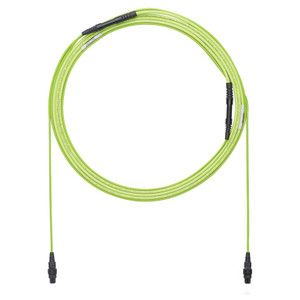
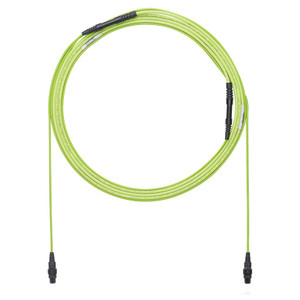
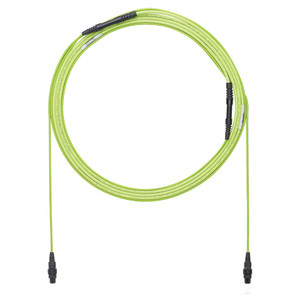
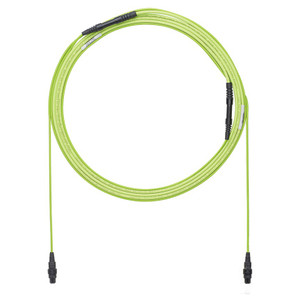
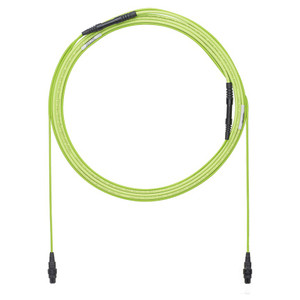
Panduit FWTYL7575LNM012 OM5 12-Fiber Trunk Cable Assembly
The Panduit FWTYL7575LNM012 is a 12-meter OM5 fiber optic trunk cable assembly engineered for high-density data center environments where cabinet space is at a premium and future bandwidth scalability is critical. This QuickNet™ trunk features PanMPO female connectors on both ends, enabling rapid 12-fiber parallel optic connections between switches, patch panels, or cassette modules without the labor and error risk of field termination. The lime-colored LSZH jacket meets strict fire safety codes for enclosed equipment rooms while providing instant visual identification of OM5 cabling per TIA-568 standards. With a small-diameter HD Flex construction that consumes 30 to 40 percent less pathway space than conventional trunks, this assembly is purpose-built for 40G/100G migration paths and emerging shortwave wavelength-division multiplexing applications that demand extended reach without the cost of singlemode infrastructure.
Key Features
- OM5 wideband multimode fiber supports 40G/100G Ethernet and future shortwave WDM to 400G over extended distances
- 12-fiber count in a single trunk reduces connector density at patch points by 85% versus individual duplex cables
- PanMPO female-to-female interface with Method B polarity for plug-and-play compatibility with structured cabling cassettes
- Ultra insertion loss specification ensures signal integrity in multi-tier spine-leaf architectures
- LSZH jacket limits smoke and toxic gas emission during fire events, meeting IEC 60332 and local building codes
- HD Flex small-diameter design saves 30–40% conduit fill and cabinet vertical pathway space versus standard trunk cables
- Lime cable jacket color provides instant visual confirmation of OM5 infrastructure per TIA-568-C.3
- 12-meter (39.37 ft) length suits typical row-to-row or end-of-row switch interconnects in pod-based data center layouts
- Factory-terminated and tested assembly eliminates field termination labor, consumables, and performance variability
- Meets TIA-568-C.3, ISO/IEC 11801, and TIA-604-5 (FOCIS-5) connector geometry standards for cross-vendor interoperability
OM5 fiber represents a generational leap in multimode bandwidth capability. While OM3 and OM4 fibers are optimized for single-wavelength 850nm transmission, OM5 extends effective modal bandwidth across four distinct shortwave wavelengths—850nm, 880nm, 910nm, and 940nm—as defined in TIA-492-AAAD and IEC 60793-2-10 type A1a.3. This wideband performance enables shortwave wavelength-division multiplexing (SWDM), a cost-effective alternative to singlemode parallel optics for 40GBASE-SR4, 100GBASE-SR4, and emerging 200G/400G-SR8 applications. In practical terms, a 12-fiber OM5 trunk can support three independent 40G QSFP+ links or a single 100G QSFP28 link today, with a clear upgrade path to 400G QSFP-DD transceivers using the same installed fiber—no rip-and-replace. The 50-micron core diameter maintains compatibility with existing OM3/OM4 transceiver ecosystems while delivering reach extensions of 20 to 50 percent depending on application; for example, 100GBASE-SR4 reaches 150 meters on OM5 versus 100 meters on OM4, a critical margin in large-footprint facilities.
The PanMPO connector interface is Panduit's implementation of the MPO (Multi-Fiber Push-On) standard defined in TIA-604-5, delivering 12 fiber connections in a single sub-miniature form factor roughly the width of an SC duplex. Each PanMPO housing contains a precision-molded ferrule with 12 fiber holes arranged in a single row, held in alignment by two stainless steel guide pins (male configuration) or two guide pin sockets (female configuration). This trunk uses female connectors at both ends, following Method B polarity convention: fibers map straight-through from position 1-to-1, 2-to-2, and so on, which is the dominant polarity scheme for cassette-based structured cabling systems from Panduit, Corning, CommScope, and others. When mated to a Method B cassette or adapter panel, transmit fibers from a switch QSFP port automatically align with receive fibers at the destination without crossover complexity. The Ultra insertion loss specification—typically ≤0.35 dB per connector pair—ensures that multi-hop topologies (spine switch → trunk → cassette → duplex patch → server, for example) remain within the 1.5 to 2.5 dB loss budget required by 40G/100G SR optics, even after accounting for splice loss, bend loss, and aging margin.
HD Flex construction is a Panduit mechanical design innovation that reduces overall cable diameter by 25 to 35 percent compared to legacy round trunk cables with the same fiber count. Traditional 12-fiber trunks use a central strength member surrounded by buffered fibers in a helical lay, resulting in an outer diameter of 6 to 8mm. The HD Flex design employs a flat ribbon architecture with ultra-thin buffer tubes and a compact oval jacket profile, shrinking outer diameter to 4.5 to 5.5mm while maintaining 1.5kN tensile strength and a 20x cable diameter minimum bend radius (90mm dynamic, 60mm static). This translates directly into conduit fill and vertical cable manager capacity: a 4-inch square backbone conduit that maxes out at nine legacy 12-fiber trunks can accommodate fifteen HD Flex assemblies at the same 40% NEC fill ratio—a 65% capacity gain without infrastructure modification. In ladder rack and vertical manager scenarios, the smaller diameter reduces bundle weight and side-load stress on cable management hardware, lowering the risk of connector damage from over-stuffed pathways.
The Low Smoke Zero Halogen jacket compound is formulated to meet IEC 60332-1 flame propagation limits and IEC 61034 smoke density limits without relying on halogenated flame retardants (chlorine, bromine, fluorine). When exposed to fire, LSZH jackets produce significantly less smoke (light transmittance >60% in IEC chamber testing) and release negligible hydrochloric acid, hydrofluoric acid, or other corrosive halogens that damage electronic equipment and pose acute inhalation hazards in enclosed spaces. Most North American data centers specify LSZH for intra-building backbone and equipment room cabling even when local electrical codes permit PVC, because the business continuity risk of smoke-induced equipment failure or extended facility evacuation outweighs the 10 to 15 percent material cost premium. The lime jacket color is not decorative—it is the TIA-568-C.3 standards-mandated identification color for OM5 cabling, ensuring that technicians can visually distinguish OM5 trunks from aqua OM3, erika violet OM4, or yellow singlemode cables during adds, moves, and changes. This color-coding discipline is essential in mixed-generation data centers where inadvertently patching OM3 to OM5 infrastructure can strand the OM5 bandwidth investment.
This 12-meter length is a deliberate fit for row-to-row and end-of-row interconnect topologies common in modular data center designs. A typical raised-floor pod measures 8 to 10 meters per row; a 12-meter trunk provides enough slack for vertical rise into overhead ladder rack, horizontal routing along the row, and a service loop at each termination point without excess cable waste that contributes to airflow obstruction and pathway congestion. In spine-leaf architectures, these trunks connect top-of-rack switches to end-of-row leaf switches (east-west traffic) or leaf switches to core spine switches in adjacent rows (north-south traffic), supporting the non-blocking any-to-any connectivity model required by virtualized server fabrics and software-defined storage clusters. The factory-terminated assembly model eliminates the field labor associated with epoxy-polish termination or mechanical splice connectors—installation time drops from 45 minutes per trunk (field termination of 24 fiber ends) to under 5 minutes (plug, verify polarity, test), and performance variability disappears because every connector is machine-polished and interferometrically inspected at the factory. This matters in large deployments: a 500-server cluster requires roughly 125 leaf-to-spine uplink trunks; factory assemblies save 80+ labor hours and ensure that zero connections fail insertion loss acceptance testing due to human error.
Compliance with TIA-568-C.3, ISO/IEC 11801-1, TIA-604-5 (FOCIS-5), and IEC 60793-2-10 type A1a.3 ensures cross-vendor interoperability across switches, transceivers, cassettes, and test equipment from any manufacturer adhering to the same global standards. RoHS compliance confirms that the assembly contains no lead, mercury, cadmium, hexavalent chromium, or restricted flame retardants, satisfying EU and California environmental procurement mandates as well as corporate sustainability reporting requirements. For integrators deploying multi-vendor leaf-spine fabrics or managing long-lived data center infrastructure across multiple technology refresh cycles, standards-compliant factory assemblies like the FWTYL7575LNM012 eliminate the single-vendor lock-in risk and ensure that a trunk installed today will mate cleanly with cassette modules, breakout panels, and transceiver form factors introduced five years from now—a critical hedge in an industry where the installed base of structured cabling routinely outlives three generations of active electronics.