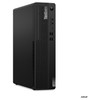
Lenovo 12TA000KUS ThinkCentre M75s Gen 5 Small Form Factor Desktop
The Lenovo ThinkCentre M75s Gen 5 (12TA000KUS) is an 8.2-liter small form factor desktop built around AMD's Ryzen 7 PRO 8700G — a processor that brings eight cores, sixteen threads, and a 4.2–5.1 GHz boost clock into a chassis that fits cleanly under a monitor arm or alongside a rack-mounted NVR. If you're deploying dedicated VMS workstations, edge decode nodes, or general-purpose enterprise desktops where floor space is constrained, this is the configuration to evaluate.
Overview
The M75s Gen 5 SFF occupies a deliberate middle ground: more compute than a mini PC, less bulk than a tower. The 8.2L chassis supports up to three internal drives simultaneously — one 3.5-inch HDD plus two M.2 SSDs — which matters for local VMS recording buffers or multi-application workloads where separating the OS drive from working storage improves reliability. The 12TA000KUS ships with Windows 11 Pro, a 512GB PCIe 4.0 NVMe SSD, and 16GB DDR5-5200 in a single UDIMM — leaving one slot open for a memory upgrade to 32GB or 64GB without touching the existing module. For surveillance workstations and VMS client deployments, that expandability is worth factoring into the total cost of ownership.
Key Features
- AMD Ryzen 7 PRO 8700G (8C/16T, 4.2–5.1 GHz): Eight physical cores with SMT handle concurrent VMS decode streams, analytics processing, and background tasks without the frame-drop stutter you get from a quad-core. The PRO designation adds AMD's enterprise manageability features — remote management, memory guard ECC-equivalent, and shadow stack — relevant if you're deploying these in a managed fleet.
- Integrated AMD Radeon 780M Graphics: The 780M is AMD's strongest integrated GPU in this generation, built on RDNA 3 architecture. It supports three simultaneous displays via the rear HDMI 2.1 and dual DisplayPort 1.4a outputs — useful for a VMS operator station running a camera wall across three monitors without adding a discrete card or expanding the chassis footprint.
- 16GB DDR5-5200 with Dual-Channel Expansion: The single 16GB UDIMM ships in one of two slots; adding a matched module unlocks dual-channel bandwidth, which directly benefits the Radeon 780M since it shares system memory. For display-heavy or multi-stream decode workloads, pairing it to 2×16GB is the first upgrade to consider.
- 512GB PCIe 4.0×4 NVMe SSD (Opal 2.0): The M.2 2280 drive runs the full PCIe 4.0 lane width, so sequential reads exceed 5,000 MB/s. Opal 2.0 self-encrypting drive support means the OS can enable hardware-level full-disk encryption without a performance penalty — a compliance requirement in some enterprise and government deployments.
- Wi-Fi 6 (802.11ax) + Bluetooth 5.3: The Realtek RTL8852BE 2×2 Wi-Fi 6 adapter covers environments where running ethernet to every workstation isn't practical. 802.11ax's OFDMA and target wake time reduce contention on dense wireless networks. Bluetooth 5.3 handles peripheral pairing without a USB dongle.
- Front-Panel USB-C (5Gbps, 15W Charging): A USB-C port on the front panel at 5Gbps with 15W charging output handles dock pass-through and device charging without routing cables to the rear. Alongside four front USB-A 5Gbps ports, this gives field technicians fast data transfer access for imaging or log pulls without moving the unit.
- Discrete TPM 2.0 (FIPS 140-2 Certified): Hardware TPM — not firmware — with FIPS 140-2 certification meets federal procurement requirements for cryptographic modules. Combined with the Opal 2.0 SSD and Windows 11 Pro's BitLocker, this system can satisfy most government and enterprise security baseline checklists without additional hardware.
- MIL-STD-810H Tested: Testing to MIL-STD-810H covers vibration, shock, humidity, altitude, and temperature cycling. In practice, this means the unit is better suited to light industrial environments — security operations centers with HVAC variation, warehouse edge locations, or mobile command deployments — than a consumer-grade PC of equivalent spec.
- 260W 90%-Efficient Power Supply: The 90% efficiency rating (80 PLUS Gold equivalent) reduces heat output and operating cost. At full load the system draws well under 200W from the wall — relevant when sizing UPS capacity for a rack of workstations or calculating per-unit energy cost over a multi-year deployment.
- PCIe 3.0 ×16 Expansion Slot: The open ×16 slot accepts a discrete GPU, capture card, or specialized processing card. Adding a mid-range GPU unlocks hardware-accelerated decode across a significantly larger camera count in most VMS platforms, without replacing the chassis.
- EPEAT Gold + ENERGY STAR 8.0: Both ratings are procurement qualifiers for public-sector and enterprise sustainability programs. EPEAT Gold covers the full product lifecycle; ENERGY STAR 8.0 sets measurable idle and active power consumption thresholds. If your organization tracks Scope 2 emissions or requires green procurement certification, these are the checkboxes that matter.
Integration & Compatibility
The Lenovo ThinkCentre M75s Gen 5 runs Windows 11 Pro out of the box, which covers driver compatibility with all major VMS platforms — Milestone XProtect, Genetec Security Center, Avigilon Control Center, and Hanwha Wisenet Wave among them. The three-display output (HDMI 2.1 + 2× DP 1.4a) maps directly to the multi-monitor layouts these platforms recommend for operator workstations. The Gigabit Ethernet port handles standard IP camera network traffic; for higher-density environments, the PCIe ×16 slot accommodates a 10GbE NIC if you're aggregating traffic from a large camera or NVR network segment. The AMD PRO platform includes AMD PRO Manageability for remote provisioning and monitoring alongside standard Windows tools like MECM and Microsoft Intune. The open M.2 slots support NVMe drives up to — and the 3.5-inch bay accepts standard surveillance-grade HDDs from Seagate SkyHawk or Western Digital Purple for local retention storage. Pair this workstation with a network video recorder for distributed recording, or deploy it as a standalone VMS server for smaller-site installations.
For organizations deploying at scale, this system's Kensington Security Slot and Padlock Loop allow physical security anchoring at the workstation level — often a requirement in public-access areas. The AMD PRO platform's remote management capabilities integrate with standard RMM tools, reducing the need for on-site visits for routine maintenance across a dispersed deployment.
If your environment requires PoE switch infrastructure for camera connectivity, this desktop works alongside standard network infrastructure without special configuration — the onboard Gigabit NIC connects to your core switch; the VMS software handles camera discovery and management from there. For guidance on sizing a VMS workstation to your camera count and stream resolution, the surveillance workstation selection guide covers the key variables.
What's in the Box
- 1× Lenovo ThinkCentre M75s Gen 5 SFF Desktop (12TA000KUS)
- 1× USB Traditional Keyboard (Black)
- 1× USB Calliope Mouse (Black)
Frequently Asked Questions
Q: What is the maximum memory the 12TA000KUS supports?
A: The M75s Gen 5 has two DDR5 UDIMM slots supporting up to 64GB DDR5-5200 in a dual-channel configuration. The 12TA000KUS ships with 1×16GB, leaving one slot open for expansion without removing the existing module.
Q: Can the 12TA000KUS run three monitors simultaneously?
A: Yes. The rear panel includes one HDMI 2.1 and two DisplayPort 1.4a outputs, all driven by the integrated AMD Radeon 780M. A discrete GPU can be added via the PCIe 3.0 ×16 slot if additional display outputs or GPU compute is needed.
Q: Is the 12TA000KUS suitable for a VMS workstation deployment?
A: The Ryzen 7 PRO 8700G's 8 cores and 16 threads handle concurrent stream decode and VMS analytics workloads that would saturate a quad-core. Windows 11 Pro is pre-installed, covering driver compatibility with Milestone, Genetec, Avigilon, and other major platforms. For higher camera counts, the open PCIe ×16 slot accepts a discrete GPU for hardware-accelerated decode.
Q: What internal storage expansion is available?
A: The system supports up to three drives: the existing 512GB M.2 NVMe SSD occupies one of three M.2 slots, leaving two additional M.2 slots and one 3.5-inch HDD bay open. This allows dedicated OS, working data, and local video retention drives without external storage.
Q: Does the 12TA000KUS meet enterprise security baseline requirements?
A: The system includes a discrete (not firmware) TPM 2.0 chip that is TCG and FIPS 140-2 certified, an Opal 2.0 self-encrypting NVMe SSD compatible with BitLocker hardware encryption, Windows 11 Pro, and physical security anchoring via Kensington lock slot and padlock loop. It also carries MIL-STD-810H testing and EPEAT Gold registration.
Q: What is the warranty on the 12TA000KUS?
A: The 12TA000KUS includes a 3-year Onsite manufacturer warranty.
I've been deploying VMS workstations across a lot of site types, and the 12TA000KUS hits a configuration point that's genuinely useful: the Ryzen 7 PRO 8700G gives you eight real cores in an 8.2-liter chassis, which means you're not trading compute for footprint the way you do with mini PCs. The PRO designation also matters in managed environments — AMD PRO Manageability integrates with standard RMM stacks, so you're not handling these boxes by hand across a multi-site deployment.
Technical Highlights:
- Ryzen 7 PRO 8700G (8C/16T, 4.2–5.1 GHz): At 5.1 GHz boost, this processor handles real-time VMS decode plus background tasks — OS updates, antivirus scans, network management — without the frame stalls you'd see on a 4-core system under the same load.
- Three-Output Display Stack (HDMI 2.1 + 2× DP 1.4a): Three independent 4K outputs from integrated graphics means an operator wall is covered without a discrete GPU purchase, keeping the system cost and power draw lower. Add a PCIe card later if the camera count grows.
- Discrete TPM 2.0, FIPS 140-2 + Opal 2.0 SSD: Hardware TPM (not firmware) combined with a self-encrypting drive means BitLocker encryption runs at drive speed, not CPU speed — no performance penalty for compliance. FIPS 140-2 certification on the TPM covers federal and state procurement requirements most firmware TPM solutions can't meet.
Deployment Considerations:
- The 12TA000KUS ships with a single 16GB UDIMM in a dual-slot board — the Radeon 780M performs noticeably better in dual-channel mode. Budget a matching 16GB stick at deployment time if this is going into a camera-wall or high-stream-count VMS role; the bandwidth difference is measurable.
- The 260W PSU leaves headroom for a mid-range discrete GPU and an additional HDD, but the SFF chassis has physical limits on card length — verify GPU clearance before specifying a card for this form factor.
This unit fits best as a dedicated VMS client workstation in a distributed security operations center, or as a small-site recording and display server where rack space is limited and three-display operator output is required without the cost of a tower build.