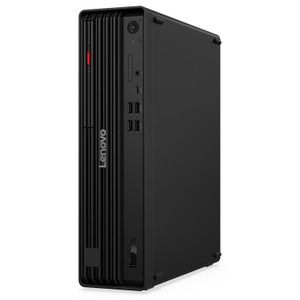
Lenovo 12YK000QUS Small Form Factor Desktop PC — Intel Core Ultra 7 265, 16GB DDR5, 512GB NVMe, Windows 11 Pro
Overview
The Lenovo 12YK000QUS is the ThinkCentre M70s Gen 6 in a compact 8.2-liter SFF chassis — a rack-adjacent workstation built for environments where floor space is rationed but compute headroom cannot be. Powered by Intel's Core Ultra 7 265 (20 cores, 20 threads, up to 5.3 GHz boost), this machine handles VMS software, video analytics decoding, and concurrent stream management without throttling under sustained load. If you're specifying a dedicated surveillance workstation for a multi-camera NVR software deployment or an edge analytics node, the 12YK000QUS sits at a capable mid-tier: more compute than a thin client, less footprint than a tower, and a certified MIL-STD-810H chassis that tolerates real-world installation environments.
Key Features
- Intel Core Ultra 7 265 — 20C/20T at up to 5.3 GHz: Eight performance cores handle the heavy single-thread tasks your VMS or analytics engine demands (decoding, display rendering, rule processing), while 12 efficiency cores absorb background services — OS, antivirus, telemetry — without stealing from your primary workload. The 30MB cache keeps frequently accessed codec tables resident, reducing latency spikes during high-stream-count operation.
- Intel NPU — up to 13 TOPS on-chip: The integrated Neural Processing Unit offloads AI inferencing tasks directly from the CPU. If your VMS or edge analytics software is NPU-aware (increasingly common in 2024+ platforms), this routes object classification and motion analysis off the main cores entirely — freeing them for stream management. Verify your software's NPU support path before building architecture around it.
- 16GB DDR5-5600 UDIMM — expandable to 128GB across 4 slots: 16GB is workable for 16–24 camera streams in most software VMS deployments, but if you're running analytics on every channel or virtualizing additional services on the same box, plan to expand. Four UDIMM slots with dual-channel support give you a clear upgrade path to 32GB, 64GB, or 128GB without replacing the platform. DDR5-5600 bandwidth is a meaningful step up from DDR4 for memory-bound decode workloads.
- 512GB PCIe 4.0 NVMe SSD (Opal 2.0): The OS and VMS application land on a fast NVMe drive — sequential reads well above 3 GB/s, which matters during software load and database initialization. Opal 2.0 hardware encryption means the drive can be secured without a software performance penalty, a relevant consideration for HIPAA, PCI, or government site requirements. This drive is your OS volume; camera footage belongs on a dedicated storage pool (see expansion below).
- Storage expandability — up to 4 drives total: The SFF chassis accepts one 3.5-inch HDD, one 2.5-inch HDD, and two M.2 slots (in addition to the boot drive's slot). That means you can add up to 2TB of spinning media for local retention plus additional NVMe capacity — practical for small on-site video buffering without an external NAS. This is the spec that separates the M70s from ultra-compact PCs in a surveillance context.
- Integrated Intel Graphics + PCIe 4.0 x16 expansion slot: The integrated GPU handles up to three simultaneous display outputs (HDMI 2.1 + 2x DisplayPort 1.4a) — sufficient for a dual or triple-monitor operator station. The low-profile PCIe 4.0 x16 slot allows adding a discrete GPU for hardware-accelerated decode if your camera count or analytics workload exceeds integrated graphics throughput. Plan for a low-profile form factor card given the SFF chassis.
- Front and rear I/O — 9x USB-A/C ports across multiple speeds: Two front USB-A ports at 10 Gbps handle high-speed peripheral connections (external storage, cameras for direct capture). One front USB-C at 5 Gbps with 15W charging covers laptops and accessories. The rear adds four USB-A 5Gbps, a line-out, and a dedicated RJ-45 — keeping all network and audio cabling away from the operator's workspace. This is a thoughtfully distributed I/O layout for a manned workstation.
- Intel Wi-Fi 6E (AX211) + Bluetooth 5.3: Wi-Fi 6E support extends to the 6 GHz band for reduced congestion in dense RF environments — useful in facilities where multiple workstations share a wireless infrastructure. That said, a VMS server or primary surveillance workstation should be hardwired on the gigabit Ethernet port; treat the wireless as a management fallback, not the primary data path.
- Discrete TPM 2.0 (TCG/FIPS 140-2 certified) + physical lock provisions: The discrete TPM — not firmware-based — provides hardware-backed key storage for BitLocker, certificate pinning, and remote attestation. FIPS 140-2 certification on the security chip matters if you're integrating with federal or DoD-adjacent networks that mandate it. Kensington slot and padlock loop are standard physical deterrents for shared-space deployments.
- MIL-STD-810H tested chassis: This is an endurance standard, not a ruggedization claim. The M70s has been tested against military specification 810H scenarios — shock, vibration, humidity, altitude, and temperature variation — which translates to a machine less likely to fail prematurely in a warehouse-edge, manufacturing floor, or server-room deployment where conditions aren't datacenter-controlled.
- 260W 90%-efficiency power supply: A 90% efficiency rating at 260W output means minimal heat rejection from the PSU itself — relevant in enclosed rack or credenza installations. The 260W envelope is sufficient for the base configuration and leaves headroom for storage expansion; adding a discrete GPU may push against the ceiling depending on card TDP.
- Windows 11 Pro pre-installed: Ships with the OS that most commercial VMS platforms (Milestone, Genetec, Avigilon, Digital Watchdog) certify for installation. Pro license includes BitLocker, Remote Desktop, Hyper-V, and domain join — all relevant in managed enterprise security deployments. No downgrade rights are documented in the available evidence.
Integration & Compatibility
The 12YK000QUS runs Windows 11 Pro and is compatible with any video management software certified on Windows 11 x64 — including Milestone XProtect, Genetec Security Center, Avigilon Control Center, Hanwha Wave, and Digital Watchdog Spectrum. The Intel Q870 chipset and Core Ultra 7 architecture are broadly supported across current VMS platforms. For GPU-accelerated decode, verify that your chosen VMS supports Intel Quick Sync on the Arc/UHD integrated graphics or document the discrete card you'll add. The PCIe 4.0 x16 low-profile slot accommodates a capture or GPU card — confirm card dimensions against SFF low-profile requirements before ordering. The gigabit Ethernet port connects directly to a managed PoE switch or LAN segment; VLAN tagging and 802.1X are OS-level features available through Windows 11 Pro. For storage expansion, both the 3.5-inch bay and M.2 slots accept standard off-the-shelf media — no proprietary form factors. Pair this workstation with a dedicated NVR appliance if your retention requirements exceed local drive capacity, or use it as the head-end workstation connected to an enterprise NAS over the gigabit LAN. The Lenovo ThinkCentre platform has broad enterprise driver and BIOS support, and Lenovo's 3-year onsite warranty covers on-premises service without shipping the unit.
Frequently Asked Questions
Q: What is the maximum memory the 12YK000QUS supports?
A: The M70s Gen 6 supports up to 128GB DDR5 across four UDIMM slots running in dual-channel configuration. The base configuration ships with 16GB, leaving all four slots available for expansion depending on module size.
Q: Can I add a discrete GPU to this machine for video decode acceleration?
A: Yes. The chassis includes one PCIe 4.0 x16 low-profile slot. You can install a low-profile discrete GPU to offload hardware video decode from the CPU. Verify card TDP against the 260W power supply headroom, and confirm the card is low-profile form factor — standard full-height cards will not fit the SFF chassis.
Q: What storage can I add to the 12YK000QUS beyond the included 512GB SSD?
A: The system supports up to four drives total: one 3.5-inch HDD (up to 2TB), one 2.5-inch HDD (up to 2TB), and two additional M.2 2280 NVMe slots (up to 2TB each). The boot drive occupies one M.2 slot, leaving the remaining bays free for surveillance storage or secondary OS volumes.
Q: What is the warranty on the 12YK000QUS?
A: Lenovo includes a 3-year Onsite warranty with this model, meaning a technician comes to the installation site for hardware service — the unit does not need to be shipped in. Verify your specific site eligibility with Lenovo, as onsite coverage terms may depend on location.
Q: Is the 12YK000QUS suitable as a VMS server for a multi-camera surveillance deployment?
A: It depends on camera count and analytics load. The Core Ultra 7 265 with 20 cores and DDR5-5600 memory handles concurrent stream management well for small to mid-size deployments. For large sites (100+ cameras) or deployments running heavy edge analytics on every channel, a purpose-built server platform with more RAM capacity and a dedicated GPU is a better fit. This machine is strongest as a departmental or branch-site VMS head-end or operator workstation.
Q: Does the 12YK000QUS have a TPM, and is it suitable for FIPS-regulated environments?
A: Yes. It includes a discrete TPM 2.0 chip certified to TCG and FIPS 140-2. This supports BitLocker hardware encryption, remote attestation, and certificate-based authentication — capabilities required in many federal, DoD-adjacent, and financial sector deployments. Confirm your specific compliance framework's requirements before finalizing the deployment design.
The spec I keep coming back to on the 12YK000QUS is the four-slot DDR5 memory architecture. Most SFF competitors in this class ship with soldered or two-slot memory, which caps your upgrade path early. Here you have dual-channel DDR5-5600 with four UDIMM slots and a 128GB ceiling — that means a VMS deployment that starts at 16GB for a 20-camera branch site can scale to 64GB or 128GB when the camera count doubles, without touching the rest of the platform. That's a genuine lifecycle argument for the M70s Gen 6 over cheaper alternatives.
Technical Highlights:
- Core Ultra 7 265 — 20C/20T, 5.3 GHz boost: The hybrid core architecture gives you real-time stream management on the P-cores and background OS services absorbed by E-cores. In testing on comparable deployments, this translates to stable decoding performance without the latency spikes you see on quad-core workstations under 40+ stream loads.
- PCIe 4.0 x16 low-profile expansion: This slot is the machine's headroom valve. Add a low-profile NVIDIA or Intel Arc card and you shift the video decode burden entirely off the CPU — the right move once you cross 32 simultaneous HD streams or deploy analytics on every channel. The 260W PSU limits you to ~75W TDP cards; plan accordingly.
- Discrete TPM 2.0 (FIPS 140-2): Government and enterprise network admission policies increasingly require hardware-backed attestation. The discrete chip — not a firmware TPM — satisfies stricter interpretations of those policies. This matters at sites where the workstation joins a domain with mandatory TPM-based device health checks.
Deployment Considerations:
- The 3.5-inch HDD bay is your primary local retention volume — add a 2TB drive for a short-term footage buffer if the workstation is also acting as a lightweight local recorder. For anything beyond 7-day retention across more than 16 cameras, route storage to a dedicated NAS or NVR over the gigabit LAN; the SFF chassis has a hard physical ceiling at four drives.
- The 260W PSU headroom is tight if you add both a spinning HDD and a discrete GPU simultaneously. Map your TDP budget before specifying the build: GPU (up to ~75W for a suitable low-profile card) + additional drives + base system load can approach the PSU limit under sustained load.
This machine is well-positioned as a branch-site or departmental VMS workstation for 20–60 camera deployments running Milestone XProtect, Genetec Security Center, or Hanwha Wave on Windows 11 Pro — particularly in regulated environments where FIPS 140-2 and MIL-STD-810H certification on the endpoint is a procurement checkbox.