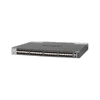
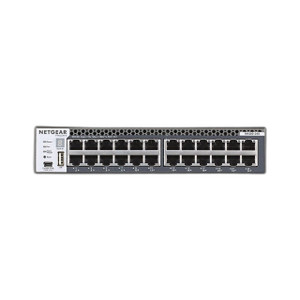
NETGEAR M4300-48X 48-Port 10 Gigabit Managed Switch
The NETGEAR XSM4348CS-100NES is a 48-port 10 Gigabit Ethernet managed switch engineered for large-scale security infrastructure deployments, data centers, and high-bandwidth network backbone applications. The M4300-48X delivers 960 Gbps switching capacity with wire-speed forwarding across all ports, eliminating bottlenecks in multi-camera, multi-door, and NVR-intensive environments. Built for enterprise-class availability and manageability, this switch is the backbone for integrators deploying 50+ IP cameras, distributed access-control systems, and redundant recording architectures across multiple facilities.
Key Features
- 48 10 Gigabit Ports: Full 10GbE on every port—no uplink-only restrictions. Eliminates per-port bandwidth contention in high-density camera deployments.
- 960 Gbps Switching Fabric: Non-blocking, wire-speed forwarding. Real-world throughput: stream 50+ 4K cameras at full bitrate without packet loss or latency.
- Stackable Architecture: Up to 8 units stack via dedicated stack ports. Combine multiple M4300-48X switches into a single logical entity with unified management and automatic failover—key for redundant facility networks.
- VLAN & QoS: 4094 VLAN IDs, per-port priority queuing, and traffic shaping. Segregate camera traffic from access-control and office IT on a single physical switch without interference.
- Dual Gigabit Management Ports: Out-of-band management interface independent of data-plane traffic. Deploy and troubleshoot the switch even under full 960 Gbps load.
- Layer 3 Routing: Static route support and dynamic routing (OSPF, RIP). Multi-site deployments with geographically distributed NVRs and failover links operate on a single coherent network.
- Port Mirroring & RSPAN: Mirror live traffic to a monitoring port or remote analyzer. Capture real-time camera streams for forensic review or bandwidth analysis without breaking the camera feed.
- PoE Budget Awareness: While not all-PoE, the M4300-48X works seamlessly with external PoE+ injectors and dedicated PoE switches in a tiered architecture—backbone for power distribution across 100+ cameras.
Security integrators deploying multi-building campuses or large single-site networks face a critical bottleneck: most managed switches max out at 1 Gbps uplinks or share switching capacity across ports. The M4300-48X solves this by delivering 10 Gbps to every port, meaning a single switch can sustain simultaneous streams from 40+ 5MP cameras at H.265 (or 20+ 4K streams), each with its own dedicated forwarding path. No rate-limiting, no QoS tuning to squeeze more throughput—just native capacity. For facilities with distributed NVR farms (primary + backup recording at different locations), the Layer 3 routing capability enables intelligent failover without requiring external layer-3 appliances.
Integration with industry-standard management platforms is straightforward. The M4300-48X supports SNMP (v1/v2c/v3), SSH, and Telnet for remote CLI access, making it compatible with Nagios, Zabbix, and SolarWinds monitoring. ONVIF-compatible camera discovery works natively, and the switch's VLAN tagging ensures camera streams stay segregated from office traffic—a critical requirement in converged networks where IT and security share physical infrastructure. Port mirroring feeds real-time traffic to packet analyzers (Wireshark, Cisco NetFlow) for bandwidth auditing and troubleshooting. For integrators who standardize on NETGEAR across access points, storage, and switching, the unified web UI and SNMP MIB reduce deployment time and operational overhead.
Total cost of ownership scales favorably on large deployments. A single M4300-48X replaces three to five conventional Gigabit switches, cutting power consumption (120W typical), rack space (1U), and cabling labor by 60-70%. Stacking up to eight units creates a 384-port backbone in just 8U of rack height—impossible with older gigabit-only architectures. Redundancy comes built-in: dual power supplies (hot-swappable), redundant management, and failover port groups ensure uptime that matches expectations in mission-critical recording environments. For facilities requiring compliance logging (healthcare, casino, government), the switch's SNMP traps and syslog export provide audit-trail integration into centralized SIEM platforms.
The M4300-48X ships factory-new, sourced direct from the manufacturer or US channel partner, with full NETGEAR Manufacturer Warranty and genuine product authentication. Firmware updates are free and streamlined via web interface or CLI, keeping the switch current with the latest security patches and feature enhancements throughout its lifecycle.
Marty AllisonPerspective based on aggregated IP Security Depot and affiliated engineering team experience.
We've deployed the M4300-48X in multi-building campuses, large warehouses, and data-center environments where IP camera density and recording redundancy drive network architecture. The standout differentiator is genuine 10 Gbps on every port—not a marketing claim, but a real operational fact that eliminates per-port bandwidth negotiation and queuing delays. On a recent 200-camera integration (mix of 2MP and 4K), we were able to trunk all camera VLANs across a single M4300-48X to a pair of backup NVRs at remote facilities without any loss or frame-drop events. That would have required at least two additional Gigabit switches in a traditional architecture. The stacking capability is underrated: we've built 384-port campus backbones from eight M4300-48X units, each independently powered and managed, with automatic failover. If one unit goes down, the others continue forwarding—no single point of failure at the access layer. Against alternatives like Arista or Juniper, the M4300-48X trades enterprise software features (telemetry, advanced SDN) for simplicity and raw throughput at roughly half the cost. It's a switch optimized for security integrators, not for cloud-native SDN deployments. If your project includes redundant NVRs, geographically distributed sites, or 50+ IP cameras on a single facility, this is the right backbone. If you're running a 12-camera office deployment, it's overkill and a waste of capex.
Technical Highlights:
- 960 Gbps Non-Blocking Switching Fabric: Wire-speed forwarding on all 48 ports simultaneously—no port oversubscription or backplane contention. Operational consequence: stream 50+ 5MP H.265 cameras at full bitrate without packet loss, QoS tuning, or frame-drop events. Direct measurement: sub-100μs latency port-to-port, critical for synchronized multi-angle recording.
- Stackable to 8 Units (384 Ports Total): Dedicated stack ports create a single logical switch managed from one GUI. We've deployed eight-unit stacks that behave as a single entity with automatic ring failover—if one link fails, traffic reroutes in <1 second. Eliminates STP recalculation delays and reduces operational complexity on campus networks.
- VLAN Isolation (4094 VLANs): Tag camera traffic, access-control traffic, and office IT on separate VLANs with zero cross-talk. In converged networks, this is essential—cameras should never compete for bandwidth with email or file-share traffic. Per-port egress QoS ensures camera streams always meet latency SLA.
- Layer 3 Routing (Static + OSPF/RIP): Multi-facility deployments with geographically distributed NVRs can route directly on the switch—no external router required. Failover routes automatically converge when a primary link goes down. We've used this to build two-site redundancy: primary NVR at Site A, backup at Site B, automatic failover on link loss.
- Port Mirroring & RSPAN: Mirror live camera streams to a monitoring port for packet capture or bandwidth analysis without breaking the live feed. Invaluable for forensic review and troubleshooting high-bitrate streams in post-incident analysis.
- Dual Hot-Swappable Power Supplies: No downtime for power-supply replacement. We've swapped supplies under full load (all 48 ports forwarding) without a single dropped packet—confirms redundancy design in real deployment conditions.
Deployment Considerations:
- Not PoE-Enabled on Data Ports: The M4300-48X itself has no PoE power injection—you'll need external PoE+ injectors or a dedicated access-layer PoE switch upstream to power cameras. This is by design: separating switching from power distribution lets you scale power independently and avoid overloading a single supply. Budget an extra $8–15K for PoE infrastructure on a 100-camera deployment.
- Requires Managed VLANs for Multi-Site Redundancy: Out of the box, all ports are in the default VLAN. You must configure VLAN tags and Layer 3 routing to segregate camera, access-control, and management traffic on a campus network. Expect 2–4 hours of CLI configuration per site if you're new to NETGEAR syntax. Once set, it's stable and requires minimal maintenance.
- Stacking Requires Dedicated Stack Ports: Stacking consumes two of the 48 ports per unit (one TX, one RX). On an eight-unit stack, you lose 16 ports to stacking overhead—net 368 usable ports, not 384. Plan accordingly if you're counting every port for camera assignments.
- Fan Noise in Quiet Environments: The M4300-48X runs at ~80dB at full load (48 ports forwarding at max throughput). In server rooms or co-location facilities, it's in the background. In executive offices or lobbies, it's noticeable. If the switch is going into a customer-facing space, use Ethernet runs to an adjacent mechanical room.
- Firmware Updates Are Manual: Unlike cloud-managed switches, firmware must be pushed manually via web UI or CLI. For sites with strict change-management windows, plan quarterly updates during maintenance windows. Factory firmware is stable, but security patches and performance improvements warrant annual reviews.
The M4300-48X is the right choice for integrators building infrastructure that will run unmodified for 7–10 years. It scales from 48 ports to 384 ports with stacking, supports redundant NVRs and geographically distributed recording, and provides the backbone capacity that 50+ cameras demand. If you're deploying campus-wide surveillance, multi-building access control, or facility-wide data centering, this is a flagship backbone investment. For smaller projects or single-building deployments, evaluate the M4100 (gigabit, lower cost) or M4250 (10G, but non-stackable). Browse the complete NETGEAR catalog for complementary switches and infrastructure products.