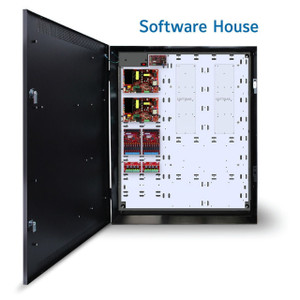
Lifesafety Power FPO250/250-4M8PNLCSD16E4 250W Managed Power Supply
Overview
The Lifesafety Power FPO250/250-4M8PNLCSD16E4 is a 250W managed power distribution system designed for multi-camera and access-control installations where circuit-level protection and output isolation matter. This supply outputs either 20A at 12VDC or 10A at 24VDC, distributed across eight supervised outputs rated at 2.5A each. Class 2 power-limited design means integrators can run low-voltage runs without conduit in many jurisdictions—a real cost save on retrofit jobs. The eight-channel managed distribution module lets you supervise and control each output independently, catching shorts or load failures before they cascade across the entire system.
Key Features
- 250W total capacity: Sufficient for 8–12 full-power IP cameras, alarm panels, or access readers without undersizing your power budget mid-deployment.
- Selectable output voltage (12VDC or 24VDC): Covers both legacy analog systems and modern IP devices; choose once at configuration and run all eight outputs at that voltage.
- 20A @ 12VDC or 10A @ 24VDC primary output: Delivers enough current to feed the entire distribution module at full load without voltage sag, critical for sites with long cable runs or peak demand spikes.
- Eight managed outputs, 2.5A per channel: Each output is individually supervised and current-limited, preventing a single short-circuited camera or reader from killing power to the rest of the system. This isolation is invaluable in multi-tenant or distributed-camera deployments.
- Class 2 power-limited design: Simplifies installation codes in many jurisdictions—no conduit required for low-voltage runs, reducing material and labor cost on retrofits or sprawling warehouse jobs.
- Managed distribution capability: Monitor and manage each of the eight outputs; some configurations support remote supervision, letting you catch a failed camera feed or disconnected reader before a floor supervisor calls in a trouble ticket.
Integration & Compatibility
Integrates with any IP camera or access-control device drawing under 2.5A per channel. The FPO250/250-4M8PNLCSD16E4 fits into larger security architectures where network video recorders or access-control panels require stable, supervised 12V or 24V rails. Output isolation makes it suitable for mixed environments—run cameras on some outputs, readers on others, without crosstalk risk. Check your device datasheets for actual draw; a typical IP camera pulls 5–12W, and most access readers under 5W, so you'll fit 8–12 devices comfortably on a single supply.
Deployment Context
Choose this supply for warehouse automation, retail, or multi-floor office sites where you need to distribute 12V or 24V power to scattered cameras, readers, or sensors and want per-output circuit protection built in. The FPO250/250-4M8PNLCSD16E4 (often searched as FPO250/250 4M8PNLCSD16E4) shines in retrofit scenarios where running individual power lines to each device is impractical and centralized, supervised distribution saves troubleshooting time. Avoid this model if your cameras are PoE-powered and you need only AC mains conditioning—use a PoE-enabled network switch instead. If your load exceeds 250W total or any single device draws more than 2.5A, step up to a larger Lifesafety supply or a parallel redundant configuration.
When to Choose a Different Model
If you need higher per-channel current (e.g., 24V solenoid locks or high-power LED lighting), consider a Lifesafety model with higher per-output ratings. If you require battery backup for 2–4 hours during mains loss, look for a Lifesafety supply with integrated UPS or charger in the same family. If your entire deployment is PoE cameras and managed switches, this product is unnecessary—your switch's PoE budget may be sufficient, and you'll save the cost of a separate supply and cabling.
Frequently Asked Questions
Q: Can I run both 12VDC and 24VDC outputs simultaneously on the FPO250/250-4M8PNLCSD16E4?
A: No. This supply is configured for either 12V or 24V at installation. All eight outputs share the same voltage rail. If you need mixed voltages, you'll need two separate supplies or a different Lifesafety model that supports dual-voltage outputs.
Q: What happens if I exceed 2.5A on a single output?
A: That output will shut down to protect the device and the supply. Check your load's actual current draw before commissioning. Most IP cameras and access readers pull well under 2.5A, but LED illuminators or solenoid locks may exceed it.
Q: Is the FPO250/250-4M8PNLCSD16E4 suitable for outdoor installations?
A: The supply itself is typically mounted indoors in a secure cabinet or equipment room. Run the 12V or 24V output to outdoor cameras or readers via shielded or twisted-pair cable. Verify the supply's operating temperature range matches your equipment room conditions.
Q: Do I need a separate UPS or battery backup with this supply?
A: The base FPO250/250-4M8PNLCSD16E4 does not include battery backup. If your cameras or access readers must stay powered during mains failure, add an external battery charger/UPS module or upgrade to a Lifesafety supply with integrated backup.
Q: How many IP cameras can this supply power?
A: Typically 8–12, depending on camera model and draw. A standard IP camera draws 5–12W (roughly 0.4–1A at 12V). Eight outputs at 2.5A maximum = 20A total capacity at 12V, or about 250W. Audit your camera specs and add a 20% headroom margin in your load calculation.
I spec the Lifesafety Power FPO250/250-4M8PNLCSD16E4 into warehouse and multi-camera retail deployments where per-output isolation and supervision keep downtime predictable. That Class 2 power-limited design is a genuine cost lever on retrofit jobs—no conduit runs required, which cuts material and labor. The eight managed outputs at 2.5A each mean a short on one camera doesn't kill power to seven others, and that's worth its weight on sites where you can't afford a 4-hour camera outage.
Technical Highlights:
- 250W total, 20A @ 12V or 10A @ 24V primary: Sufficient headroom for 8–12 IP cameras or mixed loads (cameras, readers, sensors) without voltage sag over typical cable runs. The dual voltage selection covers both legacy 24V alarm panels and modern 12V IP devices from a single supply.
- Eight independent, 2.5A per-output circuits: Each channel is individually protected and supervised. A shorted camera on output 3 triggers only that channel; outputs 1, 2, 4–8 stay live. This isolation is critical in distributed warehouse or multi-tenant environments where a single point of failure can cascade across an entire floor.
- Class 2 power-limited: Simplifies code compliance and eliminates conduit cost on low-voltage runs—real money on 50–100 meter retrofit jobs. You're dealing with safety-limited power, so inspectors approve it faster.
Deployment Considerations:
- Configure voltage once at install: you cannot run 12V and 24V simultaneously on the eight outputs. Plan your device mix upfront, or accept the cost of a second supply for mixed-voltage installations.
- Watch cumulative load: eight outputs at 2.5A each = 250W at 12V or 240W at 24V. A single high-draw device (24V solenoid, high-power IR illuminator) can eat 4–6W. Size your cameras and readers accordingly, or you'll hit per-output limits and frustrate yourself at go-live.
- This supply is indoor-mounted. Mount it in a secure cabinet or locked equipment room, ideally near your NVR or access control panel. Run the 12V/24V distribution lines to outdoor cameras via shielded twisted pair to minimize noise and voltage drop on long runs.
Best fit: retail locations with 8–12 distributed cameras and a central access reader, warehouse automation sites with mixed camera and sensor loads, and multi-floor office retrofits where per-output supervision prevents cascading outages. Skip this if your entire deployment is PoE IP cameras and your network switch has sufficient PoE budget—you'll save the supply cost and cabling overhead. For sites needing battery backup, add an external UPS or specify a Lifesafety model with integrated charger in the same family.