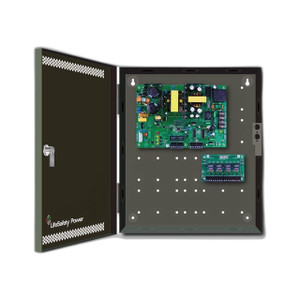
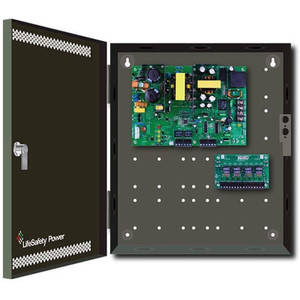
Lifesafety Power FPO150-B100C82D8PE6M/T8-C Mercury ProWire Power Supply
The Lifesafety Power FPO150-B100C82D8PE6M/T8-C is a dual-voltage access control power supply engineered to integrate FlexPower modules, door locks, readers, and fire alarm signaling into a single UL-listed enclosure. Designed for mid-to-large deployments requiring redundant power paths, intelligent battery management, and hardwired fire-life safety compliance, the Mercury ProWire consolidates power distribution and logic without requiring external relays or additional cabinetry. The 150W total output, paired with dual-bus voltage selection and zone-level control, makes it suitable for multi-building campuses and facilities with mixed 12V and 24V lock/reader ecosystems.
Key Features
- Dual Voltage Output: 12V and 24V buses independently selectable by zone. Eliminates need for separate power supplies and reduces cabinet footprint on mixed-voltage installations.
- 150W Total Capacity: Supports up to 16 auxiliary outputs (2.5A Class 2 each) and 8 relay lock outputs (3A fused each). Sized for 8–16 door deployments without external expansion.
- Fire Alarm Disconnect: Built-in Form C contact triggers automatic door unlock on fire alarm signal. Meets life-safety code requirements without hardwiring to external relay modules.
- OutSmart Dual-Color LED Indicators: 12V (green) and 24V (blue) visual status per output zone. Technicians verify power routing and fault state without menu navigation.
- Low-Battery Cutoff & Fast Charging: Prevents deep discharge damage to backup batteries; dedicated charger circuit extends battery lifespan across extended power outages.
- Surge & Fault Protection: Enhanced input/output surge immunity; AC Fault and System Fault Form C contacts report low/no battery, ground shorts, supply failure, or blown fuses to external monitoring systems.
- Programmable Relay Outputs: Each of 8 lock outputs configurable failsafe/failsecure, with NC/NO input logic and voltage or dry-contact switching per zone.
- Network-Ready Architecture: Optional NetLink module enables battery voltage monitoring, remote battery test, and power supply status in a centralized IP dashboard.
- Locksafe Optimized Voltages: Output regulation preserves lock solenoid coil integrity under sustained load, extending hardware life in 24/7 operation.
The FPO150-B100C82D8PE6M/T8-C enclosure (30.0H × 23.0W × 6.5D inches) is mounted surface or flush and scales from small office access control to enterprise-class multi-building campuses. Class 2 auxiliary outputs run low-voltage sensors, request-to-exit buttons, and door status switches; the 8 Form C relay outputs drive electromagnetic locks, strike plates, and maglocks across mixed failsafe/failsecure logic per door. Dual-bus architecture means you can supply 12V to badge readers and 24V to high-draw solenoids from the same cabinet without internal voltage conversion.
Backup battery integration is transparent: the internal charger manages trickle charge and equalization, while low-battery cutoff preserves cell life during extended blackouts. AC Fault and System Fault relay contacts feed into fire alarm panels or building management systems, creating a hardwired notification path independent of IP connectivity. On-site technicians use the dual-color LEDs to verify which zones are powered and which are in fault state, reducing mean-time-to-repair when troubleshooting door access delays. The OutSmart design eliminates guesswork in multi-zone installations.
Optional NetLink networking adds remote diagnostics: battery voltage trending, remote battery test capability, and real-time power supply status appear in a centralized dashboard. This visibility is especially valuable on campuses where power supplies are distributed across multiple buildings and on-site inspection rounds are infrequent. The lifetime warranty reflects Lifesafety Power's manufacturing confidence; the UL listing ensures code compliance for life-safety applications in healthcare, education, corporate, and industrial facilities. The combination of integrated fire alarm disconnect, dual-voltage flexibility, and battery management eliminates external control modules and reduces BOM cost on larger deployments.
Marty AllisonPerspective based on aggregated IP Security Depot and affiliated engineering team experience.
In our experience, the Mercury ProWire FPO150 fills a specific and important gap: mid-sized access control deployments where integrators need to consolidate power, battery backup, and fire-life-safety signaling without over-engineering a rack-mount UPS or building a custom relay cabinet. We've seen integrators spec this into office parks, medical office buildings, and light-industrial campuses where the number of doors (8–16 per controller) justifies the investment in a single intelligent enclosure. The dual-voltage bus selection is the silent efficiency win — on a 12-door site with mixed 12V readers and 24V locks, you eliminate the need for a second dedicated 12V supply or DC-to-DC converters, which in turn saves cabinet space, wiring complexity, and failure points.
The hardwired fire alarm disconnect is non-negotiable in code-controlled environments. We've installed plenty of systems where the fire panel has to trigger door unlock, and building inspectors want to see a direct relay contact, not an IP signal. The Mercury ProWire bakes that into the enclosure, so the integrator doesn't have to wire a separate fire alarm interface module or worry about network dependency during an evacuation scenario. That's compliance-ready out of the box.
Technical Highlights:
- 150W Total Output, 8 Lock + 16 Aux Outputs: Provides enough capacity for a single-controller footprint (no cascading power supplies) across 8–16 doors. Lock outputs are 3A fused; auxiliary outputs are 2.5A Class 2. Real-world consequence: you can supply a pair of 24V mag locks (1.5A each) and a 12V reader bank (6–8 readers, ~0.8A total) from one cabinet without undersizing.
- Dual-Bus Voltage Selection by Zone: Each relay and auxiliary output group can be independently mapped to 12V or 24V. Operational benefit: mixed-voltage estates don't require separate power supplies or external buck converters; zone-level switching reduces cabling and simplifies troubleshooting when voltage mismatches occur.
- Form C Fire Alarm Contact + AC/System Fault Contacts: Fire panel or BMS can trigger unlock via hardwired relay without IP dependency. Low-battery, ground-fault, and supply-failure conditions generate discrete relay events for remote monitoring. Compliance and diagnostics are decoupled from network uptime.
- Low-Battery Cutoff + Dedicated Charger: Automatically disconnects load when backup battery voltage drops below safe threshold, preventing permanent cell damage. Charger circuit tailors trickle charge to battery chemistry, extending runtime and lifespan across multiple discharge/recharge cycles. On a site with frequent power events, this translates to 2–3× longer battery service life versus unregulated charging.
- OutSmart Dual-Color LED Status (12V Green / 24V Blue): Visual indication of which voltage bus is active per zone. Technician benefit: during a service call or fault diagnosis, you can visually confirm power routing without a multimeter or system access. Reduces diagnostic time on multi-zone cabinets.
- UL Listed, Lifetime Warranty: Manufacturer stands behind the unit long-term. No planned obsolescence; parts availability and support are predictable across a 10–15 year facility lifecycle.
Deployment Considerations:
- Backup Battery Sizing: The FPO150 itself is the charger and distribution center, but you must select and specify the backup battery separately. A typical 12Ah 24V sealed lead-acid battery provides 2–4 hours of runtime (depending on load draw) for an 8-door site. Undersizing backup capacity is a common mistake — work with the integrator to model worst-case load and minimum acceptable runtime.
- Fire Alarm Panel Wiring: The built-in fire alarm disconnect is a Form C contact (SPDT). Your fire alarm panel must be configured to close or open that contact during alarm. Verify compatibility with the fire alarm system vendor (Notifier, EST, Honeywell) before installation; wiring is straightforward but the logic must match the panel's output card behavior.
- Zone Configuration & Output Isolation: Configuring zone-level voltage selection requires understanding your door hardware. If a single zone contains both 12V readers and 24V locks, you'll need sub-zone relay outputs or an external distribution panel. Not a flaw, but it's a design decision that should be made before rough-in.
- Network Module Optional: NetLink adds cost and complexity. For sites without centralized monitoring or with infrequent service intervals, the on-board LEDs and manual battery test may be sufficient. For large campuses or remote facilities, the upfront investment in NetLink visibility pays for itself in reduced emergency service calls and faster diagnostics.
- Enclosure Mounting & Thermal: The 6.5-inch depth is compact, but the FPO150 generates moderate heat when supplying sustained 150W load (especially during battery charging). Mount in a climate-controlled environment or ensure airflow. In unheated outdoor equipment rooms, thermal runaway during summer can degrade charger performance and battery longevity.
- Fuse Replacement & Spare Parts: The 8 relay outputs are individually fused (3A). Keep spares on-site. The auxiliary outputs are Class 2 protected, not fused; short-circuit protection is electronic. If a relay output is repeatedly nuking fuses, investigate the lock load (shorted solenoid) before cycling power.
The Mercury ProWire FPO150 is the right choice for integrators building multi-building or multi-zone campuses where dual-voltage flexibility, fire-code compliance, and network-optional monitoring matter. It's overkill for a single-door installation and under-featured for a 50-door enterprise; the sweet spot is 8–20 doors spread across 2–4 buildings. Explore the full Lifesafety Power catalog for higher-capacity options or single-voltage variants if your deployment profile differs.