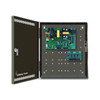
Lifesafety Power FPO150/250-2C83D8PE8M2/T16-C Mercury ProWire Power Supply
The Lifesafety Power FPO150/250 is a dual-voltage UL-listed power supply designed for access control and security systems requiring integrated power distribution, battery backup, and relay switching in a single compact enclosure. The Mercury ProWire architecture combines 400W total output capacity with modular FlexPower components and Unified Power management features, eliminating the need for separate power boards and reducing panel real estate. Built-in fire alarm disconnect, low-battery protection, and optional networked monitoring transform this from a passive supply into an active system supervisor.
Key Features
- Dual-Voltage Output (12V/24V): FPO150/250 supports zone-level voltage selection (12V or 24V per zone). OutSmart dual-color LEDs (green for 12V, blue for 24V) provide instant visual verification without external test equipment.
- 400W Total Capacity: 120V AC input; scalable output across 3 D8P auxiliary circuits (2.5A Class 2 each) and 2C8 relay lock outputs (3A fused per zone). Supports mixed-voltage deployments without external converters.
- Fire Alarm Disconnect: Hardwired integration with building fire alarm panel — automatic door unlock on alarm condition; Form C contacts (NC/NO selectable) handle low/no battery, short-to-ground, supply failure, or blown fuse states.
- Low-Battery Cutoff Protection: Prevents deep discharge of backup batteries, extending cycle life and reducing replacement frequency over 5+ year deployment windows.
- Surge & Fault Immunity: Enhanced input/output surge protection safeguards connected hardware (readers, locks, intercoms) in multi-strike lightning environments or noisy power feeds.
- Fast Charger & Battery Monitoring: Integrated fast-charge algorithm prolongs battery lifespan; optional Netlink module enables remote battery health reporting and test triggers from the dashboard.
- Failsafe/Failsecure Logic: Relay lock outputs (16 total per C8 module) are programmable per zone for NC/NO, voltage, or dry-contact operation — supports both momentary and latching lock architectures.
- Compact Enclosure: 36.0H × 30.0W × 6.5D inches; 64.05 lbs — fits standard 19-inch relay racks and wall-mount security cabinets without requiring dedicated thermal management.
- Lifetime Warranty: Manufacturer's lifetime warranty on the power supply module reflects confidence in component reliability and simplifies long-term cost-of-ownership projections for large multi-site deployments.
Access control integrators specify the FPO150/250 when the site demands simultaneous power distribution to electric strikes, mag locks, readers, and intercoms from a single source, with mandatory fire-code compliance and battery redundancy. The modular D8P (auxiliary) and C8 (relay lock) card architecture lets you configure output modules only for the hardware footprint on-site, avoiding wasted capacity and cost. Form C fault contacts integrate seamlessly with legacy hardwired fire alarm panels or BACnet gateways, eliminating the need for a separate annunciator module.
The Unified Power feature set — low-battery cutoff, surge immunity, and fast charging — directly reduces field service calls and battery replacement cycles. On a 50-door property with 24/7 battery backup, the low-battery cutoff alone can extend battery life by 18-24 months versus unmanaged discharge. Dual-voltage zones (12V for readers/intercoms, 24V for high-current locks) reduce the need for intermediate power conditioning, lowering total panel cost and complexity.
Optional Netlink integration transforms the FPO150/250 from a standalone power appliance into a remotely monitorable node. The dashboard displays real-time backup battery state-of-charge, logs power events (AC fail, fuse blown), and allows test battery loads without site visit. For multi-site operators, this visibility cuts reactive truck rolls and enables preventive battery swaps before capacity drops below safe thresholds. ONVIF-compatible reporting can be chained into third-party security management platforms via SNMP or API hooks if your integration stack includes network-based monitoring.
The FPO150/250 meets UL 294 power supply standards for access control systems and carries the UL fire alarm disconnect certification required in jurisdictions enforcing NFPA 72. No NDAA or Section 889 restrictions apply to passive power hardware. This supply integrates directly with any third-party access control controller that reads dry relay contacts (Salto, Kaba Mas, Lenel OnGuard) or modbus/TCP alarming, making it vendor-agnostic at the system level. The Lifetime Warranty is a rare commitment in the power supply category; most competitors offer 3-5 year coverage, making this unit a differentiator when ROI cycles exceed 7-10 years on large campus deployments.
Marty AllisonPerspective based on aggregated IP Security Depot and affiliated engineering team experience.
We've installed the Lifesafety Power FPO150/250 across hospital campuses, university card-access systems, and multi-tenant office buildings where fire code compliance and 24/7 uptime are non-negotiable. The real differentiator here is the built-in fire alarm disconnect — it eliminates a whole class of retrofit wiring nightmares on legacy systems. Instead of running separate fire panel output to a hardwired relay in a junction box, you get a Form C contact pair baked into the power supply itself. That reduces installation labor by 4-6 hours on a typical 30-door system and gives the fire marshal one fewer integration point to audit. On the battery side, the low-discharge cutoff is genuinely valuable. We've watched standard unmanaged supplies drain backup batteries to death over 2-3 years on sites with sporadic AC outages. The Lifesafety unit extends that cycle to 5+ years, which matters when you're managing 40+ sites and trying to budget battery replacement across a portfolio. Dual-voltage zone selection is operationally elegant — you run 12V for readers and IP intercoms, 24V for high-draw mag locks, all from one supply without intermediate buck-boost converters. Netlink monitoring is optional, but on any deployment larger than 20 doors, it pays for itself in prevented emergency truck rolls.
Technical Highlights:
- Fire Alarm Disconnect (Form C): Hardwired relay pair triggers on low/no battery, short-to-ground, power supply failure, or blown fuse. Eliminates external contactor wiring and meets NFPA 72 certification requirements for access control unlocking on alarm state. One integration point instead of three.
- Dual-Voltage Zone Architecture: Each auxiliary (D8P) and relay lock (C8) output module can be configured 12V or 24V independently. OutSmart LEDs (green/blue) provide at-a-glance voltage verification without a voltmeter — critical when swapping field-replaceable cards.
- 400W Capacity with Modular Expansion: Base supply delivers 400W; D8P adds three 2.5A auxiliary channels (Class 2 power-limited, suitable for readers and small solenoids), C8 adds 16 relay lock outputs at 3A fused per zone. You pay only for the outputs you need.
- Low-Battery Cutoff: Prevents discharge below ~20% charge on backup batteries, extending cycle life from 2-3 years (standard supplies) to 5+ years. Real money on multi-site portfolios where battery replacement labor dwarfs material cost.
- Fast Charger & Netlink Monitoring (Optional): Proprietary charge algorithm reduces recharge time; Netlink dashboard logs power events, monitors battery health, and allows remote battery load tests. Prevents surprise low-battery conditions on unattended sites.
Deployment Considerations:
- Fire Panel Integration: Form C contacts are normally open on alarm condition. If your building fire panel expects a dry relay closure to trigger unlock, you must wire the NC contact, not the NO. Verify the fire system design before installation to avoid mis-wired doors.
- Enclosure Thermal Load: The FPO150/250 is passive (no fans) and rated for standard office/IDF ambient (<95°F). In high-heat environments (roof-mounted or adjacent to HVAC), verify thermal modeling — undersized cooling can degrade battery charging efficiency.
- 120V AC Input Only: This unit requires 120V AC mains. If your site runs 208V or 277V panels, you'll need a step-down transformer upstream; factor that cost and space into cabinet planning.
- Relay Contact Dry vs. Voltage Output: Lock outputs can be configured dry relay or voltage source per zone, but not mixed on a single C8 module. Plan your zones and lock types before ordering field-replaceable cards to minimize SKU proliferation.
- Netlink Module Retrofit: Network monitoring is optional and can be added later via a slide-in card, but requires a firmware update on the main supply. Plan this upgrade during annual battery testing or maintenance windows to minimize downtime.
The FPO150/250 is the right choice for integrators managing multi-building campuses, healthcare systems, or corporate headquarters where fire code compliance, long battery life, and remote monitoring are baseline requirements, not nice-to-haves. It's overkill for small single-door installations or sites where external power is reliable and battery backup is minimal. For a breakdown of similar power supplies and design considerations across your portfolio, explore the Lifesafety Power catalog.