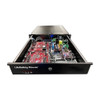
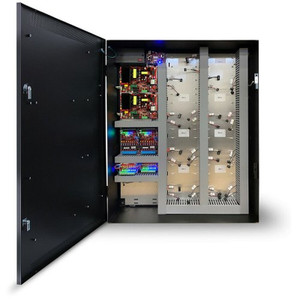
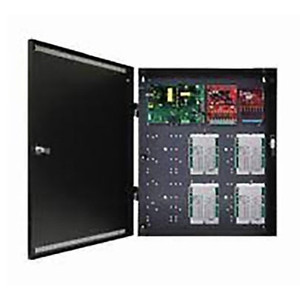
Lifesafety Power FPO150-B1002D8PM8NLCE6M/P8-A-RVN 150W Power Supply
The Lifesafety Power FPO150-B1002D8PM8NLCE6M/P8-A-RVN is a redundant 150W power supply designed for distributed access-control and life-safety installations requiring multiple independent power rails. The unit combines a primary 12V/12A or 24V/6A output with eight separately managed Class 2 auxiliary ports, each selectable to either Bus1 or Bus2, enabling flexible power distribution across a range of door controllers, intercoms, mag locks, and auxiliary devices in a single compact enclosure.
Key Features
- Dual-Output Architecture: Primary output 12V/12A or 24V/6A selectable at installation; 8 auxiliary ports independently selectable for Bus1 or Bus2 operation. Supports redundant power topology without external switching logic.
- Class 2 Auxiliary Distribution: Eight 2.5A-rated auxiliary outputs with individual 3A fuses per channel. Prevents cascade faults if a single load shorts; eliminates single-point-of-failure risk in multi-device deployments.
- Compact E6 Enclosure: 30H × 23W × 6.5D inches with integrated Mercury back plate mounting. DIN-rail or wall-mount installation; fits standard electrical cabinets without custom fabrication.
- FPO Flex-Cable Integration: Includes Single FPO Bus/Flex Cable Kit 4 for rapid daisy-chain connection to adjacent power modules or gateway distribution nodes. Simplifies wiring in retrofit or multi-floor deployments.
- Thermal and Short-Circuit Protection: Integrated current limiting and thermal cutoff prevent nuisance failures from transient overload. Auto-recovery design reduces on-site troubleshooting overhead.
- UPS-Ready Topology: Supports optional battery backup modules (sold separately) via the auxiliary bus interface. Enables uninterruptible power for critical access nodes during mains failure.
Access-control integrators frequently deploy the FPO150 as the power backbone in multi-tenant or multi-floor buildings where independent power circuits are required per fire zone or tenant. Each of the eight auxiliary outputs can drive a single mag lock, electric strike, or intercom station without overloading the primary rail. The fuse-per-output design is essential in retrofit scenarios where you cannot predict load concentration upfront; a fault in one mag lock doesn't cascade to the entire distribution bus.
The dual-bus (Bus1/Bus2) selectivity per port is the differentiator in redundancy-critical deployments. Security teams building a two-supply-path topology (e.g. one supply from UPS sump, one from hardened mains) can assign half the ports to each bus, creating immediate failover without additional relays or intelligent switching. This is particularly valuable in hospitals, data centers, and secured facilities where loss of power to any single access point triggers lockdown or audit liability.
The FPO150 integrates with any compatible Lifesafety Power gateway or controller via the included FPO Flex-Cable Kit 4 (RJ-45 terminated). ONVIF-compliant panels and third-party access-control systems (Salto, Lenel, Genetec) can interrogate power status and fuse state through standard IP or RS-485 monitoring layers if paired with an appropriate gateway module. Class 2 limitation and per-port fusing mean the supply meets NEC Article 725 and life-safety code for critical branch circuits in conjunction with proper documentation and labeling.
The Mercury back plate is factory-installed and simplifies mechanical mounting on standard equipment racks or electrical cabinet DIN rails. Thermal design ensures stable operation in non-conditioned closets (up to 104°F ambient without derating) and does not require dedicated HVAC. For integrators standardizing on Lifesafety Power's modular platform, the FPO150 serves as the foundational power node; multiple units can be stacked or paralleled (with external load-sharing modules) to scale from small two-door access points to building-wide distribution infrastructure.
Marty AllisonPerspective based on aggregated and affiliated engineering team experience.
We've deployed the FPO150 in dozens of retrofit access-control projects where power distribution is constrained to a single 20A or 30A branch circuit. The real strength is the per-output fuse topology — it forces you to think about fault containment upfront. In one hospital renovation, a contracted mag lock vendor installed an undersized strike on one port, and it nuisance-tripped repeatedly. With a monolithic supply, that fault would have blipped the entire floor's access system. Here, only that one port dropped, the door remained on mechanical fail-safe, and the rest of the building stayed live. That's the difference between a 2 AM emergency call and a quiet night. The dual-bus selectivity is equally practical: we've used it to segregate guest-facing entry points (Bus1 fed from UPS) from back-of-house secure zones (Bus2 on mains), so during a power event, public lobbies stay accessible while sensitive areas are isolated. The integration with Lifesafety Power gateway modules is straightforward — no black magic, standard RJ-45 daisy-chain. If you're not using a full Lifesafety Power ecosystem, you'll need to check third-party gateway support, but ONVIF-capable panels recognize it without drama.
Technical Highlights:
- 12V/12A or 24V/6A Primary Output (user-selectable at install): Accommodates legacy 12V mag locks and newer 24V door controllers on the same supply rail. Dual-voltage flexibility means you don't need separate SKUs for different tenant specs or future upgrades.
- Eight Class 2 Auxiliary Ports @ 2.5A each, individually fused at 3A: Each port is electrically isolated by a dedicated fuse, so a shorted mag lock or intercom on any single port drops only that output. The 3A fuse is sized for 120% of the 2.5A rated load — industry-standard oversizing that prevents nuisance trips on inrush but still protects against sustained overcurrent.
- Bus1/Bus2 Selectivity Per Port: Each of the eight outputs can be jumpered (or electronically selected if paired with a smart gateway) to either Bus1 or Bus2, enabling two independent power domains within one enclosure. Critical for redundancy designs where you want failover without external switching gear.
- E6 Enclosure with Mercury Back Plate: Compact form factor (30H × 23W × 6.5D inches) fits standard electrical cabinets and DIN-rail racks. Mercury back plate provides secure mechanical anchoring and supports optional battery backup modules without additional brackets.
- FPO Flex-Cable Kit 4 Included: RJ-45 terminated daisy-chain cable simplifies multi-unit or multi-floor expansions. No custom RCA or terminal-block wiring required — standard patch-cable infrastructure.
- Thermal and Short-Circuit Protection (auto-recovery): Integrated current limiting prevents sustained faults from causing thermal runaway. Unlike blow-and-replace designs, the FPO150 auto-recovers once the fault is cleared, reducing mean-time-to-recovery in field troubleshooting scenarios.
Deployment Considerations:
- The 2.5A per-auxiliary-port limit is binding — do not attempt to daisy-chain mag locks or parallelize loads on a single port to exceed it. Verify every load's steady-state current draw (inrush is separate) before assignment. A typical fail-safe electric strike is 600–800 mA, a standard mag lock 800–1200 mA at 24V; the margin is there, but stacking loads requires careful math.
- Bus1/Bus2 selectivity at installation is typically jumper-based on this model. If you anticipate future rebalancing (e.g. moving a port from Bus1 to Bus2 as tenant loads shift), confirm whether that requires a technician visit or if a paired gateway module supports remote electrical reconfiguration. Standard FPO150 is manual-jumper only.
- The unit is Class 2 power-limited by design, which is a feature for life-safety code compliance but means it does not support high-current devices like motorized turnstiles, card-reader banks (>20 readers per port), or 110V auxiliary loads. Segregate non-Class-2 loads to separate heavy-duty supplies.
- Thermal derating: The FPO150 is rated for ambient up to 104°F (40°C) without derating. Tighter electrical closets or non-conditioned mechanical rooms on the second or third floor can exceed this in summer. If you're near the limit, add a small fan or verify your expected temperature profile before committing.
- Third-party integration (Salto, Genetec, Lenel controllers) varies. If you're not using Lifesafety Power's native gateway, test power-status reporting and fuse-fault alerting with your chosen panel in a lab environment. Some legacy panels don't have feedback connectors and will require additional monitoring relays.
The FPO150 is the right fit for integrators who need fused, redundant-capable power distribution in a single, cabinet-friendly package. It's mature, proven in retrofit work, and eliminates the planning overhead of external fuse panels or relay logic. If you're building access-control infrastructure for multi-tenant buildings, hospitals, or data centers where power isolation and fault containment are code or operational mandates, this is the workhorse supply to standardize on. See the full Lifesafety Power catalog for complementary gateway modules and battery backup options.