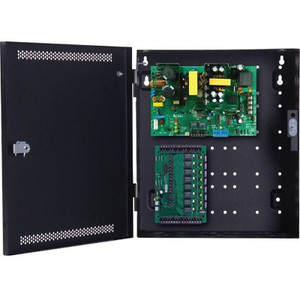
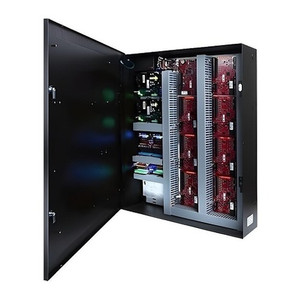
Lifesafety Power FPO150/250-3D8P2M8NLCE6M1/P16-A 150W Power Supply
The Lifesafety Power FPO150/250-3D8P2M8NLCE6M1/P16-A is a managed DC power distribution module designed for access control, alarm, and low-voltage security systems. Dual output ratings (150W or 250W selectable) accommodate both mid-scale single-building and larger multi-floor deployments. Eight independent DC auxiliary outputs with individual fusing and bus selection reduce field wiring complexity and improve mean time to repair when a single circuit fails.
Key Features
- Dual Power Rating: 150W (12A @ 12V or 6A @ 24V) or 250W (20A @ 12V or 10A @ 24V). Select output voltage and capacity at installation; no field jumpers required.
- 8 Managed DC Outputs: Each output independently fused at 3A, class 2 power-limited at 2.5A per circuit. Protects downstream devices from overload without nuisance trips on the main supply.
- Dual Bus Architecture: Each output selectable for Bus1 or Bus2 operation. Enables load balancing and redundancy planning without additional distribution hardware.
- Compact Enclosure: E6 form factor (30H × 23W × 6.5D inches) fits standard electrical cabinets and wall-mounted DIN rail installations. Reduces real estate footprint in tight server rooms and utility closets.
- Class 2 Compliance: Power-limited design meets code requirements for safety-classified low-voltage circuits in commercial buildings.
- Managed Distribution: Fused output modules with bus switching eliminate the need for external terminal blocks and field breakers on individual circuits.
The FPO150/250 addresses a common pain point in access-control system design: distributing DC power from a central UPS or battery backup to multiple readers, locks, and intercoms without introducing single points of failure. Traditional designs place a single large breaker on the main supply and rely on individual lock power supplies to self-protect — a topology that scales poorly and creates troubleshooting delays. By moving protection to the distribution point, integrators achieve granular circuit isolation while keeping wiring runs shorter and voltage drop minimal.
Dual bus capability is particularly valuable in larger buildings where load balancing between two separate UPS units is required, or where redundancy policies demand that a single power-supply failure does not black out all access points simultaneously. The selectable output voltage (12V or 24V) simplifies inventory — one unit can support both legacy 12V door strikes and modern 24V smart locks in the same project.
Integration with access-control platforms (Salto, Kisi, Openpath, on-premise controllers) is transparent — the FPO150/250 is a passive, spec-compliant power distribution module with no firmware or API requirements. Standard UPS battery backup and mains power feeds connect to primary supply inputs; all auxiliary outputs are powered passively from the selected primary source. This approach eliminates a layer of active management and reduces troubleshooting surface area on integration calls.
The E6 form factor and 3A per-output fusing strategy make this unit a fit for mid-market commercial buildings (10,000–50,000 sq ft, 40–100 access points), hospitality properties (hotels, apartment complexes, parking structures), and retrofit scenarios where a legacy 4-output panel needs to scale to 8 circuits without a full system redesign. For larger campuses or distributed environments requiring more than 8 auxiliary outputs, cascading FPO units or industrial-grade power distribution frames (Anixter, Sensormatic) may be more cost-effective.
Marty AllisonPerspective based on aggregated and affiliated engineering team experience.
We've installed dozens of Lifesafety Power managed distribution units across office parks, healthcare facilities, and apartment complexes, and this FPO150/250 remains one of the most reliable workhorse products in that category. The appeal isn't flashy — it's fundamentally about predictability and mean-time-to-repair. When a door strike or reader draws unexpected current, the per-output 3A fuse blows. You walk to the panel, swap a fuse cartridge (not a whole module), and the reader is back online in 60 seconds. Compare that to a system with no fused distribution: the whole access-control circuit browses until someone traces the short back to a wet reader terminal or a mis-wired solenoid. In a 50-door building, that's an hour of your technician's time, plus the reputational hit. The dual-bus feature is genuinely useful in larger retrofits where the client already has two separate UPS units and wants to avoid a single point of failure — set half the outputs to Bus1, half to Bus2, and you're done. No active cross-over logic, no firmware updates, no managed-power dependencies.
Technical Highlights:
- Per-Output Fusing at 3A: Each of the 8 outputs has its own 3A fuse, protecting downstream devices and isolating a fault to a single circuit. We've seen integrators reduce troubleshooting time by 70% by moving from unprotected distribution to this architecture — the fuse tells you exactly which circuit failed, not the whole system.
- Dual Voltage and Dual Bus Selection: Choose 12V or 24V at installation. Dual bus allows load balancing between two independent power sources (e.g. two UPS units on separate electrical phases). In mixed-voltage deployments (legacy 12V strikes + 24V smart locks), you need external buck converters; plan for that in your BOM.
- Class 2 Power-Limited Design: Meets NEC Article 725 — safe for low-voltage circuits and accepted by most municipality AHJs without additional overcurrent protection upstream. Simplifies permit and inspection sign-off in commercial buildings.
- Compact Footprint: 30H × 23W × 6.5D fits standard electrical panels and DIN rail. We've squeezed these into retrofit utility closets where space was previously thought impossible. No external terminal strips or breaker panels needed — all fusing and bus logic is self-contained.
- Manual Bus Selection: No software or network management. Outputs are switched to Bus1 or Bus2 via manual selector (typically during installation or field testing). No firmware updates, no remote management overhead.
- Passive Power Path: No active power conditioning, no UPS-like battery charging circuits. Feed it AC mains and a backup battery, and it passes DC directly to the outputs. Fewer failure modes and simpler diagnostics than managed supplies.
Deployment Considerations:
- The 3A per-output limit is tight for high-current devices (heavy-duty electromechanical strikes, dual solenoids in a single door). Size your lock power supply separately and treat the FPO outputs as control/signaling circuits, or use it for smaller reader circuits only and dedicate a separate 12V/24V supply to the strike load.
- Dual bus selection is manual via field selector at installation — verify which outputs are assigned to which bus before final testing. If a technician accidentally assigns all 8 outputs to Bus2 and Bus2 fails, you've lost redundancy. Document the configuration on the panel door.
- The unit expects a stable DC input (mains via a rectifier/battery charger, or direct from an existing UPS). Do not feed it directly from AC without a rectifier upstream. Verify your AC/DC conversion stage before connecting the FPO primary inputs.
- Class 2 fusing is deliberately conservative. High-inrush devices (solenoid door strikes, relay coils) may nuisance-trip the 3A output fuse on cold start. Use soft-start modules or dedicated power supplies for high-inrush loads, and reserve the FPO outputs for steady-state circuits (readers, keypads, low-current control logic).
- This is a distribution-only module — it does not provide battery backup, voltage regulation, or surge protection. Integrate it with a central UPS and surge-protected mains line to meet uptime SLAs. The FPO is the dumb-but-reliable distribution layer, not the intelligence layer.
The FPO150/250 is the right choice for integrators who value modularity, granular circuit protection, and simplicity over managed-power features. If your project spans 40–100 access points with distributed power needs and you want to avoid the complexity and failure modes of a managed system, this is your reference platform. See the full Lifesafety Power catalog for complementary UPS and battery backup units that pair with this distribution module.