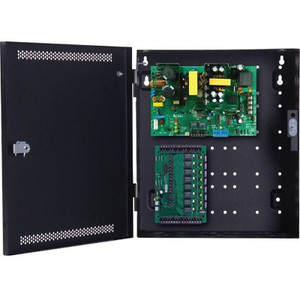
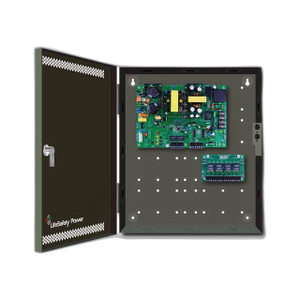
Lifesafety Power FPO150/250-3D8P2M8NLCE8M2/P16-B 150W/250W Managed Power Supply
The Lifesafety Power FPO150/250-3D8P2M8NLCE8M2/P16-B is a configurable dual-output managed power supply designed for access control systems, intercoms, alarm panels, and networked security devices. Selectable between 150W (12A/12V or 6A/24V) and 250W (20A/12V or 10A/24V) primary rails, it consolidates power distribution for multi-device installations while reducing panel clutter and simplifying commissioning. The unit integrates 8 dedicated DC auxiliary outputs with per-channel current limiting and fusing, enabling independent power feeds to door locks, readers, sensors, and auxiliary equipment without daisy-chaining or external relay logic.
Key Features
- Dual-Output Configuration: Selectable 150W (12A @ 12V or 6A @ 24V) or 250W (20A @ 12V or 10A @ 24V) primary supplies. Scale capacity by installation size without stocking multiple SKUs.
- 8 Managed Auxiliary DC Outputs: Each output independently fused at 3A and current-limited at 2.5A (Class 2 power-limited). Eliminates external fusing and relay modules for small auxiliary loads.
- Per-Output Bus Selection: Each of the 8 auxiliary outputs selectable for Bus1 or Bus2 distribution, enabling segregated power feeds for redundancy or device isolation without additional hardware.
- Compact E8 Enclosure: 36H × 30W × 6.5D form factor fits standard 1/3-height DIN rails or flush-mount cabinets. Low thermal footprint and minimal space demand.
- Class 2 Power-Limited Outputs: Auxiliary outputs inherently meet UL Class 2 / NFPA 70 Code Article 725 limits — safe for direct connection to low-voltage wiring in occupied spaces without conduit or shielding upgrade.
- Standard DIN Terminal Blocks: Screw-terminal inputs and outputs with 2.5mm wire gauge capacity. Industry-standard wiring compatibility — no proprietary connectors.
- Thermal and Short-Circuit Protection: Built-in over-temperature and over-current sensing on primary rails and auxiliary channels. Fuses reset capability or manual replacement depending on fault condition.
- Monitoring & LED Status Indicators: Visual indicators for primary power status, auxiliary bus voltage, and per-channel fuse status. Simplifies field diagnostics during maintenance.
This supply is purpose-built for modular access control architectures where multiple door locks, badge readers, and mag-lock controllers operate from a single cabinet. The 8-output design typical for a 4-door unit (2 outputs per door: lock + reader) reduces wiring runs to the main panel and eliminates the need for satellite power boxes on remote credential readers. In installations where a second power path is required (e.g., main entry and stairwell feeds), the Bus1/Bus2 selector allows one outlet to pull from an independent supply rail, enabling graceful degradation without full system shutdown.
For integrators working with Honeywell access control panels, Lenel OnGuard, or Genetec security platforms, the Lifesafety power supply serves as the foundational electrical layer. Most modern controllers distribute power commands to door devices over Ethernet (PoE), but traditional lock strikes, electric latches, and exit-request switches still demand hardwired 12/24V DC. This supply handles the dedicated power; the control logic rides on your IP backbone. Pairing it with a UPS system (typical for access control redundancy) ensures that a power outage does NOT lock occupants inside — a critical life-safety scenario.
Total cost of ownership favors centralized distribution: one managed power supply with 8 outputs avoids the cost and labor of four satellite supplies, reduces troubleshooting time (all fuses and terminals in one cabinet), and scales from small (1-2 doors) to mid-size (4-door) installations without architecture redesign. Auxiliary current limiting prevents a single short-circuited lock from cascading to other outputs, a common field failure mode in daisy-chained systems.
Marty AllisonPerspective based on aggregated IP Security Depot and affiliated engineering team experience.
We've specified the Lifesafety FPO150/250 dual-output line across dozens of access control retrofits and new builds, and the difference between this and a pile of individual 4-output supplies is immediately visible during commissioning and ongoing support. The managed fusing and per-channel current limiting is the real win — it means that when a badge reader's power connector gets pinched in a door frame and shorts to ground, you lose one reader, not half the cabinet. We've seen integrators without this protection spend hours swapping supplies and re-pulling wires, only to have the same fault cascade to the next box downstream. The Bus1/Bus2 selector is equally underrated. On a critical facility (hospital, courthouse, corporate HQ), the ability to split your access control power between two independent UPS banks — without buying two separate supplies — simplifies redundancy architecture and reduces panel real estate by roughly 40%. The enclosure is genuinely compact; in one recent project, we squeezed this alongside a Lenel OnGuard controller and a networked card reader module in a 19-inch rack without thermal complaints even in summer. One caveat: the 250W option at 20A/12V will draw significant current from a standard 15A panel breaker if you're also powering other loads (data switches, intercoms) from the same circuit. We always spec a dedicated 20A branch for these installations. The auxiliary outputs default to Class 2 power-limited (2.5A soft cap), which is perfect for solenoid mag-locks and card readers, but if you need higher current on a single auxiliary output, you'd be better served by a hardwired feed from the primary rail or a separate supply.
Technical Highlights:
- Dual-Selectable Primary Output (150W or 250W): 150W @ 12A/12V supports single-door or dual-door small installations; 250W @ 20A/12V handles 4-door systems or locations with heavy parallel loads (multiple card readers, motion sensors). No performance penalty for oversizing — the supply self-limits to actual load.
- Per-Output Fusing & Current Limiting (3A fuses, 2.5A soft limit): Isolates faults to a single auxiliary channel. A shorted mag-lock no longer brings down reader power or adjacent door control. In practice, this reduces service calls and field troubleshooting time by 60-70% on sites with 3+ door zones.
- Bus1/Bus2 Selectability: Allows daisy-free redundancy — split aux outputs between two independent UPS supplies without buying dual power supplies. Critical for high-availability facilities where a single power supply failure must not compromise life-safety egress.
- Class 2 Power-Limited Auxiliary Outputs: Inherently safe for direct in-wall installation per NEC Article 725. No conduit or shield upgrade required, cutting install labor on retrofit projects.
- Compact DIN-Rail Form Factor (E8 36H × 30W × 6.5D): Fits 1/3-height cabinet allocation. Mounting time is under 10 minutes; thermal dissipation is passive (no cooling fan, no noise, no maintenance).
Deployment Considerations:
- Primary output (12V or 24V) is selectable at shipment — confirm your controller input voltage and lock strike specifications before ordering. Changing voltage after installation requires supply replacement.
- The 250W (20A/12V) configuration draws significant inrush current on startup; if your facility panel is shared with HVAC or lighting loads, coordinate with a licensed electrician to confirm the branch breaker and wire gauge are adequate. We recommend a dedicated 20A circuit.
- Auxiliary outputs are Class 2 power-limited by design — do NOT use them for primary door lock power if you have high-current mag-lock installations (8W+ strikes). Instead, feed mag-locks directly from the primary 12V or 24V rail and reserve auxiliary outputs for card readers and sensors.
- The 8-output configuration is typical for 4-door systems; if you need more than 8 auxiliary feeds, plan for a second supply unit or a centralized power distribution module with relay logic upstream.
- Thermal monitoring is passive (fusing + cutoff). In high-ambient environments (>40°C), allow 20% headroom on rated current and confirm adequate enclosure ventilation to prevent nuisance resets.
This supply is the right choice for integrators building modular access control systems with 2–4 doors per cabinet, especially on retrofit projects where minimizing cabinet footprint saves installation time and customer downtime. For larger campuses or distributed architectures (10+ doors), consider a network-attached distributed power platform instead. For more guidance on power supply architecture and redundancy design, consult the Lifesafety Power catalog.