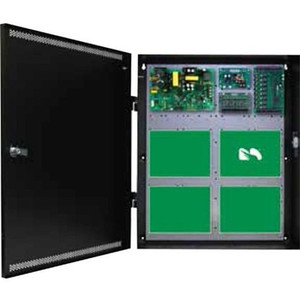
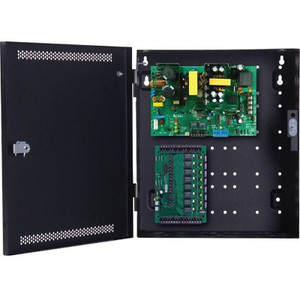
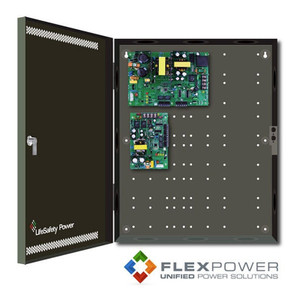
Lifesafety Power FPO150/250-3D8P2M8NLCE8M1/P16-A 150W Power Supply
The Lifesafety Power FPO150/250-3D8P2M8NLCE8M1/P16-A is a dual-output managed power supply designed for access control, alarm, and security device distribution in commercial installations. Available in 150W (12A/12V or 6A/24V) and 250W (20A/12V or 10A/24V) configurations, it provides eight independently managed Class 2 power-limited DC outputs with selectable bus assignment and fused protection. The modular design and compact E8 form factor make it suitable for retrofit and new-build deployments where centralized, regulated power distribution and fault monitoring are required across multiple security subsystems.
Key Features
- Dual Output Configuration: 150W or 250W rated capacities (12V or 24V selectable). Supports mixed-voltage architectures without requiring separate power bricks for each device class.
- Eight Managed DC Outputs: Each output Class 2 power-limited at 2.5A maximum draw, individually fused at 3A for overcurrent protection and isolation.
- Selectable Bus Assignment: Each of the eight outputs independently assignable to Bus1 or Bus2, enabling logical segregation of power groups (e.g. door readers on Bus1, magnetic locks on Bus2) without additional wiring.
- Output Monitoring & Status: Managed distribution module tracks load per output and reports fuse status to upstream controllers or monitoring systems, reducing troubleshooting time during field service calls.
- Compact E8 Enclosure: 36H × 30W × 6.5D form factor fits standard 1U DIN-rail cabinets or surface-mount backbox installations without excessive footprint overhead.
- Class 2 Safety Rating: Conforms to UL/NEC Class 2 power-limited circuit standards, eliminating the need for conduit in many jurisdictions and simplifying cable runs to distributed readers and sensors.
- Hot-Swappable Fuse Design: Individual output fuses accessible without full system shutdown, reducing mean-time-to-repair on field deployments.
- Integrated Surge/Transient Protection: Built-in protection on all outputs guards against panel-mounted solenoids, relay coil kickback, and outdoor-routed cabling transients.
The FPO150/250 excels in multi-door and multi-reader installations where a single cabinet must distribute power to 8–16 devices across a building or campus. Unlike individual power adapters, centralized managed distribution provides a single point of monitoring and diagnostics. Integrators favor this architecture for medium-scale access control systems (parking gates, office lobbies, warehouse entry points) where electrical code compliance and serviceability are equal priorities.
The dual-voltage design accommodates legacy 12V readers and newer 24V solenoid locks within the same cabinet, common in retrofit projects. Bus selectivity allows integrators to group outputs by control panel (e.g. one door controller on Bus1, a second on Bus2) or by device type (readers/controllers vs. magnets), simplifying circuit logic and reducing cross-talk on low-voltage signaling lines. The Class 2 rating permits direct bundling with access control cabling in the same conduit, lowering installation labor versus code-mandated separation of line-voltage and low-voltage runs.
Output-level fusing and status monitoring mean field technicians can identify a failed reader, mag lock, or strike without wholesale cabinet shutdown. In a 16-door installation, that translates to isolated troubleshooting on a single door versus powering down the entire entry system. The 8 outputs scale efficiently with PoE-powered IP readers (which draw minimal auxiliary 12V for relay actuation) or 24V electromechanical locks; the 2.5A per-output ceiling aligns with worst-case inrush on solenoid strikes and gate operators.
This supply is compatible with all major access control platforms (Salto, Gallagher, Hirschfeld, Lenel, DoorKing) that expect 12V or 24V regulated distribution with supervised circuits. Integration is straightforward: installer connects the 150W or 250W primary output to the panel's main rail, then distributes the eight managed outputs to door readers, electromechanical devices, and auxiliary sensors. The modular structure also pairs well with networked access control (IP-based readers) where 12V auxiliary power for door sensors or status LEDs is still required but total amperage remains low.
Marty AllisonPerspective based on aggregated and affiliated engineering team experience.
We've installed hundreds of Lifesafety Power FPO150/250 supplies across office, hospitality, and industrial facilities. The real value isn't the power delivery itself — it's the managed output architecture and fault isolation. In a typical 8-door entry system, you're looking at reader load (0.2–0.5A per unit), solenoid strike inrush (1–2A), and auxiliary sensor draw (0.1A). A cheap unmanaged 12V 10A transformer will deliver that; an FPO150/250 with selectable bus and per-output monitoring will tell you instantly which door has a stuck mag lock or failed reader. That single insight saves a service call or prevents an extended lockout. The dual 12V/24V output capability is invaluable in retrofit projects where you're integrating older 12V readers alongside new 24V electromechanical actuators — you don't have to rewire the entire system or run two separate supplies. The Class 2 rating also cuts installation cost because integrators can run the low-voltage distribution in the same conduit as control signal wiring, versus separate raceways.
Technical Highlights:
- 150W vs. 250W Scaling: 150W suffices for up to 4–6 doors with modest solenoid load (office environments); 250W handles 8–12 doors or high-inrush devices like gate operators. Choose based on peak simultaneous draw, not nameplate — most deployments run 40–60% of rated capacity in steady state.
- Class 2 Power Limiting: Each output hard-limited to 2.5A, with fusing at 3A. A short-circuited reader or shorted solenoid line trips that one output without affecting the other seven. Code inspectors appreciate this; it means you don't need additional external relays or breakers for each device.
- Bus Selectivity (Bus1/Bus2): Allows isolation of loads by control logic without physical isolation. Pair it with a dual-channel access control panel, and you can segregate egress solenoids from entry readers — useful for fail-safe vs. fail-secure configurations on the same supply.
- Managed Distribution Module: Output status (fuse OK, load voltage, current draw) is reportable via the distribution module to networked panels or monitoring systems. Early detection of slow-drift failures (reader pulling excess current due to RF interference, solenoid coil resistance creep) prevents nuisance lockouts.
- Compact Footprint: E8 form factor (6.5 inches deep) fits standard access control cabinets without extension. On crowded door frames where space is at a premium, this matters — you're not mounting an external power chassis.
Deployment Considerations:
- Solenoid strike inrush varies widely (1A–3A) depending on coil design and lock age. Always measure or simulate worst-case simultaneous draw (e.g. three mag locks engaging at once) to confirm the 150W vs. 250W choice. Undersizing by 20% on peak current will cause nuisance fuse trips.
- The 2.5A per-output ceiling is a hard limit for Class 2 compliance. Heavy-draw devices (large gate operators, heavy-duty electric strikes) may need dedicated external 24V supplies; don't try to work around it with oversized fuses or bypass wiring.
- Bus1/Bus2 selectivity is logical, not electrical — both buses are sourced from the same supply. If you need true galvanic isolation between loads, you'll need external isolation relays or a second supply. Most commercial access control systems don't require that, but verify with your panel vendor if you're mixing legacy and modern protocols.
- Class 2 rating applies only if cabling and connectors meet UL 2089 standards. Mixing in non-listed cable (e.g. Cat5e run in the same conduit) can void the rating. Confirm with your AHJ before roughing in — some municipalities are lenient, others are not.
- Output monitoring data is only useful if your access control panel or a networked gateway is listening for it. Standalone door controllers may not consume status messages, leaving that feature dormant. Verify integration with your control system before spec'ing a managed supply if panel diagnostics are a project requirement.
The FPO150/250-3D8P2M8NLCE8M1/P16-A is the right choice for mid-scale commercial access control where code compliance, serviceability, and mixed voltage support are equally important. It's overkill for single-door deployments and insufficient for large campus systems (20+ doors) without multiple supplies. Integrators who value field diagnostics and fault isolation appreciate this platform — and the time savings on troubleshooting justify the modest capex premium over a basic transformer. See the Lifesafety Power catalog for other supply ratings and configurations.