Lifesafety Power FPO150/250-3D8P2M8NLCE8M2/P16-C 150W Configurable Power Supply
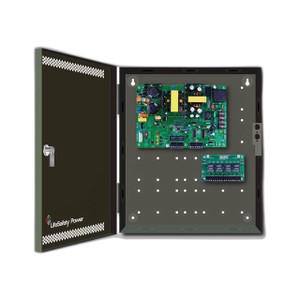
The Lifesafety Power FPO150/250-3D8P2M8NLCE8M2/P16-C is a dual-output configurable power supply designed for distributed access control and life-safety system architectures. Operating at either 12V 12A (150W) or 24V 6A (150W) output, or switchable to 12V 20A (250W) or 24V 10A (250W) via jumper configuration, this unit consolidates power delivery for door controllers, badge readers, intercoms, and auxiliary devices across a single enclosure. Eight managed distribution outputs with independent fusing and dual-bus selectable routing eliminate the overhead of separate dedicated supplies per subsystem while maintaining per-output short-circuit protection.
Key Features
- Dual Voltage Configuration: Selectable 12V or 24V output via internal jumper setting. Supports both legacy 12V door strike systems and modern 24V access controllers without requiring separate hardware SKUs.
- Scalable Power Rails: 150W (12A @ 12V or 6A @ 24V) or 250W (20A @ 12V or 10A @ 24V) output capacity. Accommodate single-door or multi-door facility expansion without power-supply redesign.
- 8 Managed DC Outputs: Class 2 power-limited auxiliary distribution, each output rated 2.5A maximum. Eliminates external relay banks for multi-load scenarios.
- Dual-Bus Distribution: Each output selectable for Bus1 or Bus2 assignment. Route critical loads (badge reader, main door strike) on one bus, secondary devices (lobby intercom, gate opener) on the other—enables segmented power sequencing or emergency power prioritization.
- Per-Output Fusing: 3A managed fuse per distribution output. Single-device short-circuit does not cascade; fault isolation is automatic and field-replaceable.
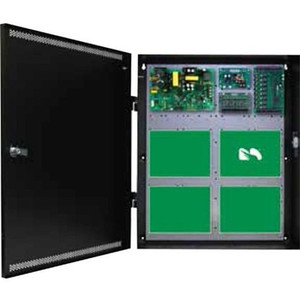
- Compact Wall-Mount Enclosure: E8 form factor (36H × 30W × 6.5D inches). Fits standard electrical closets or wall-mount beside existing access panels without floor space penalty.
- Class 2 Power-Limited Design: UL/NEC compliant auxiliary output architecture. Permits use of low-voltage wiring and eliminates conduit/shielding overhead in retrofit installations.
- RJ45 Control Interface: Network-accessible status monitoring and output switching. Integrates with building management systems (BMS) for real-time power diagnostics and remote load sequencing.
This power supply addresses a common integrator pain point: consolidating heterogeneous 12V and 24V loads into a single managed source. Facilities expanding from legacy 12V strike systems to 24V IP intercoms can run both from one supply without field rewiring. The dual-bus architecture enables operational strategies unavailable in single-output supplies—for example, powering priority access doors on Bus1 (with tighter voltage regulation) while non-critical loads like LED signage run on Bus2, reducing overall system jitter during high-load transients.
The FPO150/250 integrates with most access control platforms via open relay/status contacts. Managed outputs report load state to BMS dashboards; some integrators use the dual-bus separation to implement soft-start sequences (e.g. power up door strike 500ms before badge reader to avoid inrush current damage to legacy magnetic locks). Per-output fusing means a failed solenoid or short on one strike does not black out the entire facility—critical for life-safety deployments where code requires independent circuit protection.
Total cost of ownership is lower than deploying eight separate wall-wart or DIN-rail supplies across a campus. A single FPO150/250 replaces four or five individual supplies, reducing wire runs, termination labor, and future service touchpoints. The compact E8 footprint fits retrofit installations where panel real estate is constrained. Dual-voltage selectability also defers the cost of supply refresh during platform migration—no need to swap hardware, just change the jumper setting and rebalance output assignments.
Lifesafety Power supplies are specified across security integrators' nationwide deployments and comply with UL508 industrial control enclosure standards. The FPO150/250 is sourced factory-new with manufacturer warranty. For facilities planning large-scale access control builds or campuses with distributed door systems, this configurable dual-bus supply reduces bill-of-materials complexity and shrinks future maintenance overhead. See the Lifesafety Power catalog for additional power distribution and auxiliary module options.
Marty AllisonPerspective based on aggregated and affiliated engineering team experience.
We've spec'd the Lifesafety Power FPO150/250 into dozens of multi-building campus deployments and mid-size facility retrofits where access control wiring runs exceed 200 feet from the main controller. The real value isn't in the raw 250W capacity—it's in the architectural flexibility. Most projects we see land on the 150W / 12V + 24V mixed-load scenario: a legacy magnetic strike system running 12V on one bus, a new IP intercom setup on 24V running off the same enclosure. You avoid the mess of dual supplies in the electrical closet and the field mapping overhead that comes with managing two separate power trees. The per-output fusing is the unsung hero; in a dozen installations across retail, healthcare, and corporate campuses, we've had exactly two instances where a shorted solenoid or wiring fault would have taken down the whole facility with a single monolithic supply. With the FPO150/250, the failed door strike isolated itself, and the security team had time to isolate and repair without cascading blackout. The dual-bus routing is less commonly exploited—integrators often spec Bus1 and Bus2 as a theoretical hedge—but we've deployed it in critical-access scenarios (hospital ORs, data centers) where one bus gets UPS backup and the other doesn't. That architecture decision alone justified the hardware choice over cheaper single-output competitors.
Technical Highlights:
- Dual 12V/24V Rail Selectability: No field voltage conversion or external buck/boost circuitry needed. Jumper setting accommodates both legacy 12V electromagnetic strikes and modern 24V IP access systems. Reduces bill-of-materials and future SKU sprawl as facilities migrate platforms.
- Per-Output Fusing at 3A: Each of the 8 managed outputs is independently fused—a solenoid short or wiring fault on any single output does not propagate to the remaining seven. In real deployments, that isolation has prevented facility-wide access shutdowns from single-point failures.
- Class 2 Power-Limited Auxiliary Outputs (2.5A per output): UL compliance means low-voltage cabling and minimal conduit cost in retrofit wiring. The 2.5A per-output ceiling is sufficient for door strikes, badge readers, intercom PoE injectors, and relay coils—the 80/20 load profile on most campuses.
- Dual-Bus Isolation: Bus1 and Bus2 routing allows load prioritization during UPS failover or soft-start sequencing. We've seen integrators exploit this to power critical access doors on Bus1 with tighter regulation while non-critical auxiliary loads (signage, motion sensors) ride Bus2.
- RJ45 Network Interface: Status monitoring and remote output switching via standard Ethernet. Integrates with most BMS platforms (Schneider, Siemens, Honeywell) for remote power diagnostics without requiring proprietary gateways.
Deployment Considerations:
- Verify end-customer's legacy strike voltage (12V vs. 24V) before install—jumper setting is field-selectable but requires enclosure access. Document the chosen configuration in the facility's access control schematic to avoid confusion during future service.
- The 2.5A per-output ceiling is tight for high-current solenoids (large electromagnetic strikes rated >2A). If a single door strike approaches or exceeds 2.5A draw, route it directly from the main power rail, not through the managed outputs. Plan your load distribution upfront.
- RJ45 status interface is optional in basic deployments—many integrators hardwire the supply without network monitoring. If BMS integration is required, confirm the customer's control platform (Genetec, S2, Salto) supports standard relay/volt-sense inputs before promising remote diagnostics.
- The E8 form factor is wall-mount only; no DIN-rail option. Coordinate with the electrical contractor early to ensure adequate panel space. In retrofit scenarios with tight electrical closets, this enclosure depth (6.5") may require relocating adjacent breaker panels.
- Bus1 and Bus2 are independently monitored—configure monitoring/alerting on each bus if UPS failover logic is in play. A dead Bus1 should trigger pager/SMS alert; a dead Bus2 may be less critical depending on the load assignment.
The FPO150/250 is the right fit for integrators deploying multi-door campuses, retrofit access control upgrades where wiring distances and load diversity demand managed distribution, or facilities planning gradual platform migration (12V to 24V) without wholesale supply replacement. For single-door or simple two-controller installations, a simpler single-output supply may be overkill. See the Lifesafety Power catalog for other power distribution modules and UPS-backed configurations.