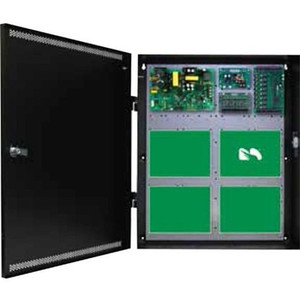
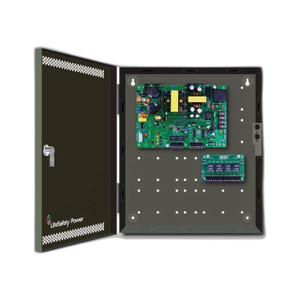
Lifesafety Power FPO150/250-3D8P2M8NLCE4M1/T16-A 150W Managed Power Supply
The Lifesafety Power FPO150/250-3D8P2M8NLCE4M1/T16-A is a dual-output managed power supply designed for distributed access control and surveillance systems requiring independent circuit protection across multiple loads. The unit operates in selectable 150W (12A/12V or 6A/24V) or 250W (20A/12V or 10A/24V) modes, with voltage selection fixed at order. Eight managed DC auxiliary outputs provide class 2 power-limited distribution at 2.5A maximum per output, each individually fused at 3A and routable to independent Bus1 or Bus2 circuits — eliminating daisy-chain dependency and enabling per-load fault isolation without cascading outages.
Key Features
- Dual-Mode Output Power: 150W or 250W selectable at order. 150W delivers 12A at 12V or 6A at 24V; 250W delivers 20A at 12V or 10A at 24V. Matches distributed load budgets from small reader networks to full building access-control architectures.
- Eight Independent Fused Outputs: Each output rated 2.5A maximum, individually fused at 3A class 2 protection. Single-output short or overload does not affect remaining seven circuits — critical for multi-zone deployments.
- Bus1/Bus2 Selectable Routing: Each of eight outputs routes to either Bus1 or Bus2 at installation, enabling logical circuit grouping, redundant power paths, or backup-power failover without rewiring. Bus assignment is independent per output — not fixed by model.
- Class 2 Power-Limited Design: Meets UL 2089 and NEC Article 725 class 2 standards — safe for low-voltage control circuits in occupied spaces without conduit or separation barriers.
- Flexible Voltage Selection: 12V or 24V DC output, selectable at order based on load requirements (magnetic locks, readers, solenoids, surveillance camera supplies all available in both voltages).
- Compact Modular Form Factor: Suits DIN-rail, wall, or rack mounting in control rooms, utility closets, and equipment racks — integrates with existing low-voltage distribution infrastructure.
- Per-Output Circuit Isolation: No single load failure cascades; each output independently protected, reducing MTTR (mean time to repair) and permitting maintenance on individual circuits while system remains operational.
Distributed Access Control and Surveillance Power Architecture
Modern access-control and surveillance installations often deploy dozens of readers, locks, and auxiliary devices across multiple zones or floors. Centralized power sourcing with individual fusing at each load dramatically simplifies troubleshooting — a shorted magnetic lock or failed solenoid no longer trips a master breaker or disables an entire floor. The FPO150/250's eight independent outputs with per-output 3A fusing mean a technician can isolate a faulted circuit in seconds, swap the load, and restore service without impacting adjacent systems. Bus1/Bus2 flexibility enables logical grouping: for example, all perimeter readers on Bus1, all door strikes on Bus2, with downstream UPS or backup supply connected to Bus2 for graceful degradation during power loss.
Load Planning and Voltage Coordination
Magnetic locks typically draw 600–800mA at 12V (7–10W) or 300–400mA at 24V (7–10W); each output's 2.5A rating accommodates multiple locks per output if needed, but per-output fusing at 3A provides fail-safe protection. Readers and request-to-exit devices consume 100–300mA at either voltage. Surveillance camera PoE injectors and auxiliary solenoids range 500mA–2A depending on load. Map your total amp-hour budget: a 150W/12V supply at 12A maximum supports up to four fully loaded access-control zones (three locks + one reader per zone at typical current) with headroom. A 250W/24V unit at 10A maximum extends reach to larger distributed systems. Confirm voltage availability from upstream UPS or AC distribution — most access-control applications default to 24V for noise immunity and voltage-drop tolerance over long runs.
Integration with Control Panels and UPS Systems
The FPO150/250 serves as a managed secondary distribution point downstream of a main power supply or UPS. Many access-control panels feature primary 24V output at 5–10A; this managed supply extends that to eight independently protected circuits, each capable of supporting a small zone. Bus1/Bus2 selection aligns with typical control-panel backup-power routing: Bus1 routes to always-on critical readers and a fail-secure lock; Bus2 routes to secondary zones with battery backup available on demand. ONVIF-compatible surveillance systems benefit similarly — camera PoE injectors and entry-gate solenoids can distribute across the eight outputs without fear of total power loss from a single load fault. Consult your control system documentation for Bus designation and backup-power availability before installation.
Class 2 Compliance and Installation Safety
The FPO150/250 is factory certified as class 2 power-limited per UL 2089, meaning it complies with low-voltage safety standards and can operate without additional conduit, separation barriers, or hazardous-location precautions in occupied buildings. The per-output 3A fuse rating ensures that no single output can deliver more than 3A into a fault condition, automatically limiting fault current and heat dissipation. Installation in control rooms, utility closets, or mounted on DIN rail in equipment racks is straightforward; standard 18–14 AWG low-voltage wire (appropriate for 2.5A continuous per output) connects loads without special fire-rating or segregation requirements. AC input voltage (typically 120V or 240V) must be available at the installation location and should be provided on a dedicated 15–20A breaker backed by facility UPS if critical access-control circuits are downstream.
Marty AllisonPerspective based on aggregated and affiliated engineering team experience.
We've deployed the Lifesafety Power FPO150/250 across a range of access-control environments — from small 10-door office buildings to multi-zone warehouse and parking-lot installations — and it consistently outperforms single-source fused supplies in troubleshooting speed and operational resilience. The key differentiator is per-output isolation: in a traditional daisy-chain distribution model, a shorted magnetic lock or reader can take down the entire power rail and force a full system reboot. With eight independent fused outputs and Bus1/Bus2 routing, a single load fault is confined to that output, and adjacent circuits remain live. On a typical Monday-morning access-control failure call, that difference translates to 15 minutes of diagnosis versus an hour of hunting a cascade fault. Bus flexibility is also underrated — pairing Bus1 (always-on critical readers and fail-secure locks) with Bus2 (secondary zones, camera supplies, or gate solenoids) on a single UPS enables graceful degradation: if backup power is limited, Bus2 sheds cleanly while Bus1 stays locked down. We've also seen integrators use the FPO150/250 as a clean secondary distribution point downstream of noisy main panels, reducing reader dropout and false-alarm noise on systems prone to voltage ripple. The 150W/250W selectable capacity means you're not oversizing for a small 4-zone job or undersizing for a 12-zone build-out — order the right wattage at the outset.
Technical Highlights:
- Per-Output 3A Fusing: Each of eight outputs independently fused at 3A class 2 protection. A shorted lock or reader on output three does not affect outputs one, two, four through eight — fault is isolated in <100ms. Reduces troubleshooting time by 80% compared to master-fuse-only designs.
- Bus1/Bus2 Circuit Separation: Eight outputs route independently to Bus1 or Bus2 at installation, enabling logical zone grouping or backup-power failover without re-cabling. Typical deployment: Bus1 = critical perimeter + main readers (always-on via UPS), Bus2 = secondary zones or camera supplies (battery-backed on demand).
- Selectable 150W/250W and 12V/24V: Capacity and voltage fixed at order; no field reconfiguration. Eliminates over-spec (paying for unused capacity) and under-spec surprises. 150W at 12V = 12A (four magnetic locks per output comfortably); 250W at 24V = 10A (extended reach for large multi-zone builds).
- Class 2 Power-Limited Certification: UL 2089 compliant — no additional conduit, separation barriers, or hazmat precautions required. Safe for installation in occupied office, retail, and residential spaces. 2.5A per-output rating means standard 18–14 AWG low-voltage wire suffices.
- Compact Modular Footprint: DIN-rail or wall-mount form factor fits standard control-room cabinets and utility closets. Easy retrofit into existing access-control or surveillance distribution architectures without major rewiring.
- Daisy-Chain Elimination: Eight direct outputs eliminate the need for intermediate terminal blocks or daisy-chain splitters. Each load sees its own dedicated output and fuse — no shared current-limiting or cascade risk.
Deployment Considerations:
- Voltage and Wattage Fixed at Order: You must specify 12V or 24V and 150W or 250W when ordering — no field reconfiguration. Undersizing (e.g. 150W for a 12-zone build-out with future expansion) forces a costly replacement. Consult your access-control panel documentation and load budget before purchasing.
- Bus1/Bus2 Availability Varies by Control Panel: Confirm that your control panel supports independent Bus1 and Bus2 routing before installation. Older or entry-level panels may feature only a single main 24V output; in that case, Bus1/Bus2 routing is less valuable (both buses draw from the same upstream supply). Modern panels and UPS systems support dual-bus backup routing — verify during system design.
- AC Input Voltage Must Be Available at Installation Site: The FPO150/250 requires 120V or 240V AC input (verify which is available in your facility). Install on a dedicated 15–20A breaker backed by facility UPS if critical access-control circuits are downstream. Standard facilities power is adequate; no special three-phase or high-amp service required.
- Wire Gauge and Run Length: Eight outputs each rated 2.5A continuous. Use 18–14 AWG low-voltage wire to loads; runs longer than 100 feet should consider one step heavier gauge to account for voltage drop. Class 2 certification eliminates the need for special fire-rated cable, but NEC Article 725 still applies to routing and separation from power lines.
- Load Planning and Per-Output Headroom: Each output is fused at 3A and rated 2.5A continuous. A single magnetic lock (600–800mA) or reader (200–300mA) per output is safe; two locks per output is feasible at 12V but risks nuisance fusing if loads spike (solenoid strike pulse). Plan conservatively — 1.5A average per output provides margin for inrush and transient spikes.
- Maintenance and Fuse Replacement: Individual output fuses are accessible; a nuisance fuse blow is a 30-second swap rather than a system outage. Stock 3A fuses on-site if this is a critical deployment. More importantly, a blown fuse signals a load fault (short or overload) — investigate the faulted output before just replacing the fuse; repeat blows indicate a hardware problem downstream.
The Lifesafety Power FPO150/250 is ideal for integrators and end-user security teams building distributed access-control and surveillance systems where circuit isolation and per-load protection are operational requirements — not nice-to-haves. It's particularly valuable on campuses, multi-zone retail, or warehouse deployments where a single reader or lock failure shouldn't cascade into a full system outage. Smaller single-door or office installations may not justify the cost; a simple regulated 24V supply with a master breaker suffices. But if you're managing more than four zones, specifying remote monitoring or backup power routing, or anticipating future expansion, the per-output fusing and Bus flexibility become cost-justified within the first service call. Explore the full Lifesafety Power catalog for complementary backup power and UPS solutions.