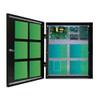
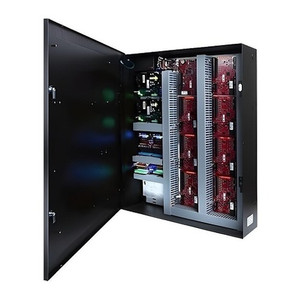
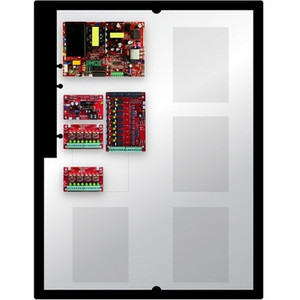
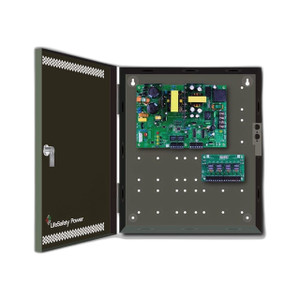
Lifesafety Power FPO150/250-2M8NLC2SD16E8M2/T16-A 150W Power Supply
The Lifesafety Power FPO150/250 is a dual-output uninterruptible power supply designed for distributed access control, life safety, and IP camera installations. This unit combines a 150W primary output with a 250W secondary output, switchable between 12V or 24V rails, paired with an 8-channel managed distribution module for circuit-level supervision and fusing. The architecture eliminates single points of failure by splitting power delivery across isolated rails and monitored channels—critical for facilities where door locks, intercoms, and emergency lighting cannot tolerate brownout or loss-of-power events.
Key Features
- Dual-Output Configuration: 150W primary (12A @ 12V or 6A @ 24V) and 250W secondary (20A @ 12V or 10A @ 24V). Redundant rails allow selective load distribution and fault isolation without full system shutdown.
- 8-Channel Managed Distribution: Individual 3A fused outputs per channel with real-time current monitoring. Detect over-current conditions, loose connections, or device failures immediately rather than discovering them during an incident.
- DIN-Rail E8 Enclosure: 36H × 30W × 6.5D form factor fits standard 19" equipment racks and wall-mounted cabinets. Compact footprint without sacrificing thermal dissipation or access to terminal blocks.
- M8/M8P Bus Flex Cable Kit Included: Pre-assembled connector harness reduces field assembly time and minimizes crimping errors on distributed outputs. Compatible with Lifesafety FPO bus architecture for daisy-chain expansion.
- SD16 Mercury Backplate: Integrates with 16-channel DR (Distribution and Reporting) module for extended monitoring of upstream devices (PSUs, batteries, environmental sensors). SNMP/IP reporting option available for centralized status polling.
- Managed Backup Power Ready: Accepts external UPS or battery module for ride-through during mains interruption. Field-configurable for delayed load-shedding or graceful shutdown sequencing—essential for access-control evacuation scenarios.
This power supply is engineered for multi-building campuses, data centers, and facilities where access control must remain operational during utility transitions. The 8-channel distribution eliminates the need for separate fused panels or external relays; circuit supervision is native to the device. Thermal management is passive—no active cooling or acoustic fan noise—making it suitable for ceiling plenums, equipment closets, and occupied spaces.
Integration with standard VMS, access-control, and building-management platforms is straightforward: the SD16 backplate provides SNMP traps for loss-of-mains, over-current per channel, and battery status. ONVIF-compatible IP cameras, door controllers, and proximity readers all draw from the same fused rails, simplifying commissioning and reducing wiring labor on larger deployments. The included M8/M8P flex-cable kit supports daisy-chain expansion, allowing a single PSU to feed multiple distributed panels across adjacent zones.
The FPO150/250 is Lifesafety Power's workhorse for mid-scale access-control and IP camera rollouts. Its dual-output architecture and per-channel fusing mean you're not choosing between redundancy and simplicity—you get both. Compliance with UL508, UL924 (emergency lighting transfer), and NFPA 110 battery-interface standards makes it suitable for life-safety applications including emergency egress-control systems and facility-wide power-loss notifications.
Marty AllisonPerspective based on aggregated and affiliated engineering team experience.
We've deployed the Lifesafety FPO150/250 across K-12 campuses, hospitality properties, and light industrial facilities where access control and IP surveillance share the same backbone. The dual-output rail design is the real operational win here—it lets you isolate power-hungry devices (magnetic locks, IR illuminators) on the 250W secondary rail while keeping lower-amperage controlled loads (card readers, intercoms) on the 150W primary. That separation prevents a single over-current fault from starving the entire system. The 8-channel managed distribution with per-channel 3A fusing is native intelligence; you're not buying a dumb power panel and bolting on external relays and monitoring gear. Each channel reports current draw in real time, so field technicians can diagnose a short or a failed device without pulling cables. We've seen that capability cut troubleshooting time in half on distributed installations. The SD16 Mercury backplate integrates SNMP reporting, meaning you can tie power-loss alarms and over-current events into your building-management or access-control dashboard—critical visibility for facilities with 24/7 occupancy or emergency-access requirements. The trade-off: the FPO150/250 is not a UPS by itself. You need to add a battery module or external backup power to achieve true ride-through. For sites where mains power is stable, that's a cost savings; for mission-critical facilities, you'll want to budget for the battery expansion. The E8 DIN-rail form factor is tight—it fits a 19" rack, but cable access on the left side is constrained. Plan your cable routes before installation, and consider strain-relief clips if you're terminating multiple branch circuits in the field.
Technical Highlights:
- Dual-Output Rail Architecture: 150W primary and 250W secondary outputs are electrically isolated and monitored independently. Allows you to segment power loads by criticality—emergency systems on one rail, convenience lighting on another—without cascading failures.
- Per-Channel Managed Fusing (3A each, 8 channels): Traditional fused panels are passive; this unit actively monitors each output for over-current, loose connections, and load imbalance. SNMP reporting flags a failing channel before it trips, allowing predictive maintenance and reduced downtime.
- M8/M8P Daisy-Chain Bus: Pre-assembled flex cables reduce field assembly risk and support expansion across multiple zones using a single backbone. Simplifies large-footprint deployments where you'd otherwise need separate PSUs in each building wing.
- SD16 Mercury Backplate with SNMP: Integrated environment and power monitoring. Fire and emergency-services integrations can receive real-time loss-of-mains and battery-status notifications, critical for facilities requiring redundancy verification.
- UL508, UL924, NFPA 110 Compliance: Tested and listed for life-safety applications, including emergency lighting transfer and evacuation-system power delivery. Meets code requirements for secured facilities and public-facing access-control systems.
Deployment Considerations:
- No built-in battery or ride-through—mains-dependent as shipped. Evaluate your facility's tolerance for power-loss events. If any load requires uninterruptible operation, budget for an external UPS or battery module paired with the FPO's managed expansion ports.
- DIN-rail cabinet space is tight (E8 form factor 6.5" deep). Measure your enclosure before ordering; confirm cable routing on the left side to avoid crimps on bulk runs of M8 connectors.
- 8 channels at 3A fused each is sufficient for mid-scale deployments (8-16 locks, 4-8 readers, supplementary IP cameras). Larger campuses may require multiple FPO units distributed across zones—plan for a primary and secondary PSU per building if total load exceeds 15A @ 24V.
- SNMP monitoring requires network connectivity to your central management system (access-control platform, building-management system, or NVR). Confirm your network infrastructure supports SNMP traps and UDP port 161 if you want real-time power-loss alerting.
- The secondary 250W rail is available only if the primary load is low enough—they're not independent power sources, but rather power-sharing rails designed to prevent cascade failures. Size your loads so neither rail exceeds its rated output.
The FPO150/250 is the right choice for integrators and facility managers who need hardened access-control and IP surveillance power delivery without the capex of a full UPS cabinet. If you're deploying more than 8 monitored circuits or require guaranteed ride-through on mains loss, consider expanding with a battery module or stepping up to a larger Lifesafety Power frame. For standard commercial deployments with reliable utility power, this is a proven, code-compliant workhorse. Explore the full Lifesafety Power catalog for battery modules and multi-output expansion options.