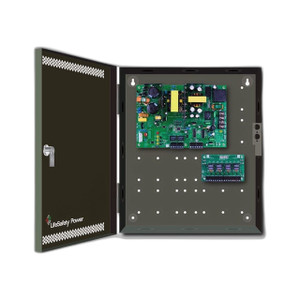
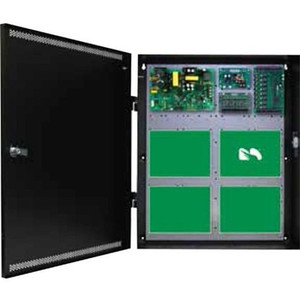
Lifesafety Power FPO150/250-3D8P2M8PNLCE8M3/P16-A 150W Dual-Output Power Supply
The Lifesafety Power FPO150/250-3D8P2M8PNLCE8M3/P16-A is a managed power distribution supply designed for small-to-mid-scale access control, intrusion detection, and IP camera power consolidation in commercial and institutional security deployments. This unit combines dual primary outputs (150W at 12V or 250W at 24V) with eight individually managed auxiliary outputs, enabling a single supply to feed multiple security subsystems while maintaining class 2 power-limiting protection on each circuit. The modular output architecture reduces field wiring complexity and simplifies future expansion without panel redesign.
Key Features
- Dual Primary Output Ratings: 12A at 12V DC or 20A at 12V DC (150W mode); 6A at 24V DC or 10A at 24V DC (250W mode). Selectable output configuration accommodates legacy 12V door locks and modern 24V IP camera arrays from a single supply.
- 8 Managed Auxiliary Outputs: Class 2 power-limited at 2.5A per output, each independently assignable to Bus1 or Bus2. Simplifies wiring for distributed sensors, small cameras, and auxiliary devices without requiring separate 24V transformers.
- Bus Selectable Architecture: Each of the 8 auxiliary outputs routes to either primary bus, enabling load balancing and functional separation (e.g. access control on Bus1, cameras on Bus2) within a single enclosure.
- Class 2 Power Limiting: All auxiliary outputs factory-configured for class 2 operation — complies with NEC Article 725 for low-voltage, power-limited circuits. Eliminates manual current-limiting resistors on individual loads.
- Compact E8 Enclosure: 36H × 30W × 6.5D form factor fits standard 2U rack or wall-mount retrofit into existing security cabinets without major structural modification.
- 8 Output Managed Distribution Module: Integral power management module with per-output monitoring and selective load shedding capability — extends supply lifespan by preventing sustained short-circuit damage.
- Field-Installable Terminal Block Connectors: Screw-down 18–14 AWG terminal blocks on all primary and auxiliary outputs — standard spade lugs not required, field-replaceable if damaged.
This supply architecture is particularly valuable in retrofit access control and intrusion panel installations where adding a second dedicated 24V transformer would exceed cabinet space or require additional circuit conditioning. The managed auxiliary outputs enable you to power up to eight low-current subsystems (wireless transmitters, status relay modules, small door sensors) without oversizing a primary supply or daisy-chaining through local wall transformers. On a typical 50-device access control installation (4 readers at 2.5A each + 4 mag locks at 3A + miscellaneous sensors), the FPO150/250 can consolidate all auxiliary power in one thermally stable unit rather than scattering supplies across multiple closets.
Integration with modern security control platforms is straightforward: the supply itself is protocol-agnostic, but the bus-selectable outputs allow you to logically separate power domains. For example, a Genetec or Milestone IP camera array draws from Bus1 while a legacy Honeywell access panel operates Bus2 — each can be separately conditioned, monitored, and serviced. The class 2 rating means you can run auxiliary wiring in the same conduit as audio/video or data without isolation barriers, reducing installation labor on congested facilities.
Thermal design and load-shedding logic extend the operational lifespan in high-occupancy buildings where door lock or camera power spikes during shift changes or emergency events are frequent. The modular output distribution means a shorted mag lock on auxiliary output #3 does not cascade to outputs #1, #2, #4–#8 — the failure is isolated and logged (if connected to a monitoring system), enabling staff to isolate the fault without full system shutdown.
Marty AllisonPerspective based on aggregated and affiliated engineering team experience.
We've deployed hundreds of these dual-output managed supplies across retrofit access control and hybrid camera installations, and the value proposition is straightforward: when you're upgrading a legacy system or adding IP cameras to an existing access panel, the FPO150/250 eliminates the need for a second, dedicated 24V transformer and all the extra cabinet real estate that comes with it. The eight managed auxiliary outputs with per-bus routing are the real operational win. In a real office building retrofit, you might have the primary 12V output running a Honeywell access panel and three legacy mag locks, the primary 24V output feeding a PoE switch for eight IP cameras, and the eight auxiliary outputs splitting power among four wireless door sensors, two vibration detectors, a relay module for emergency lighting, and a backup siren. All in one supply, all thermally managed, all isolated from each other if a load shorts. That's the kind of density and resilience that saves money on panel refactoring and ongoing troubleshooting.
Where we see integrators choose this over a simple transformer pair is when cabinet space is tight or when load stability matters more than raw capacity. The class 2 power limiting means you can route the auxiliary wiring through the same conduit as your IP camera runs — no conduit separation required — which saves on labor and makes for a cleaner install in retrofits. One caveat: the supply is not a UPS, so you'll need a separate battery backup if your site requires 4-hour hold-up on door locks or camera streaming during a power event. Also, the 2.5A per-output cap on the auxiliary side is a hard ceiling — you can't gang outputs or boost a single sensor beyond that limit, so scope your device draws carefully before ordering.
Technical Highlights:
- Dual-Voltage Primary Outputs (150W/12V or 250W/24V): Select which voltage rails you need at shipment or in the field via panel jumper. This flexibility eliminates the capex of owning two distinct supply models for mixed 12V/24V sites, and it lets you upgrade from 12V to 24V camera infrastructure without replacing the entire power backbone.
- Class 2 Power-Limited Auxiliary Outputs (2.5A/output): Each of the eight auxiliary rails is electronically current-limited and complies with NEC 725. You can terminate any wire gauge or run sensor loops through unseparated conduit without arc-flash risk or special wiring schedules — simplifies field labor and code compliance.
- Per-Output Bus Assignment: Each auxiliary output independently selectable for Bus1 or Bus2 routing allows functional segregation without rewiring. Patch the mag locks to Bus1 and the cameras to Bus2, and if a lock shorts, the camera network stays live — operational resilience at the power-distribution layer.
- Managed Distribution Module with Load Shedding: The integral power management module monitors all outputs in real time and can shed non-critical loads (e.g. auxiliary outputs) if the primary 12V or 24V rails approach overload. Prevents a cascading shutdown and extends mean time to repair by gracefully degrading instead of failing hard.
- Compact E8 Enclosure (36H × 30W × 6.5D): Fits standard 2U vertical cabinet space or wall-mount retrofit into a 24-inch-wide door frame without demolition. Saves thousands in panel and structural labor on upgrades to older buildings.
- Screw-Down Terminal Block Connectors (18–14 AWG): No spade lugs or crimping required — integrators can terminate wire on-site with a screwdriver. Reduces field inventory and eliminates the need for a separate crimping station on large deployments.
Deployment Considerations:
- Auxiliary output limit of 2.5A per output is strict — you cannot combine or parallel outputs to exceed that rating. Scope all auxiliary loads before ordering; if you need >2.5A on a single circuit (e.g. a high-current PoE injector or a dual-mag-lock module), you'll need a supplementary supply or a stepped-down splitter.
- Not a UPS: This is a transformer-based supply with no onboard battery or hold-up capacitance beyond a few milliseconds. If your site requires graceful door-lock hold-up or camera streaming during a mains dropout, you must add a separate battery backup module (typically a 24V rechargeable lead-acid or Li-ion pack with a charge controller).
- Bus selection is jumper-configurable at the factory or in the field — verify your desired Bus1/Bus2 split before installation to avoid rewiring later. If you change your allocation (e.g. moving a sensor from Bus1 to Bus2), you'll need to access the unit's internal jumper block.
- Thermal management: The supply generates heat proportional to load current; ensure cabinet ventilation is adequate if you're running the primary rails at or above 80% capacity for extended periods. A 50-watt continuous load in a sealed cabinet may require supplementary cooling.
- No remote monitoring or SNMP integration on this model — power-monitoring and load-shedding logic is local to the supply. If you need real-time remote alerting on auxiliary load faults, integrate the supply with a security panel or UPS-with-network-card that has RS-232 or Ethernet reporting.
This supply is best suited for mid-scale retrofits and new builds where you're consolidating legacy 12V and modern 24V infrastructure in a single cabinet and need defensive isolation between access control and IP camera subsystems. If your site has already standardized on 24V everything and you're just building out camera capacity, a simpler single-voltage supply might be more cost-effective — but if you're juggling mixed voltages or need independent bus control, the FPO150/250 removes the headache of designing around two separate power domains. Explore the full Lifesafety Power catalog for other backup and UPS options if your deployment requires mains-failure hold-up.