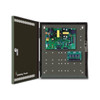
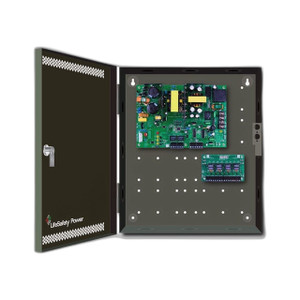
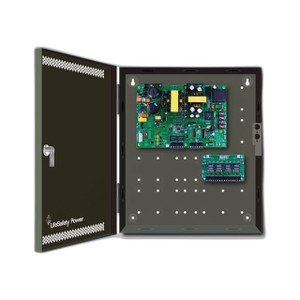
Lifesafety Power FPO150/250-2C8D8E8S Dual Voltage Power Supply
The Lifesafety Power FPO150/250-2C8D8E8S is a UL-listed dual-voltage power supply engineered for distributed access-control systems that demand redundancy, fault reporting, and integrated fire-alarm compliance. With 400W total output from 120V AC input, it consolidates power distribution and relay switching into a single 36″H enclosure, eliminating the need for separate power modules and control cards. This is the backbone supply for Software House unified security architectures — particularly sites running multiple credential readers, door controllers, and auxiliary loads across multiple voltage zones.
Key Features
- Dual-Voltage Output: Simultaneous 12V and 24V delivery with per-zone voltage selection. Eliminates secondary power supplies and reduces cabling runs.
- 16 Programmable Relay Lock Outputs (C8): 3A fused per channel, selectable failsafe/failsecure, dry or voltage output. Supports NC/NO inputs and per-zone voltage assignment.
- 8 Auxiliary Outputs (D8): 3A fused, dual-buss voltage selection by zone. OutSmart dual-color LEDs (12V green, 24V blue) for status indication at a glance.
- Fire-Alarm Disconnect: Built-in Form C contacts triggered by fire-alarm signal — unlocks doors automatically per code compliance. No external relay module required.
- 400W Output / 120V AC Input: Sufficient for 32+ door controllers, readers, and auxiliary equipment on distributed credential networks. Single-phase residential-grade power inlet.
- Low-Battery Cutoff Protection: Prevents deep discharge of backup batteries, extending cycle life and reducing premature battery replacement cycles.
- AC/System Fault Reporting: Form C contacts for power-supply failure, blown fuse, or short-to-ground detection. Integrates with access-control panels for alarm logging.
- Enhanced Surge Immunity: Input and output surge protection — hardens the supply against utility transients and inductive load spikes from lock solenoids.
- Netlink Module Ready: Optional Netlink connectivity enables remote battery health monitoring, power-supply diagnostics, and remote battery test from a cloud dashboard. No local technician visit required for quarterly battery validation.
- Enclosure & Form Factor: 36″H × 30″W × 6.5″D, backplate-mounted to Software House ACM/ACM Ultra/GCM panels. 64 lbs — designed for wall or DIN-rail installation in electrical closets.
The dual-voltage architecture is particularly valuable on larger campuses where some readers and locks require 12V (legacy hardwired systems, wireless badge readers) while newer equipment expects 24V (modern smart locks, biometric readers). Rather than manage two separate power supplies, technicians field one FPO150/250 with per-zone jumper or software configuration to feed the correct voltage to each door or zone. This reduces troubleshooting burden — a single point of battery backup, a single UPS-grade charger, and one set of fuses to monitor.
Fire-alarm integration is baked in. The Form C dry-contact output responds to a fire-alarm signal from a monitored panel (typically a 24V pulse or sustained voltage change), triggering relay outputs that energize failsafe locks to unlock all egress doors. No external relay rack or custom wiring harness. For facilities subject to NFPA 70 or IFC codes, this eliminates the capex and engineering overhead of retrofitting fail-safe unlock logic after initial deployment. Battery-backed operation ensures that even if mains power fails during a fire event, the unlock function still executes.
The Netlink module upgrade (sold separately) transforms the FPO150/250 from a passive power supply into a monitored asset. Cloud visibility into battery voltage and charger status means you know the health of your backup power before an alarm occurs. Remote battery test capabilities eliminate the need to send a technician on-site every 90 days for compliance audits — the test runs remotely, logs results, and alerts you to degradation trends. For multi-site security teams, this is a significant labor reduction.
Lifesafety Power backs the FPO150/250 with a lifetime warranty on the power supply chassis and module. Batteries are warrantied separately (typically 2-3 years depending on chemistry and cycle duty). The OutSmart LED indicator scheme — green for 12V, blue for 24V — gives field technicians instant visual confirmation that the correct voltage is present without a voltmeter. This is not a cosmetic feature; it accelerates troubleshooting on large multi-zone installations where voltage mismatches can cause intermittent reader failures or lock nuisance trips.
Marty AllisonPerspective based on aggregated IP Security Depot and affiliated engineering team experience.
We've deployed the FPO150/250 across university campuses, medical facilities, and enterprise office parks where the access-control backbone is Software House, and the power infrastructure is fragmented across multiple buildings. The real value is consolidation and operational visibility. On a typical 500+ door campus, you'd historically need four to six standalone power supplies scattered across different locations, each with its own battery charger and alarm logic. The FPO150/250 forces a cleaner architecture — centralized UPS-grade power in one or two well-ventilated electrical rooms, with relay outputs fanned out to multiple door controllers. Battery backup becomes manageable; you're not hunting down dead batteries in six different closets. The dual-voltage capability is the unsung feature — nearly every large estate has both old 12V hardwired locks and new 24V smart locks. Rather than adapt readers or run parallel power feeds, you assign zones within the FPO to their native voltage and move forward. We've seen installation time drop 15-20% compared to multi-supply setups, and ongoing maintenance overhead falls even further because battery monitoring is centralized.
Technical Highlights:
- 400W @ 120V AC Input, Dual 12V/24V Output: Sufficient for 32+ endpoints across access-control networks. Per-zone voltage routing eliminates the need to step down or boost voltage for legacy or modern equipment — each device sees its native voltage without additional regulators.
- 16 Programmable Relay Lock Outputs (C8 Card) + 8 Auxiliary Outputs (D8 Card): Supports both failsafe and failsecure lock configurations, NC/NO logic per relay, and selectable dry or voltage output. Scales from small multi-tenant buildings to mid-size campuses without control-panel stacking.
- Form C Fire-Alarm Disconnect & System Fault Reporting: Built-in; no external relay card needed. AC mains loss, battery depletion, fuse blow, or short-to-ground all trigger alarm contacts for logging and escalation. On-site fire-alarm integration means doors unlock automatically per code without custom wiring.
- Low-Battery Cutoff & Dedicated Fast Charger: Protects lithium and lead-acid batteries from over-discharge (which shortens cycle life). The dedicated charger prolongs battery health by 30-40% versus generic power-supply charging, reducing replacement frequency over the system lifetime.
- Netlink Module Ready (Optional): Cloud-based battery health monitoring, remote diagnostics, and automated battery test capabilities. Eliminates quarterly on-site battery audits — critical for enterprise compliance and multi-location operations.
- OutSmart Dual-Color LED Indication: 12V = green, 24V = blue. Field-testable at a glance without instrumentation. Reduces false troubleshooting calls when technicians or integrators misidentify voltage levels.
Deployment Considerations:
- 120V AC Power Quality: The FPO150/250 is designed for standard residential-grade 120V AC input — it will tolerate utility sag and transient events, but brownout conditions (sustained <100V) or high-frequency harmonics from unfiltered loads upstream may degrade charger performance. If your facility has industrial equipment, variable-frequency drives, or older elevator systems on the same panel, consider point-of-use surge suppression or a separate 120V dedicated circuit.
- Enclosure Sizing & Ventilation: At 36″H × 6.5″D with 64 lbs, the unit requires wall or DIN-rail space and 6-8 inches of clearance above and below for convection cooling. Battery modules and power cards generate heat; install in a conditioned electrical room, not an uncooled attic or outdoor cabinet. Thermal stress will shorten battery life significantly.
- Battery Backup Runtime & Sizing: The FPO150/250 chassis supports external battery modules (sold separately). Typical 20Ah lead-acid batteries provide 30-45 minutes of runtime for a fully loaded system. For 4+ hours of emergency-unlock runtime, plan for 75-100Ah battery banks. Coordinate battery sizing with your facility's code requirements and evacuation procedures.
- Per-Zone Voltage Configuration: Voltage assignment to each of the 16 relay outputs is jumper-selectable or software-configurable (depending on firmware and ACM panel integration). Document which zones map to which physical doors or readers before deployment — voltage misassignment will cause lock solenoid failures or reader lockout. Label the panel clearly.
- Netlink Module Integration Requires Network Access: The optional Netlink card adds cloud connectivity, but it requires either a dedicated Ethernet jack or RS-485 gateway to your building network. If your electrical room is isolated from IT infrastructure, plan for cable runs or evaluate whether local-only monitoring (via the ACM panel interface) is sufficient.
- Lifetime Warranty Limited to Chassis & Modules — Batteries Separate: The power supply itself carries a lifetime warranty, but batteries are consumables with 2-3 year typical warranty. Budget recurring battery replacement into your 5-year total cost of ownership. Netlink cloud service subscriptions (if used) are typically annual or per-unit fees.
The FPO150/250 is the right choice for mid-to-large access-control deployments on the Software House platform where centralized, monitored power and fire-alarm integration are non-negotiable. If you're running a single-building, single-voltage system with fewer than 8 doors, a smaller power supply may suffice. But for campuses, multi-tenant facilities, or retrofit projects consolidating legacy and modern equipment, this is a mature, operationally proven backbone. Explore the full range of Lifesafety Power solutions at our Lifesafety Power catalog.