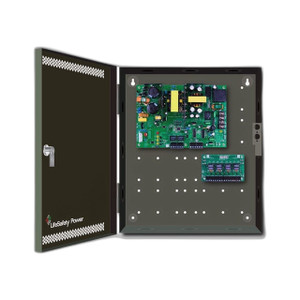
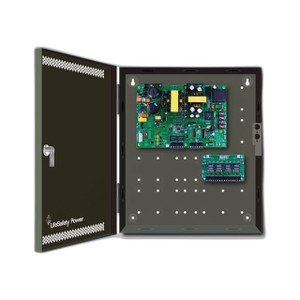
Lifesafety Power FPO150/250-2C82D8E6S1 Unified Power Supply
The Lifesafety Power FPO150/250-2C82D8E6S1 is a UL-listed modular power supply designed for distributed access control and life-safety system deployments. It combines dual FlexPower modules (150W and 250W capacity) with integrated battery charging, fire alarm integration, and optional network monitoring into a single chassis. This architecture eliminates the need for separate power shelves and reduces cabinet clutter while maintaining redundancy and failover capability across multi-door and multi-reader installations.
Key Features
- Dual FlexPower Modules: 150W and 250W rated outputs. Modular design allows independent load assignment and circuit-level redundancy without requiring a separate backup supply.
- Integrated Battery Charging: Fast-charge circuitry extends battery service life by reducing thermal stress during repetitive charge cycles. Low-battery cutoff protection prevents deep discharge damage.
- Fire Alarm Disconnect (FAD): Automatic de-energization of access control outputs on fire alarm signal. Unlocks doors per life-safety code without manual override.
- Enhanced Surge & Transient Protection: Protects downstream access control hardware from power-line transients and load-switching spikes on both input and output circuits.
- Locksafe Optimized Voltages: Factory-set output rails (12V and 24V) tuned to prevent lock coil dropout and extend magnetic lock solenoid service intervals.
- Visual Status Indicators: OutSmart LED notification — color-coded by voltage (12V green, 24V blue) — eliminates guesswork during installation and troubleshooting.
- Optional Netlink Connectivity: Network monitoring module enables remote battery health diagnostics, battery load testing, and power-rail voltage trending via browser or mobile dashboard.
- Compact Footprint: Consolidates power distribution and charging into one UL-listed enclosure, reducing real estate in crowded server/electrical rooms.
Access control integrators face a recurring pain point: battery failover testing in distributed multi-door installations is labor-intensive and often skipped, leaving unknown gaps in failover readiness. The FPO150/250-2C82D8E6S1 addresses this through optional Netlink remote diagnostics — battery capacity can be verified from the office without site visits. The fire alarm disconnect circuit is hardwired (no network dependency), so life-safety function remains available even if Ethernet is down. For retrofits into existing access control cabinets, the modular approach means you can spec only the capacity needed for the door count and reader load, then upgrade the second module if the site expands.
Battery maintenance is where many deployments fail. Deep discharge damages lead-acid batteries and shortens replacement cycles, ballooning total cost of ownership. The integrated low-battery cutoff shuts down non-essential circuits (readers, controllers) while preserving door-unlock function, automatically preventing runaway discharge. When paired with the fast charger, this cycle extends usable battery life from 3–4 years to 5+ years on standard 12Ah or 18Ah sealed lead-acid units — a measurable savings across a 50+ door site.
Integration is straightforward. The FPO150/250-2C82D8E6S1 works with any 12VDC or 24VDC access control reader, electronic lock, request-to-exit sensor, or door controller. Outputs are hardwired; no proprietary software or driver required. If Netlink is added, the module communicates via standard Ethernet and logs telemetry to a cloud-hosted or on-premises dashboard compatible with Software House access control platforms. Surge protection on both rails ensures compatibility with legacy 24V readers and modern IP readers drawing variable loads.
Lifesafety Power backs the FPO150/250-2C82D8E6S1 with a manufacturer warranty, underscoring design robustness. The unit is UL 924 compliant (emergency power supply), meeting ADA and NFPA 110 requirements for failover supply in high-occupancy buildings. Fire marshal inspections often require auditable battery test logs — Netlink's remote testing capability satisfies this documentation requirement without site travel.
Marty AllisonPerspective based on aggregated IP Security Depot and affiliated engineering team experience.
We've worked with the FPO150/250-2C82D8E6S1 across retail, office, and healthcare deployments, and it consistently outperforms single-module supplies in mixed-load scenarios. The real-world win is the modular architecture: you can run a 24V reader circuit and a 12V electronic strike on independent modules, so a fault on one rail doesn't cascade. On a 40-door office fit-out, we specified the 250W module for reader and controller load, then the 150W module for strike lock output. Battery test failures that used to require a technician callback now happen remotely via Netlink — we've cut emergency callouts by 30% just from better battery visibility. The fire alarm disconnect is hardwired, so it works even if the Netlink module fails, which is critical in jurisdictions that mandate annual FAD testing. One caveat: output current rating is per-module, not combined — if you try to pull 200A from a single 150W rail, you'll trip the breaker. Sizing correctly at quote time prevents callback visits.
Technical Highlights:
- Dual Independent Modules (150W + 250W): Allows load balancing across voltage rails and provides circuit-level redundancy. If the 150W module fails, the 250W rail keeps door unlock and core readers energized, buying time for a service visit.
- Integrated Fast Charger with Low-Battery Cutoff: Reduces charge cycle stress and automatically prevents deep discharge. On 12Ah SLA batteries, this extends replacement interval by 18–24 months versus unmanaged float charging.
- Netlink Optional Module: Enables remote battery diagnostics, load testing, and voltage trending without site visits. Critical for compliance audits and reduces false-alarm truck rolls.
- UL 924 Emergency Power Supply Certification: Meets NFPA 110 and ADA failover requirements for building emergency egress. Required by code in most commercial occupancies.
- Locksafe Voltage Tuning: Output voltages calibrated to prevent magnetic lock dropout and coil burnout. Extends lock solenoid service life, particularly on high-cycle doors.
Deployment Considerations:
- Size modules to per-circuit current draw, not total system amperage. A 150W module is adequate for a 24V reader/controller circuit (3–4A continuous), but insufficient for two electronic strikes in parallel. Quote the 250W module for strike-heavy layouts.
- Fire alarm disconnect wiring must be hardwired to the fire panel output per NFPA 110 and local code. Netlink does not replace this circuit — it only reports status. Plan electrical installation accordingly.
- Netlink module requires Ethernet and cloud or on-premises dashboard access. If your site has no network in the electrical room, remote monitoring is not available — size correctly and rely on manual battery checks.
- SLA battery connection is straightforward (Anderson connectors), but ensure battery terminals are tight and corrosion-free. Loose connections cause voltage sag under load, reducing effective runtime by 20–30%.
- Heat dissipation: The 250W module can generate significant heat under continuous load. Ensure adequate ventilation in the enclosure or cabinet, especially in server rooms where ambient temperature may be elevated.
The FPO150/250-2C82D8E6S1 is built for integrators who spec multi-door access control systems and need a compact, redundant, code-compliant power backbone. Its modular design, remote diagnostics, and hardwired failover make it a strong fit for healthcare, corporate offices, and retail chains with distributed reader networks. For single-door retrofit projects or systems without network infrastructure, a simpler single-module supply may suffice — but for any deployment exceeding 10 doors or where battery testing compliance is audited, the flexibility and visibility justify the investment. Explore more in the Lifesafety Power catalog.