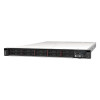
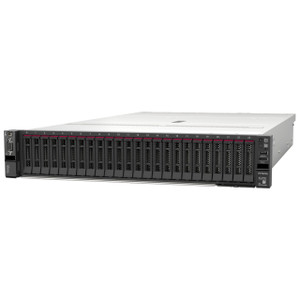
Lenovo 4XG7A63590 AMD EPYC 7413 24-Core Processor for ThinkSystem SR645
Overview
The Lenovo 4XG7A63590 is an AMD EPYC 7413 processor option for the ThinkSystem SR645 server platform — a 24-core, 48-thread CPU built for compute-intensive workloads where per-core throughput and memory bandwidth directly impact application performance. With a 2.65 GHz base clock that boosts to 3.6 GHz and a 128 MB L3 cache, the 4XG7A63590 targets deployments running video analytics backends, database engines, virtualization hosts, and AI-inference pipelines that demand consistent multi-threaded headroom without forcing a move to the top of the EPYC lineup. Socket SP3 keeps it within the SR645's native ecosystem — no platform change, no new chassis investment.
Key Features
- 24 Cores / 48 Threads: Double the logical thread count relative to core count means workloads like multi-stream video analytics, VM-dense hypervisors, or parallel database queries have headroom to run without starving each other. If you're consolidating physical servers, more threads per socket means fewer hosts to buy and manage.
- 2.65 GHz Base / 3.6 GHz Boost: The 950 MHz boost headroom matters for workloads with bursty single-thread demand — license-plate recognition bursts, motion-event processing spikes, or real-time alerting engines that briefly need clock speed before settling back to sustained throughput. You get a CPU that handles both the steady stream and the spike.
- 128 MB L3 Cache: One of the defining traits of the EPYC Milan generation. A large L3 keeps working datasets in-cache for analytics engines and inference runtimes — reducing DRAM round-trips and improving latency on operations that would otherwise stall waiting for memory. For VMS databases or local AI model inference, this is the spec that separates Milan from older server generations.
- Octa-Channel DDR4-3200 Support: Eight memory channels with DDR4-3200 support means the CPU can drive up to 204.8 GB/s of aggregate memory bandwidth. For video surveillance applications running frame buffers, deep-learning inference models, or high-throughput NVR indexing, bandwidth is often the real bottleneck — this ceiling is high enough that memory will rarely be the limiting factor in a well-configured SR645.
- 180W TDP (Configurable 165W–200W): The 7413's thermal envelope is adjustable — you can dial it down to 165W TDP-down for power-constrained deployments or up to 200W TDP-up when you need sustained maximum throughput. This flexibility is useful in colocation environments where you're paying per-watt or managing rack PDU budgets, and in on-premise closets where cooling headroom is limited.
- Socket SP3 Platform: Designed specifically for the Lenovo ThinkSystem SR645, the SP3 socket ensures full platform compatibility — BIOS microcode support, memory controller tuning, and thermal design are validated end-to-end by Lenovo for this processor. Installing a non-validated CPU in a server platform is a common source of unreported stability issues; the 4XG7A63590 eliminates that variable.
Integration and Compatibility
The 4XG7A63590 is a factory option or field-installable processor upgrade for the Lenovo ThinkSystem SR645 platform. The SR645 is a 1U/2U dual-socket AMD EPYC server chassis — this processor installs into Socket SP3 on the system board. Memory compatibility follows the EPYC 7003 (Milan) series memory population rules: octa-channel DDR4-3200, with specific DIMM count and configuration constraints determined by the SR645's memory riser configuration.
For security integrators building a network video recorder or analytics server stack, the SR645 with this CPU pairs naturally with high-bandwidth storage (NVMe or SAS RAID) and GPU accelerators for inference — the memory bandwidth ceiling of 204.8 GB/s won't be the bottleneck. Lenovo's XClarity Administrator can manage the SR645 platform, and the server supports standard IPMI/Redfish out-of-band management, which is essential for remote data center deployments.
Organizations running video management software backends — Milestone XProtect, Genetec Security Center, or Avigilon Control Center — at scale will benefit from the 48-thread compute headroom when running concurrent analytics streams alongside recording and event management. The EPYC architecture's memory channels also make this a reasonable fit for in-memory database workloads that underpin modern VMS installations. Review the server selection guide if you're evaluating whether a single-socket or dual-socket platform better fits your channel count and analytics load — the SR645 supports a second EPYC socket, and the 4XG7A63590 can run as either a single or first processor in a dual configuration. For deployments requiring redundant infrastructure, pair with a UPS appropriate for the SR645's power draw profile.
Frequently Asked Questions
Q: What server platform is the Lenovo 4XG7A63590 compatible with?
A: The 4XG7A63590 is an AMD EPYC 7413 processor option validated for the Lenovo ThinkSystem SR645 server platform. It installs into the Socket SP3 processor socket on the SR645 system board.
Q: How many cores and threads does the EPYC 7413 provide?
A: The AMD EPYC 7413 in the 4XG7A63590 provides 24 physical cores and 48 threads via simultaneous multithreading (SMT), running at a 2.65 GHz base clock with boost up to 3.6 GHz.
Q: What is the TDP of the 4XG7A63590, and is it adjustable?
A: The rated TDP is 180W. It supports configurable TDP-down to 165W for power-constrained environments and configurable TDP-up to 200W for maximum sustained throughput. Actual power configuration depends on BIOS settings within the SR645 platform.
Q: What memory speed and how many channels does the EPYC 7413 support?
A: The EPYC 7413 supports octa-channel (8-channel) DDR4-3200 MHz memory with a maximum aggregate bandwidth of 204.8 GB/s. Memory population rules are governed by the SR645 system board configuration.
Q: Can this processor be used in a dual-socket SR645 configuration?
A: The SR645 is a dual-socket platform. The 4XG7A63590 can function as the primary or secondary processor in a two-CPU configuration, provided both sockets are populated with compatible EPYC Milan-series processors. Consult the SR645 configuration guide for validated dual-CPU combinations.
When a customer asks me about the 4XG7A63590, the first question I ask back is what their analytics-to-recording ratio looks like. The EPYC 7413's 128 MB L3 cache is genuinely large — it changes how the CPU handles inference workloads compared to older Xeon-class servers that were forcing constant DRAM round-trips. If you're running on-box AI analytics alongside VMS recording, that cache difference is felt in latency, not just benchmark numbers.
Technical Highlights:
- 204.8 GB/s Memory Bandwidth: Octa-channel DDR4-3200 means frame buffer throughput for high-channel-count recording won't bottleneck at the CPU's memory interface — a genuine concern on older quad-channel platforms at 100+ camera deployments.
- Configurable TDP (165W–200W): The ability to tune the power envelope in firmware is underappreciated. In a colo rack where you're billed per kW, dialing to 165W TDP-down while still running 48 threads changes your TCO calculation meaningfully.
- 3.6 GHz Boost Clock: Event-driven workloads — license plate hits, motion alerts, exception alarms — spike hard and briefly. The 950 MHz boost headroom over the 2.65 GHz base means those spikes are absorbed in cache rather than queuing behind a slow base clock.
Deployment Considerations:
- The 4XG7A63590 is a Lenovo-validated part for the SR645 — installing non-listed processors in enterprise server platforms risks BIOS incompatibility and unsupported thermal states. Stay within the validated options list for the SR645 platform.
- At 180W TDP, confirm the SR645 chassis cooling configuration matches the processor's thermal requirements before installing in a high-ambient-temperature environment such as an IDF closet or edge rack without active airflow.
This processor makes the most sense in a centralized VMS or analytics server role — specifically a ThinkSystem SR645 running a multi-stream AI inference pipeline where 24 physical cores, high memory bandwidth, and a large L3 cache all contribute directly to throughput rather than sitting idle. It's not the right pick for a lightweight edge recorder; it's designed for the backend rack that handles the heavy lifting for a large camera deployment.