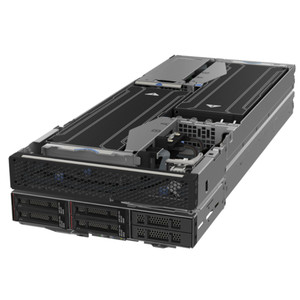
Lenovo 4XG7A63084 Intel Xeon Gold 5218R 20-Core Processor Option Kit for ThinkSystem SD530
Overview
The Lenovo 4XG7A63084 is a factory-configured processor option kit that installs the Intel Xeon Gold 5218R into the ThinkSystem SD530 dense server node. Running at a 2.1 GHz base clock with a 4 GHz max turbo frequency across 20 physical cores and 40 threads, this 2nd Generation Intel Xeon Scalable (Cascade Lake) part is the right CPU choice when you need substantial parallel compute headroom in a 2U quad-node chassis — without stepping up to a higher-TDP part that creates thermal and power budget complications in dense deployments.
The SD530 is purpose-built for high-density compute scenarios: HPC workloads, virtualization hosts, AI inference at the edge, and compute-heavy video analytics backends. The 5218R lands in the practical sweet spot of the Gold family — enough core count for serious multi-tenant workloads, a 125W TDP that the SD530's cooling architecture handles cleanly, and the Cascade Lake microarchitecture's deep instruction set support for AVX-512 workloads common in analytics-heavy environments.
Key Features
- 20 Cores / 40 Threads: Forty concurrent execution threads give your hypervisor or container scheduler the resources to run a meaningful number of VMs or pods on a single node. In a quad-node SD530 chassis populated with four of these kits, you're provisioning 160 threads in a single 2U slot — relevant when rack space is the binding constraint.
- 4 GHz Max Turbo Frequency: Single-threaded workloads — sequential database queries, license-server processes, legacy applications that don't parallelize — get a 4 GHz ceiling rather than being penalized by the 2.1 GHz base clock. The processor manages this autonomously; no manual configuration required.
- 27.5 MB L3 Cache: The large on-die cache reduces DRAM fetch latency for working sets that fit within it — important in analytics workloads that repeatedly scan the same data structures. Fewer cache misses means fewer stalls, which translates directly to throughput under sustained load.
- 1 TB Max Memory per Socket: The 5218R supports up to 1 TB of DDR4-2667 RAM per socket via the LGA 3647 (Socket P) platform. That headroom supports memory-intensive workloads like in-memory databases, large video analytics buffers, or heavy virtualization density without requiring a processor swap when memory requirements grow.
- DDR4-2667 Support: Dual-channel DDR4 at 2667 MHz provides the bandwidth headroom for the 5218R's 20-core configuration. Matching memory speed to the processor's rated maximum avoids leaving bandwidth on the table — under-speccing DIMMs to slower speeds is a common deployment error that limits throughput on memory-bound workloads.
- 125W TDP — Thermally Matched to SD530: At 125W, this processor is within the thermal envelope the SD530's cooling system is rated to handle. Selecting a 150W or higher TDP option in a dense 4-node chassis can force fan speeds that increase acoustic output and reduce drive longevity. The 5218R avoids that tradeoff.
- 14nm Cascade Lake Architecture: The Cascade Lake stepping adds hardware mitigations for Spectre/Meltdown variants directly in silicon, recovering most of the performance lost to software-based mitigations on earlier Skylake Xeon generations. Deployments that were downgraded from Sky Lake parts for security compliance see a measurable throughput recovery here.
- UPI Bus Interconnect: Intel Ultra Path Interconnect (UPI) handles inter-socket communication in dual-socket SD530 configurations. For workloads that don't strictly partition across NUMA domains, UPI latency and bandwidth characteristics matter — Cascade Lake UPI runs at up to 10.4 GT/s, which keeps cross-socket memory access from becoming a bottleneck in most enterprise workloads.
- 64-Bit Operating Mode: Full 64-bit instruction support — a baseline requirement for any modern server OS or hypervisor, but worth confirming when evaluating processor compatibility for workloads migrated from older infrastructure.
Integration and Compatibility
The 4XG7A63084 is a Lenovo option kit designed for the Lenovo ThinkSystem SD530 server platform. It uses the LGA 3647 Socket P footprint, which is standard across the 2nd Generation Intel Xeon Scalable server lineup. Verify SD530 board revision and firmware revision compatibility against Lenovo's ThinkSystem compatibility documentation before installing — newer firmware revisions are frequently required to fully enable Cascade Lake feature sets, including hardware security mitigations.
For server compute platforms running VMware vSphere, Microsoft Hyper-V, or Linux KVM, the Xeon Gold 5218R's AVX-512 support and hardware security patching are recognized automatically by modern hypervisors without guest OS changes. If deploying in a video analytics backend environment — feeding processed streams to an NVR or VMS cluster — the 40-thread execution environment supports running multiple deep learning inference workloads in parallel without CPU contention causing frame-drop events.
For memory configuration, pair this processor with registered ECC DDR4-2667 DIMMs matched to Lenovo's SD530 memory compatibility list. Using non-listed DIMMs can cause training failures at boot. The server memory and accessory category includes compatible RDIMM options for this platform. Network infrastructure planning guides for compute clusters are also available if you are building out the surrounding switching layer.
Frequently Asked Questions
Q: What server platform is the Lenovo 4XG7A63084 designed for?
A: The 4XG7A63084 is a processor option kit for the Lenovo ThinkSystem SD530 dense server node. It installs the Intel Xeon Gold 5218R (LGA 3647 Socket P) into that platform specifically — it is not a universally compatible CPU kit for other Lenovo server families without independent verification of socket and firmware compatibility.
Q: How many cores and threads does the Xeon Gold 5218R provide?
A: The 5218R delivers 20 physical cores and 40 threads via Intel Hyper-Threading. This enables the SD530 node to present 40 logical processors to the hypervisor or OS scheduler, supporting high VM or container density per node.
Q: What is the maximum memory this processor supports?
A: The Xeon Gold 5218R supports up to 1 TB of DDR4-SDRAM per socket at up to 2667 MHz. This is the ceiling per processor socket on the SD530 platform — actual memory capacity depends on the number and capacity of DIMM slots populated with compatible registered ECC DIMMs.
Q: What is the TDP of the Xeon Gold 5218R, and does it matter for the SD530?
A: The 5218R has a 125W Thermal Design Power (TDP). The SD530 is designed for dense 4-node configurations in a 2U chassis, and CPU TDP directly affects cooling requirements and fan speed. At 125W, this processor operates within the SD530's designed thermal envelope. Selecting a processor with higher TDP could exceed the platform's cooling capacity or increase noise and thermal stress on surrounding components.
Q: Is the Cascade Lake architecture relevant for security-sensitive deployments?
A: Yes. Cascade Lake (used by the 5218R) includes hardware-level mitigations for certain Spectre and Meltdown vulnerability variants baked into the silicon. Earlier Skylake-generation Xeon processors required software or microcode mitigations that imposed measurable performance overhead. The Cascade Lake hardware fix recovers most of that overhead, which is important for deployments that require security patch compliance without accepting the throughput penalty.
Q: What memory speed should I pair with this processor?
A: The 5218R natively supports DDR4-2667 MHz. Install DDR4-2667 registered ECC DIMMs from Lenovo's SD530 compatibility list to achieve the rated memory bandwidth. Using slower DIMMs (e.g., DDR4-2400) will operate but leaves memory bandwidth on the table, which matters for memory-bound workloads like analytics or in-memory databases.
The 4XG7A63084 comes up regularly when customers are configuring SD530 nodes for video analytics or virtualized compute workloads and need to decide between the 5218R and adjacent Gold-family options. The 20-core count and 125W TDP combination is the practical choice for dense 4-node chassis builds — you get 40 threads per node without pushing the thermal envelope in a way that creates problems in the second year of operation.
Technical Highlights:
- 4 GHz Max Turbo: The gap between 2.1 GHz base and 4 GHz boost is wide enough to matter in mixed workloads — single-threaded tasks hit the turbo ceiling while background parallel jobs run at base. In a video analytics stack, your inference engine saturates the cores while management processes get turbo headroom without manual affinity pinning.
- 27.5 MB L3 Cache: For inference workloads that load model weights repeatedly across inference calls, this cache size is large enough to retain frequently accessed weight tensors, reducing DDR4 round-trip latency and keeping throughput consistent under concurrent stream processing.
- DDR4-2667 / 1 TB Max: The per-socket memory ceiling of 1 TB at 2667 MHz gives enough overhead to run high-density VM environments without memory contention. In an SD530 quad-node chassis, that's 4 TB addressable RAM across the full chassis — meaningful for consolidating workloads that would otherwise require dedicated 1U or 2U servers per application.
Deployment Considerations:
- Confirm SD530 firmware is updated to a Cascade Lake-supporting revision before installation. Lenovo has published specific XCC and UEFI firmware requirements for 2nd Gen Xeon Scalable support — running an older firmware version with this processor can cause boot failures or disable hardware security features.
- At 125W TDP, ambient temperature management in the rack matters. SD530 nodes in fully populated chassis rely on adequate front-to-back airflow. Rack positions with blocked intake or exhaust paths will cause throttling that negates the 4 GHz turbo benefit under sustained load.
For teams building a compute backend behind a video surveillance or physical security platform — whether feeding an on-premises VMS or running analytics at the edge before forwarding metadata to a cloud platform — the SD530 populated with the 5218R is a deployable, thermally predictable foundation for that workload.