Product images are provided for reference and may not represent the exact model, configuration, or included
components.
Build a complete system in one click
Manufacturer-verified compatible cameras, recorders, mounts, accessories, and licenses for this product.
Build Your Complete System
Manufacturer-verified compatible cameras, recorders, mounts, accessories, and licenses for this product. Adjust quantities and add the entire bundle to your cart in one click.
ItemQtyStatusPrice
Mounts & Accessories recommended
Recorders, NVRs & Storage recommended
Licenses & Software where applicable
Services & Training optional
$0.00$0.00$0.00$0.00$0.00$0.00
No Bots, Just Experts
Questions about this product? Free pre-sales support from a senior specialist — product questions, compatibility checks, BOM quotes, price confirmation — typically answered within one business day. Need camera placement or system design work? Engineering time is $175 per hour (qty 1 = 1 hour). Hardware buyers get up to one hour ($175) credited back on their order.
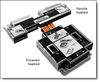
Lenovo 4XG7A63074 Intel Xeon Gold 6258R Processor for ThinkSystem SD530
Overview
The Lenovo 4XG7A63074 is a factory-configured Intel Xeon Gold 6258R processor option for the ThinkSystem SD530 server platform. Built on Intel's 2nd Generation Xeon Scalable (Cascade Lake) architecture at 14nm, the 6258R delivers 28 physical cores with 56 threads and a 2.7GHz base clock that can sustain up to 4.0GHz under Turbo Boost — making it a capable fit for dense compute workloads in rack-optimized server environments where per-socket thread count and memory bandwidth both matter.
At 205W TDP, this is a high-performance Cascade Lake part. Integrators and IT architects specifying the Lenovo ThinkSystem line should account for per-socket thermal budget when populating dual-socket SD530 nodes in high-density blade chassis — airflow and power delivery requirements will scale accordingly.
Key Features
28 Cores / 56 Threads: The 6258R's core count translates directly to parallel workload capacity. For virtualization hosts, each additional thread is a vCPU you can assign — 56 threads per socket means a dual-socket SD530 node can present over 100 vCPUs before overcommitting, which matters when sizing VM density for enterprise server deployments.
2.7GHz Base / 4.0GHz Boost: A 2.7GHz base keeps sustained multi-threaded workloads fed, while the 4.0GHz Turbo Boost ceiling supports latency-sensitive single-threaded operations. The gap between base and boost (1.3GHz) is meaningful for mixed workloads where some threads run hot and others idle.
38.5MB L3 Cache: The large last-level cache reduces DRAM fetch penalties on data-intensive workloads like database queries, analytics engines, and video management system (VMS) indexing operations. More cache per core generally means fewer expensive memory accesses under load.
Hexa-Channel DDR4-2933: Six memory channels running at 2933MHz deliver substantial memory bandwidth — critical for workloads that can't fit their working set in cache. Each channel expands your memory bus, so a fully populated SD530 memory configuration gets the full benefit. This also means the processor supports high-density DDR4 configurations up to 1TB per socket.
Up to 1TB System Memory per Socket: 1TB addressable RAM per socket is a practical ceiling for in-memory database workloads, large-scale VMS servers handling high-channel-count recording, or AI inference environments running large model weights. For most enterprise deployments, this headroom means you won't be constrained by processor-side memory limits.
LGA 3647 (Socket P) Platform: The socket is Xeon Scalable standard — the SD530 platform supports validated processor options within this family. Verify Lenovo's processor compatibility matrix for the SD530 generation before specifying an upgrade or replacement scenario.
64-bit Operating Modes: Full 64-bit support is table stakes for any modern server OS or hypervisor. Relevant primarily as a compatibility confirmation for legacy procurement checklists.
205W TDP: This is not a low-power part. A 205W socket draw requires adequate chassis airflow, appropriate power supply headroom, and data center cooling capacity. In a dual-socket SD530 configuration, budget over 410W for CPU thermal load alone before factoring in memory, storage, and NIC draw.
Integration & Compatibility
The 4XG7A63074 is sold as a Lenovo ThinkSystem SD530-specific processor option. It installs into the LGA 3647 (Socket P) socket and is validated against Lenovo's SD530 firmware and cooling stack. For deployments integrating with data center networking infrastructure or storage fabrics, the processor's PCIe lane allocation and memory bandwidth specs should be cross-referenced against the SD530's I/O subsystem documentation. Workloads running VMware vSphere, Microsoft Hyper-V, or Red Hat KVM on SD530 nodes will benefit from the 56-thread count at the hypervisor scheduler level. Lenovo's ServerProven compatibility program is the authoritative source for validated memory, NIC, and storage add-in card options for this platform.
Frequently Asked Questions
Q: What server platform is the Lenovo 4XG7A63074 compatible with?
A: The 4XG7A63074 is a processor option validated for the Lenovo ThinkSystem SD530 server. It uses the LGA 3647 (Socket P) socket, which is the standard Xeon Scalable platform socket. Always verify Lenovo's SD530 processor compatibility matrix before ordering for an upgrade scenario.
Q: What is the core and thread count for the Xeon Gold 6258R in this configuration?
A: The Intel Xeon Gold 6258R delivers 28 physical cores with Hyper-Threading enabled for 56 logical threads per socket. A dual-socket SD530 node provides 56 cores and 112 threads total.
Q: What is the maximum memory supported by the 4XG7A63074 processor?
A: The Intel Xeon Gold 6258R supports up to 1TB of DDR4-2933 memory per socket via six memory channels. Actual installed memory capacity depends on the SD530 platform's DIMM slot count and validated memory configurations.
Q: What is the TDP of the Xeon Gold 6258R and why does it matter for rack planning?
A: The 6258R carries a 205W Thermal Design Power rating. This affects chassis airflow requirements, power supply sizing, and data center cooling allocation. In dual-socket configurations, plan for over 410W in CPU thermal load alone before accounting for other components.
Q: What memory type and speed does the 4XG7A63074 processor support?
A: The Xeon Gold 6258R supports DDR4-SDRAM at 2933MHz across six memory channels, delivering the memory bandwidth needed for data-intensive enterprise workloads.
Senior Specialist · Typically replies within 1 business day
Message sent!
A representative will reply to your email within one business day.
Build a complete system in one click
Manufacturer-verified compatible cameras, recorders, mounts, accessories, and licenses for this product.
Build Your Complete System
Manufacturer-verified compatible cameras, recorders, mounts, accessories, and licenses for this product. Adjust quantities and add the entire bundle to your cart in one click.