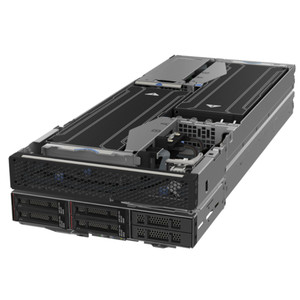
Lenovo 4XG7A63079 Intel Xeon Gold 6238R Processor for ThinkSystem SD530
Overview
The Lenovo 4XG7A63079 is a 2nd Generation Intel Xeon Scalable processor option for the ThinkSystem SD530 platform, pairing a 28-core Intel Xeon Gold 6238R at 2.2 GHz base with a 4.0 GHz single-core Turbo Boost ceiling. With 56 threads, 38.5 MB of L3 cache, and support for up to 1 TB of DDR4-2933 memory, this is a CPU upgrade or build-to-order processor insert aimed at compute-dense rack deployments where thread count and memory bandwidth both matter — think video analytics servers, VMS back-end hosts, or multi-tenant edge compute nodes. The 165 W TDP sits in the middle of the Cascade Lake Gold stack: more headroom than the 6230R, meaningfully below the Platinum-tier parts.
Key Features
- 28 Cores / 56 Threads at 2.2 GHz base: The 6238R's core density makes it particularly useful for workloads that scale horizontally — concurrent VMS stream decoding, multi-channel AI inference, or virtualized security infrastructure where you're running multiple workloads on a single sled. More threads mean fewer bottlenecks when 40+ camera streams hit the decoder simultaneously.
- 4.0 GHz Turbo Boost: When single-threaded latency matters — license plate recognition lookups, database queries, alert triage logic — the 4.0 GHz Turbo ceiling keeps response times tight without requiring a higher-TDP Platinum part.
- 38.5 MB L3 Cache: A large L3 reduces main-memory round-trips on repetitive access patterns common in video buffering and object-detection pipelines. Fewer cache misses translate directly to lower per-stream CPU overhead.
- DDR4-2933 Support, Up to 1 TB: The 2933 MHz memory speed is the fastest supported by Cascade Lake and makes a real difference in memory-bandwidth-bound workloads. The 1 TB ceiling gives the SD530 enough headroom for large in-memory analytics databases or high-channel VMS configurations with hot-frame buffering.
- 165 W TDP: The SD530 is a 2-socket half-width sled; at 165 W per socket the thermal envelope is well-defined and fits within standard SD530 node power budgets. Confirm your chassis and PDU allocation before ordering — exceeding the sled's power delivery spec affects neighboring nodes in the same DW612 or DW612S enclosure.
- 14 nm Cascade Lake on LGA 3647 (Socket P): The mature 14 nm node and LGA 3647 socket are fully aligned with the SD530's platform specification. No firmware surprises — this is a validated, platform-native option, not a field upgrade experiment.
- UPI Bus Architecture: Ultra Path Interconnect keeps CPU-to-CPU and CPU-to-memory fabric latency low in dual-socket SD530 configurations, which matters when both sockets are sharing workload state — common in clustered VMS or distributed analytics deployments.
- 64-bit Operating Mode: Full 64-bit instruction support means no constraints on OS or hypervisor selection. Deploy VMware ESXi, Windows Server, or any mainstream Linux distribution without architectural limitations.
Integration and Compatibility
The 4XG7A63079 is a platform-specific part for the Lenovo ThinkSystem SD530 server node. It is not a retail-boxed CPU — it ships as a Lenovo field-replaceable unit (FRU) or factory configuration option. Verify your SD530 firmware and UEFI version against Lenovo's Hardware Compatibility List before installation; Cascade Lake 2nd Gen Xeon parts require specific UEFI microcode levels that may not be present on older SD530 firmware images. In dual-socket configurations, both processors must be identical models — mixing Xeon Gold 6238R with a different SKU is not supported. Memory DIMMs should be validated against Lenovo's ServerProven list for DDR4-2933 compatibility at full-population density.
Frequently Asked Questions
Q: What server is the Lenovo 4XG7A63079 compatible with?
A: The 4XG7A63079 is a processor option for the Lenovo ThinkSystem SD530 server node. It uses the LGA 3647 (Socket P) socket and is not interchangeable with non-SD530 Lenovo platforms without independent compatibility verification.
Q: How many cores and threads does the Xeon Gold 6238R in the 4XG7A63079 provide?
A: The Intel Xeon Gold 6238R provides 28 physical cores and 56 threads via Hyper-Threading, running at a 2.2 GHz base frequency with up to 4.0 GHz Turbo Boost on a single core.
Q: What is the maximum memory supported by the 4XG7A63079 processor?
A: The Xeon Gold 6238R supports up to 1 TB of DDR4-2933 SDRAM per processor socket. Actual maximum installed memory in the SD530 depends on the number of DIMM slots available in the specific SD530 configuration.
Q: What is the TDP of the 4XG7A63079 and does it affect SD530 enclosure planning?
A: The Thermal Design Power is 165 W. In a dual-socket SD530 sled that equates to 330 W CPU load per node. Confirm that your DW612 or DW612S enclosure and PDU can support the combined node power draw before deploying at full density.
Q: Can the 4XG7A63079 be used in a dual-socket SD530 configuration?
A: Yes, the SD530 supports dual-socket configurations. When deploying two processors, both must be identical — two units of 4XG7A63079 (Xeon Gold 6238R). Mixing processor models in the same sled is not supported.
Q: What operating systems are supported with the 4XG7A63079?
A: The Xeon Gold 6238R operates in 64-bit mode, supporting all mainstream 64-bit operating systems including VMware ESXi, Windows Server, and Linux distributions validated on the Lenovo ThinkSystem SD530 platform. Check Lenovo's ServerProven list for certified OS/hypervisor combinations.
The 4XG7A63079 is one of the higher-core-count options in the SD530 Cascade Lake lineup — 28 cores and a 38.5 MB L3 cache is a meaningful step up from the mid-range Gold 6-series parts, and the 4.0 GHz Turbo ceiling keeps it competitive on single-threaded response time even though the base clock sits at 2.2 GHz. For dense compute in a half-width sled form factor, that's a useful combination.
Technical Highlights:
- 28 Cores / 56 Threads: At 56 concurrent threads per socket, the SD530 with this processor can sustain parallel decode of 40+ simultaneous HD streams without pinning CPU utilization — relevant if you're running Milestone, Genetec, or a similar multi-stream VMS directly on the node.
- DDR4-2933 at 1 TB ceiling: 2933 MHz is the top supported speed for Cascade Lake; paired with a fully-populated SD530 DIMM configuration, memory bandwidth won't be the bottleneck in analytics-heavy workloads. 1 TB capacity per socket leaves room for large in-memory video indexing databases.
- 165 W TDP: Well-defined thermal envelope for enclosure planning. At 165 W per socket, dual-socket SD530 nodes draw roughly 330 W under sustained CPU load — account for that in per-chassis power allocation before committing to high node density.
Deployment Considerations:
- Confirm SD530 UEFI firmware supports 2nd Gen Xeon Scalable (Cascade Lake) before ordering — older firmware images shipped with early SD530 units may require a UEFI update before the 6238R is recognized correctly.
- The LGA 3647 socket requires careful seating and torque procedure; this is a platform FRU, not a retail CPU. If you're field-upgrading an existing SD530, follow Lenovo's service manual torque spec precisely — socket damage is not covered under standard replacement terms.
This processor is best suited for SD530 deployments acting as multi-channel video analytics hosts or virtualization nodes where both thread count and memory capacity are limiting factors — specifically environments running concurrent deep-learning inference alongside stream recording, where the 28-core density genuinely displaces the need for a second physical server.