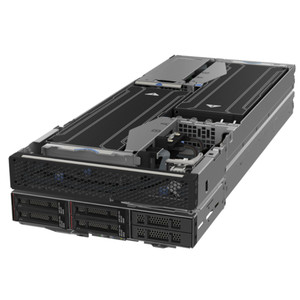
Lenovo 4XG7A63081 SD530 Xeon Gold 6226R 16-Core Processor Node
Overview
The Lenovo 4XG7A63081 is a processor option kit pairing the 2nd Generation Intel Xeon Gold 6226R with the ThinkSystem SD530 compute node — a dense, half-width server designed for scale-out HPC, AI inference, and data-intensive workloads in enterprise data centers. The 6226R delivers 16 physical cores running at a 2.9 GHz base with a 3.9 GHz Turbo Boost ceiling, giving you 32 threads on a single socket without the cost premium of higher-tier Platinum dies. If you're building a high-density rack for video analytics, machine learning pipelines, or large-scale NVR back-end processing, this node hits a strong price-to-performance target in the Cascade Lake generation.
Designed around the LGA 3647 (Socket P) platform, the 4XG7A63081 fits within the Lenovo ThinkSystem SD530 chassis, which hosts up to two of these compute nodes in a 1U form factor — doubling your core density per rack unit compared to standard 1U single-node designs.
Key Features
- 16 Cores / 32 Threads at 2.9–3.9 GHz: The Xeon Gold 6226R's 16-core, 32-thread configuration covers demanding parallel workloads — video transcoding, concurrent analytics streams, or multi-tenant virtualization — without requiring a dual-socket board. Turbo Boost to 3.9 GHz handles single-threaded burst tasks like database lookups or real-time alerting logic that can't be parallelized.
- 22 MB L3 Cache: The 22 MB shared last-level cache keeps frequently accessed data close to the execution units, reducing main memory round-trips on workloads with moderate working sets — relevant for VMS indexing engines or analytics models that repeatedly reference a bounded dataset.
- 150 W TDP: At 150 W, this processor sits in the mid-range TDP band for the Cascade Lake Gold family. The SD530's dense cooling design handles it, but factor this into per-node power budgeting: two nodes per 1U chassis means up to 300 W of processor TDP alone before storage, DIMMs, and NICs are counted.
- Hexa-Channel DDR4-2933 Memory: Six memory channels operating at up to 2933 MHz provide aggregate bandwidth that scales well with core-heavy workloads. Analytics and inference tasks that stream large datasets through DRAM benefit directly — bandwidth-starved processors waste core counts, and the 6226R's six channels avoid that bottleneck for most video and ML pipelines.
- Up to 1 TB Addressable RAM: The processor's memory controller supports up to 1 TB of DDR4-SDRAM per socket. For in-memory databases, large video frame buffers, or virtualized environments running dozens of VMs, this ceiling gives you genuine headroom without hitting a hard architectural wall mid-deployment.
- 14 nm Cascade Lake Architecture: Built on Intel's 14 nm Cascade Lake process, the 6226R benefits from mature silicon yield (stable supply, predictable performance) and is fully compatible with the Xeon Scalable 2nd Generation platform — including hardware mitigations for Spectre/Meltdown variants baked into the microarchitecture.
- 64-Bit / 32-Thread Execution: Full 64-bit operating mode with 32 hardware threads is required for modern enterprise OS environments — RHEL, Windows Server, VMware ESXi all run optimally here. No 32-bit OS constraints, no hyperthreading limitations to work around.
Integration & Compatibility
The 4XG7A63081 is engineered for the Lenovo ThinkSystem SD530 platform specifically — verify chassis generation and BIOS level compatibility via Lenovo's ServerProven list before ordering if you're dropping this into an existing SD530 deployment rather than a new build. The LGA 3647 socket is shared across the Xeon Scalable 2nd Generation lineup, but Lenovo platform firmware validation is specific to tested configurations.
From a server and storage infrastructure standpoint, the SD530 is commonly deployed in high-density HPC clusters, video analytics back-ends, and virtualization farms where 2U chassis housing four compute nodes is the standard rack unit. Pair this processor node with appropriate DDR4-2933 RDIMMs to fully utilize the hexa-channel memory bus — running fewer than six populated channels leaves memory bandwidth on the table.
For data center architects building out NVR back-end compute or AI-driven video analytics tiers, the 6226R fits between the entry-level 6210U (20-core but 150 W) and the higher-clocked 6234 (8-core but 3.3 GHz base) — making it a practical middle ground when you need both core count and sustained clock speed. Consult a server infrastructure specialist to confirm workload fit before committing to a large node order.
Frequently Asked Questions
Q: What server platform is the Lenovo 4XG7A63081 compatible with?
A: The 4XG7A63081 is designed for the Lenovo ThinkSystem SD530 compute node. It uses the LGA 3647 (Socket P) platform for 2nd Generation Intel Xeon Scalable processors. Always verify BIOS and firmware compatibility via Lenovo's ServerProven list for your specific chassis revision.
Q: What is the base and boost clock speed of the Xeon Gold 6226R in this kit?
A: The Intel Xeon Gold 6226R runs at a 2.9 GHz base frequency with a Turbo Boost ceiling of 3.9 GHz, delivering 16 cores and 32 threads per socket.
Q: How much memory does the 4XG7A63081 processor support?
A: The Xeon Gold 6226R supports up to 1 TB of DDR4-SDRAM per socket via six memory channels at up to 2933 MHz. Full bandwidth utilization requires populating all six channels with appropriate RDIMMs.
Q: What is the TDP of this processor, and does it affect chassis selection?
A: The Xeon Gold 6226R has a 150 W Thermal Design Power. The ThinkSystem SD530 is designed to handle this TDP within its dense cooling architecture, but two nodes per 1U chassis means up to 300 W of combined processor TDP — a key input for PDU and cooling planning.
Q: Is the Lenovo 4XG7A63081 a drop-in upgrade for existing SD530 nodes?
A: It is designed for the SD530 platform, but drop-in compatibility depends on existing BIOS version and current processor configuration. Lenovo's ServerProven compatibility tool should be checked before treating this as a direct upgrade in a populated chassis.
The 4XG7A63081 is one of those processor configurations that earns its place in high-density compute deployments through solid fundamentals rather than headline specs. The Xeon Gold 6226R's hexa-channel DDR4-2933 memory bus is the real differentiator here — most analytics and inference workloads that underperform on paper are actually memory-bandwidth-starved, not compute-starved, and six channels at 2933 MHz eliminates that constraint for the majority of video back-end and ML inference use cases I see in practice.
Technical Highlights:
- 16C/32T at 2.9–3.9 GHz: Enough parallelism to handle 30–40 concurrent HD analytics streams or dense VM workloads without hitting a thread ceiling, while the 3.9 GHz Turbo headroom keeps single-threaded alert logic and indexing tasks responsive.
- 22 MB L3 Cache: Reduces DRAM round-trips on workloads with bounded working sets — VMS database indices, analytics model weights under ~22 MB, and real-time metadata lookups all benefit from cache residency at this level.
- 150 W TDP within the SD530's dual-node 1U chassis: Two nodes in one rack unit is the SD530's density argument — but 300 W of combined processor TDP before DIMMs and NICs is a real number. Your PDU breaker sizing and in-row cooling capacity need to be confirmed before populating both nodes at full DIMM load.
Deployment Considerations:
- Populate all six DIMM channels to realize the full 2933 MHz bandwidth — running four-channel or two-channel configurations wastes the bandwidth advantage that justifies this processor tier over a lower-core-count Gold SKU.
- The 150 W TDP is at the upper end of what some older SD530 firmware revisions were tuned for — check Lenovo's ServerProven list and apply the latest XCC/UEFI firmware before commissioning to avoid thermal throttling under sustained load.
This configuration is a strong fit for enterprise video analytics back-ends running 50+ camera feeds through GPU-assisted inference pipelines, where the CPU handles pre/post-processing, metadata indexing, and alert routing while GPUs handle the inference layer — the 6226R's core count and memory bandwidth keep that CPU-side pipeline from becoming the bottleneck.