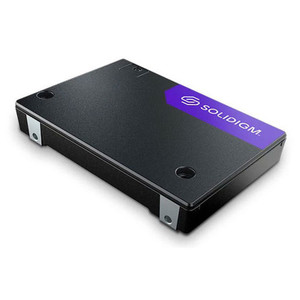
Lenovo 4XB7A93891 ThinkSystem 2.5" U.2 CD8P 12.8TB Mixed Use NVMe PCIe 5.0 x4 SSD
Overview
The Lenovo 4XB7A93891 is a 12.8TB, 2.5-inch U.2 hot-swap NVMe SSD built for ThinkSystem servers running demanding mixed read/write workloads — think AI inference pipelines, video surveillance storage pools, transactional databases, and high-throughput analytics platforms where both IOPS ceiling and sustained bandwidth matter simultaneously. Running over a PCIe 5.0 x4 interface, this drive delivers the bandwidth headroom that previous-generation PCIe 4.0 platforms simply cannot match, making it the right call when you're upgrading to a Gen 5 ThinkSystem chassis and need storage that won't become the bottleneck.
Key Features
- 12.8TB TLC NAND Capacity: At 12.8TB per slot in a standard 2.5-inch U.2 form factor, you can build a dense all-flash storage tier without sacrificing drive-bay real estate. TLC NAND provides a practical cost-per-terabyte advantage over SLC or MLC drives at this capacity point, and the Mixed Use endurance rating means it's spec'd to handle sustained writes — not just read-heavy archival. If your workload is exclusively read-intensive, a Read Intensive variant would be more cost-efficient; if you're writing continuously at near-line speeds, a Write Intensive spec is more appropriate.
- PCIe 5.0 x4 Interface: PCIe 5.0 x4 doubles the theoretical bandwidth ceiling of PCIe 4.0 x4. Sequential read throughput hits 12,000 MB/s and sequential write reaches 5,500 MB/s — figures that matter in video surveillance back-ends processing dozens of simultaneous HD or 4K streams, or in AI compute nodes doing model checkpointing. If your server chassis is still Gen 4, the drive will negotiate down, but you won't realize the Gen 5 throughput advantage until the platform matches.
- 2,000,000 Random Read IOPS (4KB): Two million random read IOPS at a 4KB block size is the operational ceiling that separates enterprise NVMe from consumer or prosumer parts. For video management systems replaying concurrent archived footage across many operators, or databases serving rapid point queries, this headroom ensures the storage subsystem is never the constraint during peak demand.
- 400,000 Random Write IOPS (4KB): 400K write IOPS handles heavy ingestion — continuous camera stream writes, log aggregation, or database commit workloads — without the queue-depth stalls that plague lower-tier NVMe drives under sustained mixed traffic.
- Low Latency — 69µs Read / 10µs Write: Sub-70-microsecond read latency and sub-10-microsecond write latency are the numbers to watch for latency-sensitive applications: real-time analytics, live forensic video review, or any VMS workflow where seek-and-play responsiveness is user-visible. High IOPS with poor latency produces a drive that looks fast on synthetic benchmarks but feels sluggish in interactive workloads.
- TCG Opal 2.0 Hardware Encryption: Hardware-based self-encrypting drive capability via TCG Opal 2.0 means the encryption/decryption engine is on the drive controller — zero CPU overhead, no performance penalty. For environments with data-at-rest compliance requirements (HIPAA, PCI-DSS, government deployments), this is the correct way to cover encrypted storage without throttling your server's compute resources.
- Hot-Swap U.2 Carrier: The hot-swap designation means you can pull and replace this drive without powering down the server — critical for maintaining uptime on 24/7 surveillance recording platforms or production database servers where a maintenance window is not available. The 2.5-inch U.2 form factor fits standard ThinkSystem hot-swap bays directly.
- S.M.A.R.T. Support: S.M.A.R.T. telemetry surfaces drive health data — wear indicators, uncorrectable error counts, temperature, and remaining spare capacity — to server management software. Integrated with Lenovo XClarity or third-party monitoring tools, this lets you schedule proactive replacements before a drive fails rather than reacting to unplanned outages.
Integration & Compatibility
The 4XB7A93891 is designed for Lenovo ThinkSystem servers with PCIe 5.0 U.2 NVMe drive bays. Verify your specific ThinkSystem chassis and HBA/controller against Lenovo's current compatibility matrix before ordering — not all ThinkSystem models support U.2 PCIe 5.0 bays, and mixing PCIe generations in a storage pool can introduce performance inconsistencies. The U.2 (SFF-8639) connector is standard across enterprise server platforms, but firmware and driver support are validated against ThinkSystem hardware specifically.
For enterprise SSD deployments in video surveillance back-ends, pair this drive with a network video recorder platform that exposes raw storage to the host OS — software-defined storage or direct-attached configurations extract the most value from 2M IOPS drives. For broader Lenovo ThinkSystem storage planning, review the full server and storage line to match the drive to a validated chassis. See the storage planning guide for guidance on retention calculations and drive-count sizing for surveillance workloads. Complementary network switches with sufficient uplink bandwidth ensure the storage performance is accessible over the network without creating a bottleneck upstream of the drives.
Frequently Asked Questions
Q: What servers is the Lenovo 4XB7A93891 compatible with?
A: This drive is designed for Lenovo ThinkSystem servers with PCIe 5.0 x4 U.2 NVMe hot-swap bays. Always verify against Lenovo's official compatibility list for your specific ThinkSystem model before purchasing, as not all ThinkSystem chassis support PCIe 5.0 U.2 drives.
Q: Does the 4XB7A93891 work in PCIe 4.0 servers?
A: The drive will physically fit and electrically negotiate down to PCIe 4.0 speeds in compatible U.2 bays, but you will not achieve the rated 12,000 MB/s sequential read or 2,000,000 IOPS figures. Those numbers require a PCIe 5.0 x4 host interface. Confirm with Lenovo's compatibility documentation for your chassis.
Q: What does Mixed Use (MU) endurance rating mean for this SSD?
A: Mixed Use indicates the drive is rated for workloads with a roughly balanced mix of reads and writes — typically around a 70/30 read/write ratio. It provides more write endurance than a Read Intensive drive but is not intended for workloads that are continuously write-heavy (which would call for a Write Intensive spec). It's a practical fit for surveillance storage pools that combine continuous recording with frequent playback.
Q: Does the 4XB7A93891 include hardware encryption?
A: Yes. The drive supports TCG Opal 2.0 self-encrypting drive (SED) functionality. Encryption and decryption are handled by the drive controller, meaning there is no CPU performance overhead. Activation requires compatible drive management software or a TCG Opal-compliant key management solution.
Q: Is this drive hot-swappable?
A: Yes. The 4XB7A93891 is rated for hot-swap operation in compatible ThinkSystem bays, allowing drive replacement without powering down the server — a key requirement for 24/7 uptime environments like video surveillance recording platforms.
Q: What is the sequential read speed of the 4XB7A93891?
A: Sequential read speed is rated at 12,000 MB/s (measured via ATTO benchmark) over the PCIe 5.0 x4 interface. Sequential write is rated at 5,500 MB/s. These figures apply when installed in a PCIe 5.0 host platform.
When I spec storage for a high-density surveillance or AI-compute platform, the number I look at first is random read IOPS under mixed load — and the 4XB7A93891 posts 2,000,000 IOPS at 4KB reads alongside 400,000 write IOPS, which means this drive is engineered for the concurrent read/write pattern that surveillance VMS backends actually generate, not just a clean sequential benchmark. At 12.8TB in a single 2.5-inch U.2 hot-swap slot, you're also getting serious capacity density without giving up the hot-swap maintainability that 24/7 deployments require.
Technical Highlights:
- PCIe 5.0 x4 Bandwidth: 12,000 MB/s sequential read and 5,500 MB/s sequential write are only reachable on a Gen 5 host — if you're still on a Gen 4 ThinkSystem platform, budget the upgrade accordingly or accept that roughly half the sequential bandwidth will be on the table.
- Sub-70µs Read Latency: The 69µs random read latency spec is the figure that determines how responsive live forensic review feels in a VMS. High IOPS with poor latency produces a drive that benchmarks well but stalls during interactive seek-and-play operations — this drive avoids that trap.
- TCG Opal 2.0 SED: Hardware encryption with zero CPU overhead is the only acceptable approach for regulated storage environments. Enabling Opal on this drive requires an Opal-compliant management layer; don't assume it activates automatically on first install.
Deployment Considerations:
- Verify your ThinkSystem chassis model against Lenovo's NVMe U.2 PCIe 5.0 compatibility matrix before ordering — U.2 bays exist in multiple generations and the PCIe 5.0 speed rating is not universal across ThinkSystem SKUs.
- TLC NAND at Mixed Use endurance is appropriate for blended recording-and-playback workloads, but if your write-to-read ratio is consistently above 50% writes (pure ingestion nodes, continuous write logging), a Write Intensive variant will deliver longer usable drive life.
This drive is the right specification for a ThinkSystem-based, PCIe 5.0 all-flash surveillance storage node handling 50+ simultaneous 4K camera streams — the combination of 12.8TB density, 2M IOPS headroom, hot-swap serviceability, and hardware encryption covers every hard requirement in that deployment profile without over-specifying for lighter workloads.