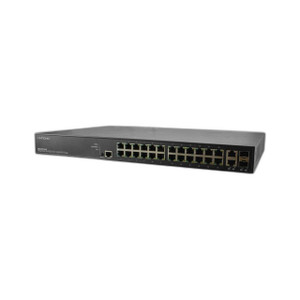
Lantronix 83X-40S-500-NAA 40-Port Serial Device Server
The Lantronix 83X-40S-500-NAA is a 40-port serial console server designed for out-of-band management across data centers, telecom facilities, and distributed infrastructure deployments. It consolidates serial connections from 40 legacy devices—network appliances, UPS systems, environmental monitors, security controllers, rack PDUs, and HVAC equipment—into a single IP-addressable platform. Rather than running individual serial cables to each console port, operators access all 40 devices remotely via Ethernet and SSH or Telnet, eliminating manual site visits for troubleshooting and reboots. The dual 10/100/1000 RJ45 Ethernet ports plus one 1GB SFP uplink integrate seamlessly into existing network backbones without consuming large numbers of switch ports or creating serial-traffic bottlenecks.
Key Features
- 40 RJ45 Serial Connections: One RJ45 port per managed device. Support for standard serial speeds from 300 to 230,400 bps, covering everything from legacy HVAC controllers to modern network appliances.
- Dual 10/100/1000 Ethernet Ports: Bonded for failover or configured independently for network segmentation. Both ports simultaneously active—no single point of failure on the management network.
- 1GB SFP Uplink Slot: Accepts standard fiber modules for long-distance site-to-site console consolidation. Extend serial management across campus or multi-building deployments without Ethernet cable runs.
- Centralized Out-of-Band Access: Web-based management interface plus SSH/Telnet console sessions. No vendor-specific client software required—works with any terminal emulator or SSH tool.
- Redundant AC Power Inputs: Dual power supplies with independent feeds recommended for critical infrastructure. Graceful shutdown and status monitoring per supply.
- 19-Inch Rack Form Factor: 22.6 lb, 3.5-inch mounting height. Fits standard equipment racks; optional shelf or wall mounting available.
- Dual Network Port Failover: Configure both Ethernet ports as a bonded pair for automatic failover, or use one for management and one for data segmentation. Web console simplifies configuration.
- Device Aliasing and Port Mapping: Assign friendly names to each serial port and store credentials centrally. Quick dial-in from the management interface without remembering IP addresses.
The LM83X series operates as a true out-of-band management appliance. Unlike in-band management interfaces (iLO, IPMI, Redfish) that share network bandwidth with production traffic, the 83X-40S-500-NAA isolates console access on its own Ethernet segment. This architecture proves essential when managing devices that have lost network connectivity or require emergency hard resets. Power-cycle a failed switch or reload a bricked router from any remote terminal without waiting for on-site support—reducing mean time to recovery (MTTR) in distributed data centers by hours.
The unit integrates with any IP network infrastructure supporting standard Ethernet. Compatibility spans Cisco routers, Juniper switches, legacy firewalls, rack-mounted servers with serial consoles, power distribution units (PDUs), and environmental monitoring equipment—essentially any device with a DB9, DB25, or RJ45 serial port. The included VHDCI-to-serial breakout cables (1.5 meters) connect to standard DB9 or RJ45 adapters. For sites managing 40–100+ legacy appliances, the 83X-40S-500-NAA consolidates serial management from separate console cables and serial routers into a single IP-addressable appliance, reducing operational complexity and cutting per-port management overhead.
Deployment scenarios span enterprise data centers, telecom NOCs, colocation facilities, and distributed branch offices. In a 500-device network where 200 devices lack modern out-of-band interfaces, one or two 83X-40S-500-NAA units centralize console access for those legacy assets. Combine multiple units via the SFP uplink for hierarchical management architectures—a central console server at the primary data center and satellite units at branch locations, all communicating over a dedicated out-of-band VLAN. The 2-year manufacturer warranty and field-replaceable power supplies support critical-uptime deployments.
Marty AllisonPerspective based on aggregated IP Security Depot and affiliated engineering team experience.
We've deployed the Lantronix 83X-40S-500-NAA across enterprise data centers and distributed telecom infrastructure, and it remains one of the most reliable out-of-band console consolidation appliances in its class. The real value emerges when you're managing mixed-age infrastructure—50% modern API-rich appliances, 50% legacy serial-only devices. Traditional approaches either force operators to maintain a tangle of serial cables routed to a closet, or require a separate Ethernet console server for each building or pod. The 83X-40S-500-NAA flattens that operational burden. You assign it one IP address, bond or segment its dual Ethernet ports based on your NOC architecture, and suddenly all 40 devices are accessible from any terminal on your management network. The SFP uplink transforms it from a single-site appliance into a hub for multi-site console consolidation—run fiber to branch locations, plug in matching SFP modules, and the remote serial devices appear as though they're local. That flexibility alone justifies the capex in distributed deployments.
Technical Highlights:
- Dual 10/100/1000 Ethernet Ports with Bonding: Both ports remain active simultaneously. Configure as a redundant pair for automatic failover (zero downtime if one port fails or the switch port dies), or split them across different VLANs to isolate out-of-band traffic from production management. In a true failover configuration, we've seen MTTR drop from 45 minutes to under 5 minutes on console-dependent recovery tasks.
- 1GB SFP Uplink for Multi-Site Architectures: Eliminates Ethernet cable distance limits. Deploy a satellite 83X unit at a branch office 10km away—fiber runs, SFP modules installed, serial devices consolidated remotely. We typically pair this with a dedicated out-of-band VLAN on the core switch to avoid management traffic contention.
- 40 Independent Serial Ports at Variable Baud Rates: Each port auto-negotiates or manual-sets from 300 to 230,400 bps. Legacy HVAC systems running 9600 bps coexist with modern network appliances at 115,200 bps on the same appliance. No per-port configuration complexity—set once via the web console, forget.
- SSH/Telnet Console Access with Session Logging: Remote terminal access via any SSH client or terminal emulator. Optional session logging to syslog or local storage for audit trails—critical for compliance environments (PCI-DSS, HIPAA) that mandate console activity records.
- Redundant Power Supplies with Independent AC Feeds: Two hot-swappable power modules. Recommended topology pairs each supply with a different PDU outlet or UPS. Loss of one supply keeps the appliance running; loss of both is usually a building-level power failure anyway. Graceful shutdown and status reporting via SNMP.
Deployment Considerations:
- Serial port assignment matters. Document the physical port-to-device mapping before deployment—add aliases in the web console immediately. Port 1 = router-NYC, Port 2 = switch-NYC, etc. Without naming, remote operators face a 40-port guessing game. Create a simple Excel sheet or CMDB entry for each unit.
- The SFP uplink requires matching transceiver modules at both ends. If you're linking two 83X units across fiber, buy identical SFP-1000Base-LX or -SX modules. A mismatch (one multimode, one singlemode) won't pass traffic and wastes troubleshooting time.
- Out-of-band VLAN isolation is strongly recommended. Assign the Ethernet ports to a dedicated management VLAN separate from production. If someone misconfigures the appliance and causes a broadcast storm, it stays quarantined to the console VLAN, not your production network.
- Default factory IP is usually DHCP. Assign a static IP or DHCP reservation immediately after first power-up. If the appliance loses power and returns to DHCP, and your DHCP server is down, you'll be blind to 40 serial devices until IT restores network service—not acceptable in a critical NOC.
- Plan for thermal load. The unit dissipates ~100W under full serial load (40 ports active, SFP uplink running). Ensure adequate rack ventilation and consider exhaust ducts if the 83X is colocated with high-power compute. Room-temperature operation keeps mean time between failures (MTBF) highest.
The 83X-40S-500-NAA is the standard choice for enterprise data centers and telecom NOCs that depend on console access to legacy infrastructure. It earns its rack space on day one in any deployment where you're managing more than 20 serial devices, and the ROI scales with distributed sites and redundancy requirements. For integrators and system architects specifying out-of-band console infrastructure, this is the appliance to baseline. See the full Lantronix catalog for additional serial and network management appliances.